

Traditional smart contracts have been around since Ethereum launched in 2015 - they’re like digital vending machines: if you send the right amount of crypto, you get your token or NFT. Simple. Predictable. But what if the contract could think? What if it could look at weather patterns, port delays, fuel prices, and market trends - and then decide, on its own, whether to release payment, reroute a shipment, or trigger a claim? That’s not science fiction anymore. AI-powered smart contracts are here, and they’re rewriting the rules of how agreements work on the blockchain.
What Makes an AI-Powered Smart Contract Different?
Traditional smart contracts run on fixed rules: if X happens, then do Y. No exceptions. No flexibility. If a package isn’t scanned as delivered by 5 PM, the payment holds. Even if a storm delayed the truck. Even if the warehouse system crashed. That’s the problem. They’re rigid. AI-powered smart contracts fix that by adding machine learning. These aren’t just scripts anymore. They’re models trained on thousands of past transactions. Think of them like a contract that’s been reading every single deal in its industry for years. It learns what usually goes wrong, what causes delays, which suppliers are reliable, and which data feeds are noisy. Then, when a new deal comes in, it doesn’t just check a box - it makes a judgment. For example, in AXA’s flight delay insurance system, the AI contract doesn’t just wait for an airline’s official delay notice. It pulls real-time flight status from multiple sources, checks airport weather, cross-references historical on-time rates for that route, and even looks at air traffic control alerts. If it’s 99.2% confident the flight will be delayed over 3 hours, it pays out automatically - in 47 minutes, not 14 days. The technical backbone? It’s a mix of Solidity (for the blockchain side), TensorFlow or PyTorch (for the AI models), and oracles like Chainlink that feed live data from the real world. The contract lives on-chain, but the heavy lifting - the pattern recognition, the probability calculations - happens off-chain in secure, decentralized environments. That’s how they keep gas fees manageable.Where AI Smart Contracts Are Actually Making a Difference
You won’t see them replacing simple token swaps. But in complex, multi-variable environments? They’re already saving companies millions. In supply chains, Maersk’s 2024 pilot with Fetch.AI reduced logistics costs by 22.4%. The AI contract didn’t just wait for a container to arrive. It watched: port congestion in Shanghai, weather in the Suez Canal, fuel prices in Rotterdam, and even labor strike forecasts. When a delay was predicted, it rerouted shipments automatically - not based on a rule, but on learned patterns. The result? Fewer idle containers, lower fuel burn, and happier customers. In insurance, Sirion’s 2024 whitepaper showed AI contracts detecting fraudulent claims with 98.7% accuracy. Traditional systems flag based on keywords - “accident,” “hospital,” “claim.” AI looks at the whole picture: medical history patterns, geolocation data, social media posts from the claimant, even the timing of the incident relative to policy renewals. It spots anomalies human auditors miss. Financial institutions are testing them for trade finance. Imagine a letter of credit that auto-adjusts based on commodity price swings, currency volatility, and geopolitical risk scores. No more manual reviews. No more delays. Just a contract that adapts as the market moves.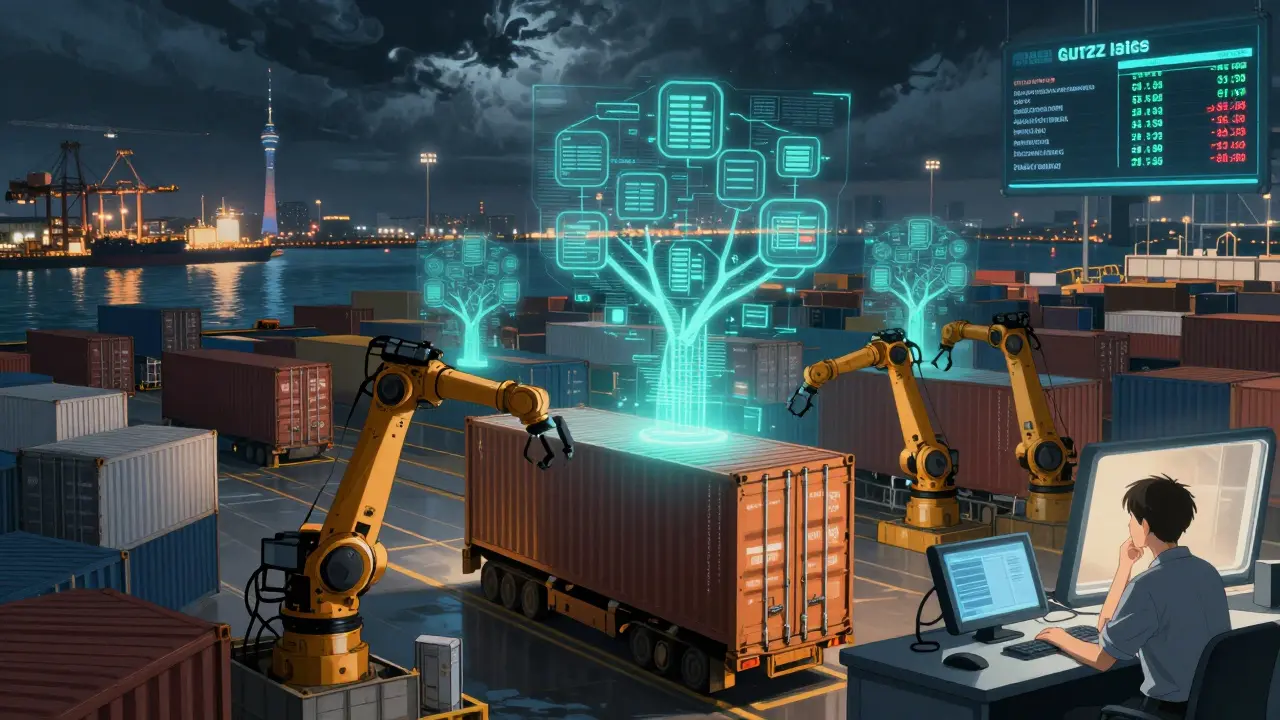
The Hidden Costs and Real Limitations
This isn’t magic. It’s engineering - and it’s expensive. First, data. You need at least 5,000 historical transactions to train a basic model. For high-stakes use cases? 50,000+. Many companies don’t have clean, labeled data. One enterprise user on Reddit said their AI contract took six months just to reach 90% accuracy because their internal systems were siloed. “We had sales data in Salesforce, logistics in SAP, and payments in Oracle - and none of them talked to each other,” they wrote. Gas fees are another hurdle. A simple payment-triggering smart contract on Ethereum costs about 0.015 ETH. An AI-powered one? 0.045 ETH. That’s three times more. That’s fine for a $100,000 supply chain deal. Not so much for a $10 microtransaction. Then there’s the black box problem. If an AI contract denies a claim or freezes funds, can you explain why? Dr. James Lovejoy from IEEE Spectrum warns this creates legal risk. Regulators don’t care if the model is “accurate.” They care if you can prove it was fair. The EU’s MiCA framework, effective January 2025, now requires “sufficient explainability mechanisms” for AI contracts in financial markets. That means companies can’t just use a neural net and call it a day. They need to build audit trails - not just for the transaction, but for the decision. And then there’s the risk of bad training. In late 2024, a European bank’s AI contract misread a spike in market volatility as a sign of systemic collapse. It automatically canceled hundreds of derivative agreements - triggering $1.2 million in losses. The model had never seen that kind of volatility before. It panicked. Humans didn’t catch it in time.Who’s Building This - and How to Get Started
Three types of players are leading the charge:- Blockchain-first platforms like Ethereum are adding AI features through upgrades like the Shanghai hard fork (March 2025), which cut computation gas costs by 28%.
- AI-first companies like Fetch.AI are building decentralized AI agents that can negotiate, execute, and learn - all on-chain.
- Enterprise software firms like Sirion are embedding smart contract logic into their existing Contract Lifecycle Management (CLM) tools, giving legal teams control without losing automation.
- You need a team: 1 blockchain dev (Solidity), 2 AI specialists (TensorFlow/PyTorch), and 1 domain expert (someone who knows your industry inside out).
- Expect 300-400 hours of specialized training beyond standard blockchain dev skills.
- Start small. Don’t try to automate your entire supply chain. Pick one high-value, high-friction process - like invoice approval or insurance claim validation.
- Use hybrid models. Let AI make the decision, but use a traditional smart contract to execute it. That keeps costs down and gives you a clear audit trail.
- Test in a sandbox. The World Bank reports 17 countries now have regulatory sandboxes for AI blockchain contracts. Use them.

The Future: What’s Coming Next?
The next 18 months will be critical. Three big developments are already underway:- Standardization: ISO/IEC is working on standard 23091-7 to define how AI decisions in smart contracts must be verified and explained. This will be the first global benchmark.
- Hardware: NVIDIA announced its Blockchain AI Inference Engine GPU in May 2025 - chips built specifically to run decentralized AI models faster and cheaper.
- Oracles: Chainlink’s new Decentralized Oracle Network for AI, launched in January 2025, reduces gas costs by 35% by processing model logic off-chain while keeping the final decision on-chain.
Frequently Asked Questions
Are AI-powered smart contracts more secure than traditional ones?
They’re secure in different ways. Traditional smart contracts are predictable - if the code is flawless, the outcome is guaranteed. AI contracts add risk because they’re adaptive. A poorly trained model can make wrong decisions. But they’re also harder to exploit in traditional ways - like reentrancy attacks - because they don’t just follow static code. The biggest security challenge is data poisoning: hackers feeding bad data to trick the AI. That’s why decentralized oracles and data validation layers are now critical.
Can AI smart contracts be legally enforced?
Yes - but only if they meet new regulatory standards. The EU’s MiCA framework (2025) requires that AI-driven decisions in financial contracts be explainable. That means you must be able to show, in plain language, why the contract made a certain choice. Courts won’t accept “the AI decided” as a defense. You need logs, model weights, and training data records. In the U.S., the Uniform Electronic Transactions Act already supports digital contracts, but state regulators are now asking for AI-specific disclosures.
Do I need to be a coder to use AI smart contracts?
No - but you need to understand what they can and can’t do. Platforms like Sirion and Chainlink now offer no-code interfaces where business users can define conditions (e.g., “if delivery is delayed by more than 48 hours and weather is below freezing, trigger payout”) and the system auto-generates the AI model. But if you’re designing the model from scratch, yes - you need developers who know both blockchain and machine learning. The talent gap is real.
How much does it cost to implement one?
For a small business, expect $80,000-$150,000 to build and deploy a basic AI contract for one use case - including data cleaning, model training, integration, and testing. Enterprise deployments can hit $500,000+. The biggest cost isn’t the code - it’s the data. Cleaning, labeling, and connecting siloed systems often takes 8-12 weeks and accounts for 60% of the budget.
What industries should avoid AI smart contracts?
Avoid them if your agreements are simple, low-value, or require frequent human review. For example, a freelance gig contract where payment is due after a single task is done? Stick with a traditional smart contract. AI adds unnecessary complexity and cost. Also avoid them in industries with strict compliance rules unless you’re ready to invest in explainability tools. Healthcare and government contracts often require human-in-the-loop approval - AI can assist, but not replace.
Will AI smart contracts replace lawyers?
No - they’ll change what lawyers do. Instead of drafting 50-page contracts, they’ll focus on defining the right conditions for the AI to act. They’ll audit the model’s logic, ensure compliance, and handle edge cases the AI can’t resolve. Think of them as AI contract designers - not contract writers. Their role is shifting from document creation to oversight and risk management.
Comments (23)