

Quick Summary
- The United States leads 2025 rankings due to institutional maturity and risk-adjusted returns.
- Kazakhstan and Iceland offer the best energy cost advantages through tax breaks and geothermal power.
- Switzerland and Hong Kong provide the clearest regulatory frameworks for institutional players.
- Operational risk varies wildly, with China remaining a high-risk underground option despite bans.
- Taxation policies, from zero capital gains to corporate exemptions, are the primary differentiator for 2025.
Choosing where to run your mining rig isn't just about electricity bills anymore. In 2025, the decision involves navigating a complex web of regulatory clarity, tax incentives, and energy sustainability. If you are looking to scale operations or simply move your setup to a safer jurisdiction, the landscape has shifted significantly from the wild west days of the early 2020s. Governments are now actively courting miners, viewing them as tools for economic diversification rather than threats to financial stability.
This guide breaks down the actual rankings for 2025, focusing on where the real opportunities lie. We are looking at jurisdictions that balance low energy costs with legal safety. You won't find vague advice here. We are talking about specific tax codes, energy sources, and the real-world risks that keep operators up at night.
The Top Tier: Institutional Safety and Scale
For large-scale operations, safety and access to capital matter more than a few cents off the kilowatt-hour. This is why the United States holds the top spot in the 2025 rankings. It isn't just about volume; it is about the mature institutional framework that surrounds the industry. Large miners here benefit from risk-adjusted returns that are hard to match elsewhere. The infrastructure is ready, and the legal precedents are set.
Switzerland is consistently ranked as the most crypto-friendly nation globally. The Financial Market Supervisory Authority, known as FINMA, has led the way in creating regulatory development that actually makes sense for businesses. If you are an institutional investor seeking long-term stability, this is your destination. The country's financial system demonstrates strong integration with crypto operations, and local banks are generally receptive to working with blockchain firms.
Then there is Hong Kong. A global leader in the crypto and blockchain space that re-emerged in 2025. The Securities and Futures Commission introduced mandatory licensing regimes for Virtual Asset Service Providers. While this sounds strict, it actually provides legitimacy. Major banks including HSBC and Standard Chartered have begun providing banking services to crypto companies here. You also get Bitcoin and Ethereum ETFs with easy institutional access, which is a massive plus for liquidity.
These three jurisdictions-US, Switzerland, and Hong Kong-form the "Safe Harbor" tier. You might pay a bit more for power, but you sleep better at night knowing your assets aren't subject to sudden confiscation or regulatory bans.
Energy Powerhouses: Low Cost and Green Credentials
If your primary metric is the cost per terahash, you need to look at countries with abundant natural energy resources. Kazakhstan has emerged as a major player, accounting for 6.17% of global cryptocurrency mining operations. The government actively encourages mining through incentives including lower energy prices and tax breaks. They view Bitcoin mining as a strategic opportunity to create jobs and diversify their traditionally oil-dependent economy. Crypto businesses registered in the Astana International Financial Centre are exempt from corporate taxes until 2066.
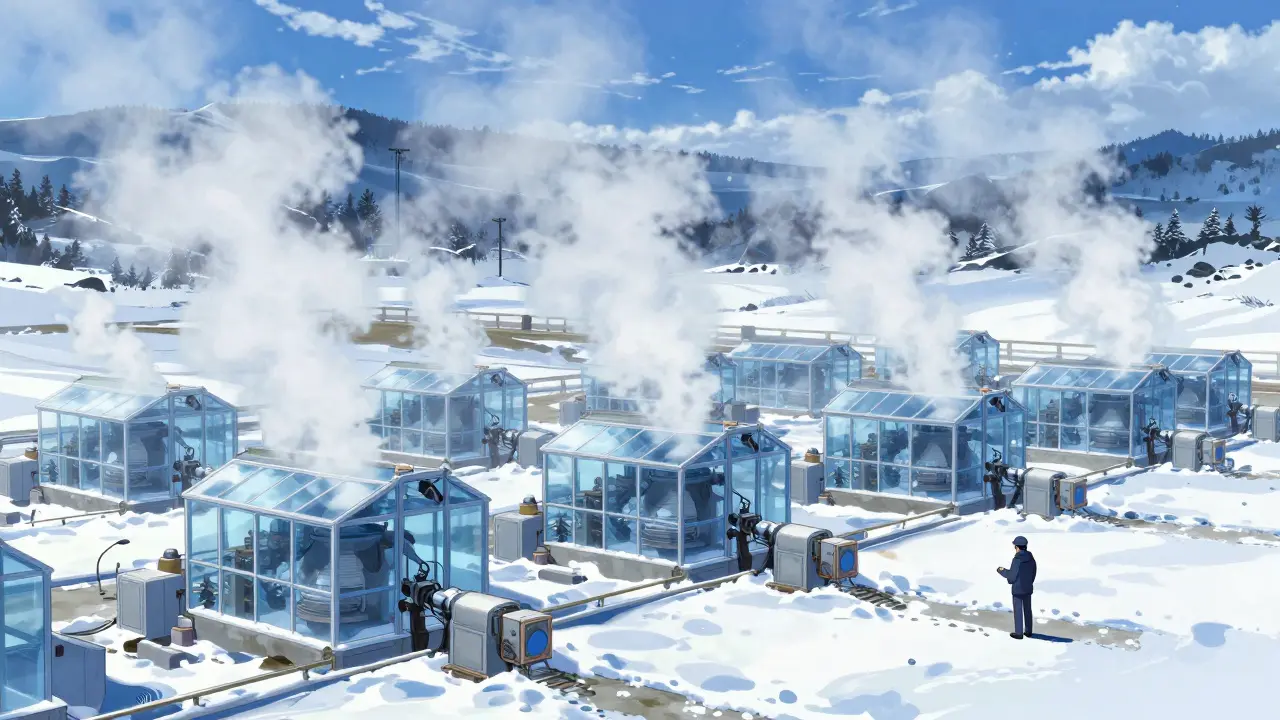
Iceland presents unique advantages for mining operations due to its naturally cool climate that reduces equipment cooling costs. The country has an overabundance of cheap geothermal electricity resulting from high production rates and minimal population density. For a miner, cooling is a hidden cost that eats into margins. In Iceland, the weather does the work for you.
Canada offers vast energy resources that make it appealing for Bitcoin miners, with provinces like Quebec and British Columbia providing surplus hydropower capacity. However, the regulatory landscape remains fragmented across provinces. Some impose restrictions or outright bans while others actively encourage mining operations. You have to navigate complex regional policies to find the sweet spot.
Georgia offers one of the most competitive tax regimes globally with no capital gains taxes on cryptocurrency holdings. Combined with favorable conditions for mining operations due to low electricity costs, it is a strong contender for individual miners or smaller pools.
Regulatory Innovators and Tax Havens
Some countries are betting the farm on blockchain technology to redefine their financial sectors. Liechtenstein's Blockchain Act (Token and TT Service Provider Act) has established the nation as a regulatory leader. It offers comprehensive legal certainty for token-based business models including asset-backed cryptocurrencies and tokenized securities. Low-tax policies and structured frameworks make it attractive for institutional investors seeking long-term stability.
Japan has been a pioneer in cryptocurrency regulation since recognizing Bitcoin as legal tender in 2017. The Financial Services Agency enforces strict but clear regulations that provide consumer protection while encouraging innovation. Major Japanese financial institutions have embraced blockchain technology with ongoing developments in crypto trading and AI algorithms for decentralized finance.
El Salvador stands out as often cited as the most crypto-friendly country due to its historic adoption of Bitcoin as legal tender and implementation of zero capital gains tax policies. While the energy costs aren't the lowest in the world, the political will to support the ecosystem is unmatched. It is a bold move that attracts miners willing to align with a national strategy.
The High-Risk Wildcards
You cannot talk about global mining without addressing the elephant in the room: China. The country continues to play a substantial role in global Bitcoin mining despite implementing an official ban on cryptocurrency mining operations. It maintains relevance through underground mining operations that benefit from access to cheap electricity, particularly hydropower in provinces like Sichuan during rainy seasons. However, regulatory risks remain exceptionally high for operators in this jurisdiction. If you choose this path, you are gambling on the ability to stay under the radar.
China's historical expertise in hardware manufacturing and established mining infrastructure keeps it relevant, but it is not a recommendation for those seeking compliance. China is the classic high-risk, high-reward scenario that defines the edge of the market.
Estonia has positioned itself as crypto-friendly through active legalization efforts and investor willingness to fund blockchain-related projects. It sits in the middle ground, offering a digital-first approach to governance that appeals to tech-savvy operators.

Comparing Mining Jurisdictions for 2025
To help you visualize the trade-offs, here is a breakdown of the key factors you need to weigh. Energy cost is obvious, but regulatory clarity is what keeps your business running year after year.
| Country | Primary Energy Source | Tax Advantage | Regulatory Status |
|---|---|---|---|
| United States | Mixed (Gas, Renewables) | Favorable Institutional Framework | Clear, Mature |
| Kazakhstan | Coal, Hydropower | 0% Corporate Tax until 2066 | Pro-Mining |
| Switzerland | Hydropower | Low Tax, Bank Access | Highly Regulated |
| Iceland | Geothermal | Cool Climate, Cheap Power | Supportive |
| Hong Kong | Imported Grid | No Capital Gains Tax | Licensing Required |
| El Salvador | Geothermal, Hydro | Zero Capital Gains Tax | Bitcoin Legal Tender |
| China | Hydropower | Low Cost | Banned (Underground) |
Notice how the energy source correlates with the region. Nordic countries rely on hydro and geothermal, while Central Asian hubs rely on coal or hydro. This affects your carbon footprint, which is becoming a secondary KPI for institutional investors.
How to Choose Your Jurisdiction
Deciding where to mine depends on your specific operational goals. Are you a solo miner with a few rigs, or are you running a data center? If you are a solo miner, Georgia or El Salvador might offer the best tax efficiency for your personal gains. If you are running an institutional operation, the United States or Switzerland provides the banking relationships you need to manage cash flow.
Consider the climate. In Iceland or Canada, the air conditioning costs are negligible. In hotter climates, you need to budget for cooling infrastructure, which can eat up to 30% of your energy budget. The "cool climate" advantage is a real financial metric, not just a comfort feature.
Finally, think about the future. Regulations change. A country that is friendly today might tighten rules tomorrow due to political pressure. Diversifying your operations across two jurisdictions can mitigate this risk. For example, keep your legal entity in Liechtenstein for stability, but run the hardware in Kazakhstan for power costs.
Which country has the lowest electricity cost for mining?
Kazakhstan and Iceland typically offer the lowest electricity costs due to government incentives and abundant geothermal or hydro resources, respectively.
Is Bitcoin mining legal in China in 2025?
Officially, no. China maintains a ban on cryptocurrency mining operations, though underground operations continue to exist with high regulatory risk.
What is the best country for tax-free crypto mining?
El Salvador and Georgia offer zero capital gains tax on cryptocurrency holdings, making them attractive for individual miners.
Why is the United States ranked number one?
The US leads due to its mature institutional framework, access to capital, and favorable risk-adjusted returns for large-scale operations.
How does climate affect mining profitability?
Cooler climates like Iceland reduce equipment cooling costs, which can significantly improve overall profit margins by lowering energy consumption.
Comments (19)
Kazakhstan looks solid for the power costs but the grid stability is questionable at best
When you start looking at the actual infrastructure requirements for a sustainable mining operation you realize that electricity cost is only one variable in a much larger equation that involves legal certainty and banking access. The United States offers a level of institutional maturity that simply cannot be replicated in emerging markets where the rules can change overnight without warning. Switzerland provides a similar level of safety but at a premium price point that might not be viable for smaller operators with tighter margins. Kazakhstan is interesting because the tax breaks are substantial but the reliance on coal creates a reputational risk that could affect future partnerships with ESG focused funds. Iceland is great for cooling but the isolation can make logistics difficult when you need to ship hardware or replace components quickly. Canada has the power but the regulatory fragmentation means you have to navigate a patchwork of provincial laws that can be confusing for a centralized business model. Georgia and El Salvador are good for individuals but they lack the banking infrastructure to handle large scale capital flows without friction. Liechtenstein is niche but the legal certainty there is unmatched for tokenized assets which might be the future of collateralized mining. Japan is strict but the clarity means you know where you stand which is better than ambiguity in other regions. China remains a ghost in the machine with underground operations that are profitable but carry an existential risk that no prudent operator should ignore. Estonia is trying to be the digital hub but the market size is small compared to the giants. Diversification is the only real strategy here because putting all your rigs in one jurisdiction is gambling with your entire livelihood. You need a legal entity in a stable place and hardware in a cheap power zone to balance the risk profile effectively. Climate change is also a factor because hotter regions will see cooling costs rise faster than power costs drop in many cases. Ultimately the decision comes down to whether you value short term profit or long term survival in this industry
That is a really good point about the grid stability issues in Central Asia
Looking at the hash rate distribution metrics and the PUE ratios across these jurisdictions suggests that the institutional capital is flowing towards the US due to the risk adjusted return profiles being significantly higher than the emerging markets despite the energy cost differential
Exactly the regulatory arbitrage is key here and the compliance overhead in places like Switzerland is worth the premium for the long term stability of the asset class
us should just take it all back why are we letting kazakhstan steal our miners they are using coal mostly and its bad for the air
i think you might be a bit harsh on the coal situation since they are trying to diversify but yeah the air quality is a consern for sure
The average individual miner simply lacks the sophistication to understand the macroeconomic implications of jurisdictional selection 😒 one must consider the geopolitical stability metrics
america first always 🇺🇸 dont trust the foreign grids they will shut you down when they want to
your patriotism is blinding you to the actual profit margins and the reality is the dollar is weakening so diversification is smart
another generic list nobody reads these tables anymore just pick the cheapest power
sometimes the cheapest power comes with strings attached that nobody sees until it is too late
that is a very fair assessment of the hidden risks in the lower tier jurisdictions
this whole ranking is biased towards the west and ignores the actual on ground reality in asia where the hardware is still made
you clearly dont know what you are talking about because the supply chain is irrelevant to the operational jurisdiction
It is important to maintain a professional perspective when discussing international regulatory frameworks and economic incentives
the regulatory arbitrage you mention is actually a compliance risk vector that institutional players avoid at all costs
it feels like we are watching the end of the wild west era and moving into something much more sterile and corporate
I agree that the corporate shift is inevitable for safety but the spirit of decentralization is fading