

When you hear that a country warns its banks not to touch cryptocurrency, it’s not just a suggestion-it’s a legal boundary. In Saudi Arabia, that boundary is clear: financial institutions are forbidden from dealing in cryptocurrencies. This isn’t a rumor or a guideline. It’s a firm stance backed by official warnings from the country’s top financial regulators, repeated over several years and reinforced by government ministries.
Why Saudi Arabia Warned Its Banks
The Saudi Arabian Monetary Authority (SAMA), now known as the Saudi Central Bank, issued its first official warning about cryptocurrencies in 2017. At the time, Bitcoin and other digital coins were surging in global popularity, and some local businesses were starting to accept them. But Saudi regulators saw danger. They didn’t see innovation-they saw risk. No oversight. No accountability. No legal protection for consumers. And crucially, no clear alignment with Sharia law, which governs finance in the Kingdom. By December 2018, the warning got sharper. A joint committee including SAMA and the Capital Market Authority (CMA) declared virtual currencies “illegal and unlicensed.” That wasn’t a vague caution. It was a red line. Financial institutions-banks, investment firms, payment processors-were told outright: don’t touch this. Don’t hold it. Don’t trade it. Don’t offer it to customers. Don’t even advertise it. The Ministry of Finance added weight to that warning in 2019, stating clearly that cryptocurrencies are “neither legally recognized nor regulated by any official entities in Saudi Arabia.” That means if you lose money trading Bitcoin through a Saudi bank, you have no recourse. If a bank gets hacked because it stored crypto, it’s on them. No safety net. No insurance. No legal standing.What Exactly Are Financial Institutions Forbidden From Doing?
The rules aren’t ambiguous. Here’s what Saudi banks and financial firms cannot do:- Accept cryptocurrency as payment for services or goods
- Hold cryptocurrency in any form-wallets, custodial accounts, or reserve funds
- Offer crypto trading platforms or investment products tied to digital assets
- Process transactions involving cryptocurrency exchanges
- Market or promote any crypto-related service to customers
But Crypto Is Still Popular in Saudi Arabia
Here’s the contradiction: while banks are banned, regular people are buying crypto anyway. Saudi Arabia is the second-largest crypto market in the Middle East, behind only the UAE. And it’s growing fast. Why? Because 63% of the population is under 30. Young Saudis are tech-savvy, skeptical of traditional banking, and drawn to the idea of decentralized finance. Many use peer-to-peer apps, offshore exchanges, or VPNs to bypass restrictions. Some trade on platforms like Binance or Kraken, which don’t verify users’ locations. Others use local peer-to-peer marketplaces where buyers and sellers meet in person or via messaging apps. There’s no official data on how many Saudis hold crypto, but estimates from industry analysts suggest millions are active. This creates a dangerous gap. The government warns banks to stay away-but doesn’t stop individuals from trading. That means people are exposed to scams, fraud, and market crashes without any legal protection. And because these transactions happen outside the banking system, there’s no way for authorities to track them for money laundering or terrorist financing.
Why Doesn’t Saudi Arabia Just Legalize It?
It’s not that Saudi Arabia hates technology. On the contrary, it’s investing billions in blockchain. The government launched Project Aber in 2019-a joint central bank digital currency (CBDC) initiative with the United Arab Emirates. This isn’t Bitcoin. It’s a digital version of the Saudi riyal, controlled entirely by the central bank. It’s designed for secure interbank transfers and cross-border payments. They’re also encouraging tokenization-turning traditional assets like bonds, real estate, or trade invoices into digital tokens on a blockchain. Goldman Sachs and Rothschild are already working on these projects in Saudi Arabia. These aren’t cryptocurrencies. They’re regulated, audited, and tied to real-world value. The key difference? They’re under SAMA’s control. So why not let Bitcoin in? The answer lies in Sharia law. Islamic finance prohibits speculation (gharar), gambling (maysir), and interest (riba). Many scholars argue that Bitcoin’s extreme volatility and lack of intrinsic value make it a form of gambling. Others say it’s just a tool-neutral until used. But the official position hasn’t shifted. Until there’s a unified religious and legal consensus, the ban stays.The Gray Area: Is Crypto Illegal or Just Unregulated?
There’s a legal nuance that trips up even experts. Saudi Arabia hasn’t passed a law that says “cryptocurrency is illegal.” Instead, it’s built a wall around it by refusing to recognize it. The Anti-Money Laundering Law (AML) and Counter-Terrorism Financing Law (CFT) define “funds” broadly to include any digital asset. That means if someone uses crypto to launder money, they can still be prosecuted. But if someone just buys Bitcoin for investment? There’s no law protecting them-and no law saying they’re breaking the rules. This creates a gray zone. For banks? Clear prohibition. For individuals? Legal ambiguity. For regulators? Awaiting a decision.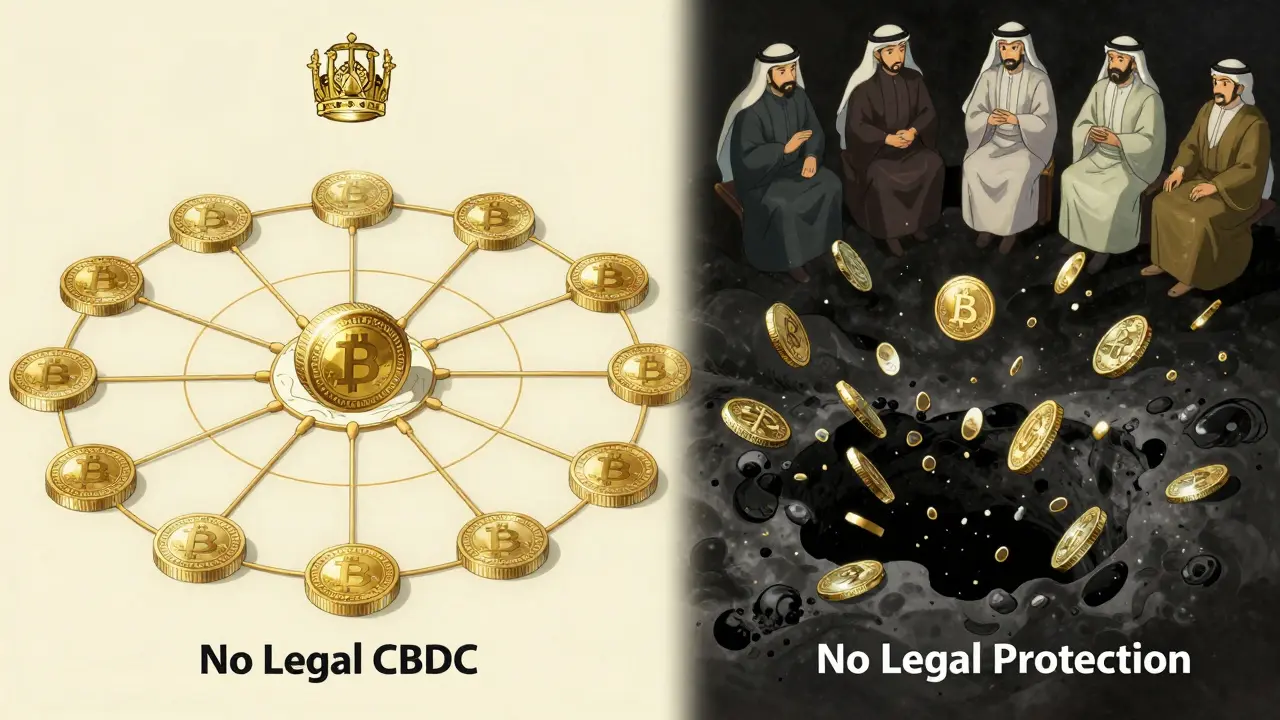
What’s Next for Crypto in Saudi Arabia?
The signs point to a future where crypto doesn’t disappear-but it won’t look like what you see in the U.S. or Singapore. Saudi Arabia is building a parallel system: one where blockchain powers finance, but only under strict state control. Think of it like this: they’re okay with digital money, as long as it’s their digital money. In the next few years, we may see:- Official Saudi CBDC rollout for retail use
- Regulated tokenized assets (bonds, stocks) traded on licensed platforms
- Strict licensing for crypto-related businesses that meet Sharia compliance standards
- Final religious rulings from top scholars on whether Bitcoin is halal or haram
What Should You Do If You’re in Saudi Arabia?
If you’re a resident or citizen:- Don’t use your bank account to buy or sell crypto. It’s risky and could trigger scrutiny.
- Understand that you have zero legal protection if you lose money.
- Be careful with peer-to-peer trades-scams are common.
- If you’re a business owner, don’t accept crypto as payment. It’s a violation of SAMA rules.
- Train your team on the official prohibitions.
- Don’t develop crypto products-even if clients ask.
- Watch for changes in the CMA or SAMA announcements-they’re the only legal authorities that matter here.
FAQ
Is cryptocurrency illegal in Saudi Arabia?
Cryptocurrency is not explicitly banned by law, but it is not recognized or regulated by any Saudi authority. Financial institutions are strictly prohibited from dealing with it. For individuals, trading crypto exists in a legal gray zone-it’s not illegal, but it’s unprotected and risky.
Can Saudi banks offer crypto services?
No. Saudi banks, investment firms, and payment processors are forbidden from offering, holding, trading, or promoting any cryptocurrency. Doing so violates directives from SAMA and the CMA and can result in license suspension or legal action.
Why is Saudi Arabia investing in blockchain but banning crypto?
Saudi Arabia sees blockchain as a tool for efficiency and transparency in official finance. Projects like Project Aber and tokenized bonds are state-controlled, Sharia-compliant, and traceable. Cryptocurrencies like Bitcoin are decentralized, volatile, and outside government control-making them incompatible with the Kingdom’s financial sovereignty goals.
Are there any legal crypto exchanges in Saudi Arabia?
No. There are no licensed cryptocurrency exchanges operating in Saudi Arabia. Any platform claiming to be based in or regulated by Saudi authorities is misleading. Users who trade on international platforms do so at their own risk.
Can I be arrested for buying Bitcoin in Saudi Arabia?
There are no known cases of individuals being arrested solely for buying or holding Bitcoin. However, if your crypto activity is linked to money laundering, fraud, or terrorist financing, you can be prosecuted under existing AML and CFT laws. The risk is not from owning crypto-it’s from how you use it.
Comments (15)
This whole ban is just the Saudi government being terrified of anything they can’t control. They’ll throw billions at blockchain tech but act like Bitcoin is the devil’s spreadsheet. Meanwhile, teens are trading crypto like it’s Pokémon cards on Discord. The hypocrisy is thicker than camel milk.
Look i know the official line is 'no crypto' but the real story is the state wants its own digital currency and doesn't want any competition. Project Aber? That's not innovation, that's control dressed up as progress. People will always find ways to trade, especially when banks are so slow and boring. The ban doesn't stop crypto, it just makes it riskier for regular folks. And honestly? That's the point.
lol so banks cant touch crypto but everyone is buying it anyway? classic. guess they just gonna ignore it until it blows up in their face. also why is no one talking about how many saudi teens are using binance with vpn? its like a national hobby now
It’s not just about Sharia law-it’s about power. The moment you let decentralized money exist, you lose the ability to track every riyal. That terrifies a regime built on centralized control. They’ll tokenize bonds, sure, but only if the blockchain runs on their servers, under their rules, with their approval. Crypto isn’t the threat. Autonomy is.
I lived in Riyadh for two years and saw this firsthand. Young Saudis are obsessed with crypto-not because they hate banks, but because they’re tired of waiting weeks for a simple wire transfer. They want speed, transparency, and ownership. The government wants to give them a digital riyal that still needs three signatures to move $100. It’s not progress. It’s a prison with a fancy app.
People keep saying 'it's not illegal, just unregulated' but that’s a legal loophole that only benefits lawyers and hackers. If you lose your crypto to a scam, you can’t go to court. If a bank gets hacked because someone used their account to buy Bitcoin, the bank gets punished but the victim gets nothing. That’s not a gray zone-it’s a legal wasteland.
they're not banning crypto... they're banning freedom. the us and china are racing to control the future of money but saudi arabia? they're trying to bury it under sand and prayer rugs. and don't even get me started on how they're using islamic scholars as a shield for authoritarianism. this is the new cold war and crypto is the weapon they're afraid of
imagine being told you cant use a tool because someone else might misuse it. that’s what this is. the government says 'dont touch crypto' but then builds its own version and calls it 'blockchain innovation.' so the problem isn’t the tech-it’s who gets to own it. if i can’t trust my bank, why should i trust the state with my digital money?
as someone from india where crypto is also in a gray zone, i get it. governments fear what they cant tax or track. but the real winners here are the young people who use p2p apps and ignore the rules. they dont care about the flag or the royal crest-they care about getting rich before their parents retire. this ban is just a delay tactic.
Let me be clear: this is not a religious issue. This is a political one. The Kingdom is not banning crypto because of Sharia-it is using Sharia as a convenient veil for financial control. In Nigeria, we see the same pattern: central banks panic when people start using Bitcoin to bypass currency controls. The real fear? That people realize they don’t need permission to be financially free.
so i get the whole 'no bank involvement' thing but why is no one talking about how many saudi women are using crypto to start small businesses? they’re buying and selling on telegram groups, paying freelancers in usdt, and bypassing the whole male guardian system. this isn’t just about money-it’s about autonomy. the government hates that more than volatility.
Westerners think this is about religion. It’s not. It’s about Saudi Arabia refusing to be a puppet of global finance. If you want crypto, go to Dubai. We’re building our own system. Period.
While the legal framework remains rigid, the cultural shift is undeniable. The younger generation is engaging with decentralized technologies not as rebellion, but as practical adaptation. The state’s response-tightening control while investing in state-led alternatives-reflects a broader global tension between innovation and institutional preservation. This is not unique to Saudi Arabia; it is a microcosm of the 21st century’s monetary evolution.
they banned crypto but now they're using blockchain to track your shopping habits and your prayer times. so yeah, you can't buy Bitcoin but your fridge knows you skipped Fajr. thanks for the surveillance state, guys.
you know what’s wild? the same people who say crypto is haram because it’s speculative are totally fine with buying lottery tickets or investing in real estate that flips every year. it’s not about the money, it’s about who controls the narrative. if the government says it’s safe, it’s safe. if it’s outside their system? dangerous. double standard much?