

Imagine a world where the tech giants don't just take your location and browsing data for free. Instead, you get paid for every move you make and every site you visit. That was the big promise of GeoDB is a blockchain-based data monetization platform designed to give users control over their personal information by rewarding them with tokens. This project aimed to disrupt a Big Data and AI industry valued at over $620 billion by flipping the script: the data generator, not the corporation, captures the value.
The GEOCASH Airdrop: How it Worked
Back in 2020, GeoDB launched a massive distribution campaign to get people into its ecosystem. The GEOCASH (also known as the GEO token) was the utility currency distributed through a multi-tiered airdrop system to incentivize app downloads and user growth.
To get a piece of the pie, users didn't just click a button; they had to actually use the software. The process was straightforward: download the GeoDB app on Android or iOS, create a wallet, and start "mining" tokens by allowing the app to collect location and behavioral data. To speed things up, GeoDB leaned heavily on referral programs. If you had a referral code, you earned extra tokens for every friend you brought into the fold. Some regional pushes were even more specific, like a limited offer for 2,000 users in India who could claim free tokens on the Bitforex exchange.
Understanding the GEO Tokenomics
If you're looking at your wallet and wondering what the GEO token actually is, you need to look at the numbers. The token was originally launched on the Ethereum a decentralized, open-source blockchain with smart contract functionality that served as the original host for the GEO token.
| Attribute | Value |
|---|---|
| Maximum Supply | 350 Million GEO |
| Total Supply | 313.17 Million GEO |
| Circulating Supply | 82.64 Million GEO |
| Original Network | Ethereum (ERC-20) |
| New Network | ODIN Chain |
While the maximum supply is capped to prevent inflation, the actual market activity has cooled significantly since the airdrop craze. Most of the remaining liquidity is found on Uniswap V2 a decentralized exchange protocol on Ethereum where GEO is traded primarily against WETH.
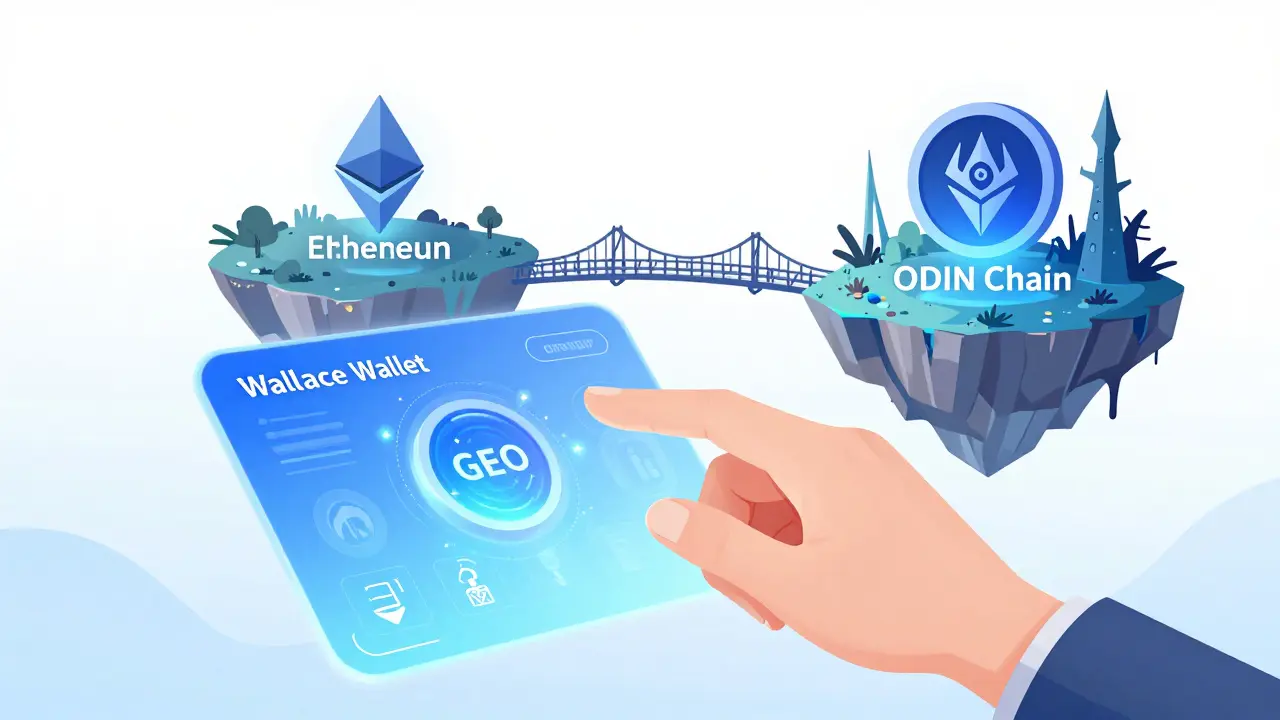
The Shift to ODIN Chain and Wallace Wallet
The project didn't stop at the airdrop. To improve efficiency and reduce the high gas fees associated with Ethereum, the project announced a migration to the ODIN Chain a blockchain network designed to provide a more scalable infrastructure for the GeoDB ecosystem.
Along with the chain move came the introduction of the Wallace Wallet the primary digital wallet interface used by GeoDB users to manage, store, and transfer their GEO tokens. This wallet became the central hub for users. Instead of juggling complex exchange interfaces, the Wallace Wallet provided a more streamlined way to interact with the data-reward system. If you were part of the original airdrop, moving your assets into this wallet was a critical step in maintaining access to your tokens during the migration phase.
Is Data Monetization Still Viable?
The core idea of GeoDB-getting paid for your data-is a concept called "Data Sovereignty." In a traditional setup, a company like Google or Meta tracks your movement and sells that insight to advertisers. GeoDB tried to cut out the middleman. By using a mobile app to track location and browsing habits, the system converted that digital footprint into a financial reward.
However, the reality of the market is often different from the promotional hype. During the 2020 peak, some materials suggested users could earn $5 or more daily. In practice, the value of the tokens fluctuated wildly. As of 2026, the trading volume has dropped to a fraction of its former self, often seeing daily volumes as low as $120. This shows a common trend in GEOCASH airdrop projects: high initial excitement followed by a struggle to maintain long-term utility and liquidity.

Common Pitfalls and Security Tips
Whenever you participate in an airdrop or a new ecosystem like GeoDB, security is the biggest hurdle. Many users lost their GEO tokens because they didn't handle their mnemonic phrases correctly. A mnemonic phrase is a series of 12 to 24 words that acts as the master key to your wallet. If you lose those words, you lose your funds; if someone else gets them, they own your money.
Additionally, users should be wary of "fake" airdrop clones. During the GeoDB peak, several phishing sites popped up mimicking the official sign-up pages. Always verify that you are using the official app store links or the verified Telegram channel (such as t.me/WallaceWallet) before entering any private keys or connecting your wallet to a third-party site.
Can I still join the GeoDB airdrop today?
No, the original 2020 airdrop campaign has concluded. However, users can still interact with the ecosystem through the Wallace Wallet and trade GEO tokens on supported exchanges like Uniswap V2.
What is the current price of GEOCASH (GEO)?
The price is highly volatile and has seen a significant decline from its peak. Recent data shows it trading around $0.00016, though you should check a real-time tracker like CoinGecko for the most current rate.
How do I migrate my tokens to ODIN Chain?
Migration typically involves using the Wallace Wallet to bridge your tokens from the Ethereum network to the ODIN Chain. You should follow the official migration guide provided within the app to ensure your assets are moved safely.
Is GeoDB safe for my personal data?
The platform is built on the premise of trading data for rewards. While the blockchain secures the tokens, you are explicitly giving the app permission to track your location and behavior. Always review the terms of service to understand exactly what data is being collected.
Where can I trade GEO tokens?
GEO tokens are primarily traded on Uniswap V2 using the GEO/WETH pair. In the past, Bitforex also supported the token, but liquidity is currently concentrated on decentralized exchanges.
What to do next
If you are a former airdrop participant, your first step should be to secure your mnemonic phrases in an offline location and check if your tokens have been migrated to the ODIN Chain. If you are a new investor, keep in mind that the current trading volume is very low, which means selling large amounts of GEO could lead to significant slippage.
For those interested in the concept of data monetization, look into other "DePIN" (Decentralized Physical Infrastructure Networks) projects. While GeoDB paved the way, newer projects often have higher liquidity and more active developer communities, providing a more stable environment for those wanting to earn from their digital footprint.
Comments (21)
Another day, another 'revolutionary' token that crashed to zero. Shocker. 🙄
For anyone still holding, make sure you've moved to ODIN Chain. The gas on Ethereum will literally eat your entire balance if you try to trade a small amount of GEO now. It's just not worth it.
I wonder if these tokens are still worth anything in real money.
it's basically a penny stock at this point just keep it in your wallet and forget about it until some miracle happens
The slippage on Uniswap V2 is absolutely insane for low liqudity pairs. I tried to swap some GEO but the price impact was basically a rug pull in real time. Definitely need to check the depth of the pool before any transactional execution.
We must ask ourselves why we crave the validation of a token when our very existence is the data being sold. It is a tragic cycle of digital capitalism where we pretend to be the master of our data while merely changing the landlord. The morality of this trade is deeply flawed.
Typical. People love to act like they're fighting 'big tech' while literally handing over their GPS coordinates to some random dev team for a handful of worthless coins. It's a joke.
Imagine thinking you were 'disrupting the industry' by using a wallet called Wallace. Pure poetry.
The move to ODIN Chain was a necessary step for scalability. Ethereum's L1 just can't handle the micro-transactions required for a data-reward system. If you're interested in the DePIN space, looking at how they handle state transitions is where the real value is. Most of these projects fail because the incentive loop isn't tight enough to keep users from dumping as soon as the airdrop ends.
Keep your heads up everyone! 🌟 Just a little reminder to double check those seed phrases! Safety first! 🔒✨
dont use any sites that ask for your private key no matter what they promise you it is always a scam
One should note that the circulating supply is significantly lower than the maximum supply, which often suggests that a large portion of tokens remains locked or unissued. This discrepancy can create a false sense of scarcity in the market.
This is such a great learning opportunity for new crypto enthusiasts!!! The synergy between data sovereignty and blockchain is just... wow!!! We are moving toward a more equitable digital future, regardless of the current price action!!! 🚀🌈
just keep exploring other depin projects if this one feels stale now there are some really cool things happening with decentralized storage and compute that you might like
I appreciate the detailed breakdown of the migration process. It helps clear up the confusion regarding the bridge between networks.
Honestly the whole concept of paying people $5 a day for their location data is just laughable because no company is actually paying that much for raw GPS pings unless the data is incredibly niche or the token is just inflated by a pump-and-dump scheme which we all know happened here :) 🙄
It is quite fascinating to see how these digital ecosystems mirror the organic growth and decay of actual biological systems, where an initial burst of energy leads to a plateau and eventually a quiet dormancy, allowing new ideas to sprout from the ruins 🌿✨. I believe that while the financial reward failed, the philosophical seed of owning one's data is a beautiful thing that will eventually bloom in a more sustainable way for all of us 🌏💖.
The 'data sovereignty' angle is just a fancy way of saying 'give us your info for a coin that's worth less than a grain of sand'. Absolute malarkey.
Too long. Didn't read. Token is dead anyway.
We should definitely look for a way to consolidate these old airdrop tokens. Maybe someone knows a tool for batch-checking old wallets without exposing keys? That would be a huge help for everyone who joined back in 2020.
The presentation of the token specifications is quite orderly. I find the transition to the ODIN Chain to be a prudent technical decision for the longevity of the project.