
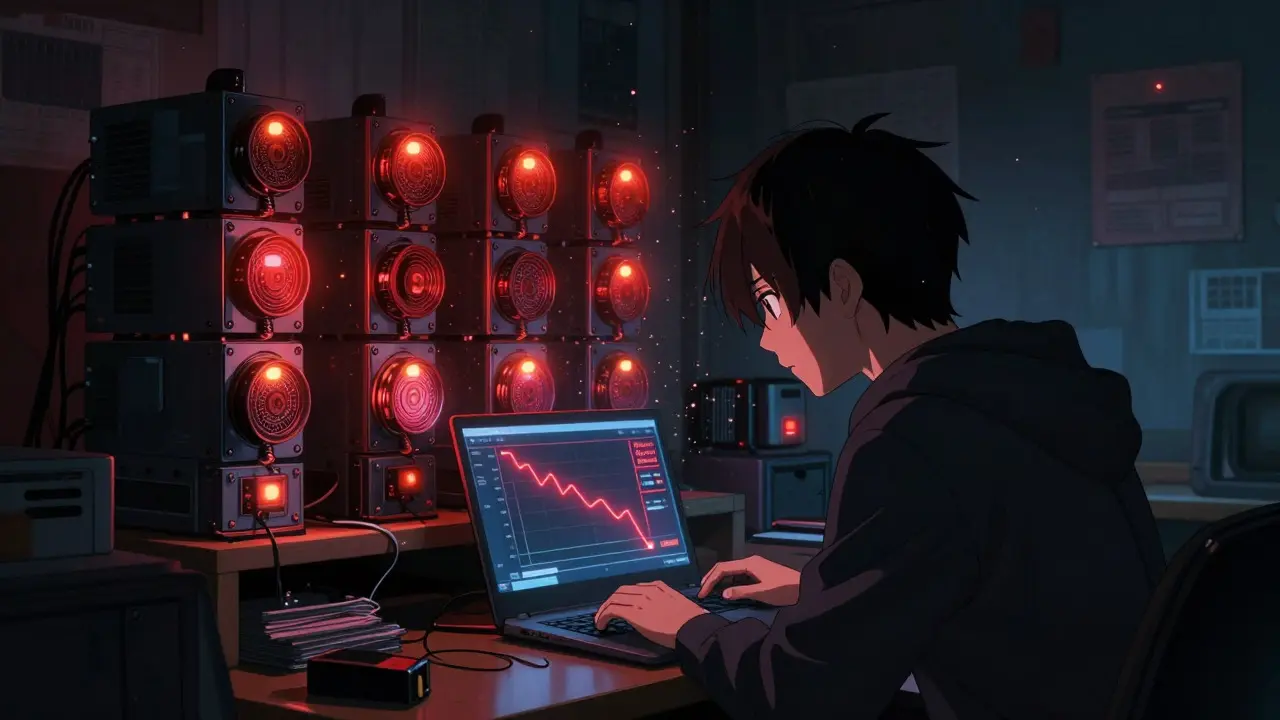
Imagine waking up one morning to find your paycheck cut in half overnight. Your rent, your electricity bill, and your grocery costs haven’t changed a bit. You still have to pay them. This is the exact reality for many Bitcoin miners immediately following a Bitcoin halving event.
The term "miner capitulation" sounds dramatic, but it simply describes the moment when less efficient mining operations become unprofitable and are forced to shut down. It’s a natural, albeit painful, part of the Bitcoin ecosystem that happens roughly every four years. With the most recent halving occurring in April 2024, reducing block rewards from 6.25 BTC to 3.125 BTC, we are currently living through this cycle. Understanding what drives these shutdowns-and who survives-helps explain the health of the entire network.
The Math Behind the Shutdown
To understand why miners fold, you have to look at the basic economics. Mining Bitcoin isn't just about owning computers; it's an energy-intensive business model where revenue is strictly controlled by the protocol. Every time a block is mined, the miner receives a reward. The halving cuts this reward by 50%. However, the cost of running those machines stays exactly the same.
Let’s break down the numbers. Before the 2024 halving, miners were earning approximately $0.055 per day for every terahash (TH) of computing power they deployed. Overnight, that income dropped to roughly $0.0275 per TH. If your electricity costs more than that amount to generate one terahash of work, you are losing money every single second your machine runs.
This creates a brutal filter. Operations with high electricity bills or old, inefficient hardware suddenly find themselves in the red. Industry analysis suggests that after the 2024 halving, Bitcoin prices needed to stay above $54,000 for many marginal miners to remain viable. If the price dips below that threshold, the math stops working, and the power switches get flipped off.
Who Survives and Who Folds?
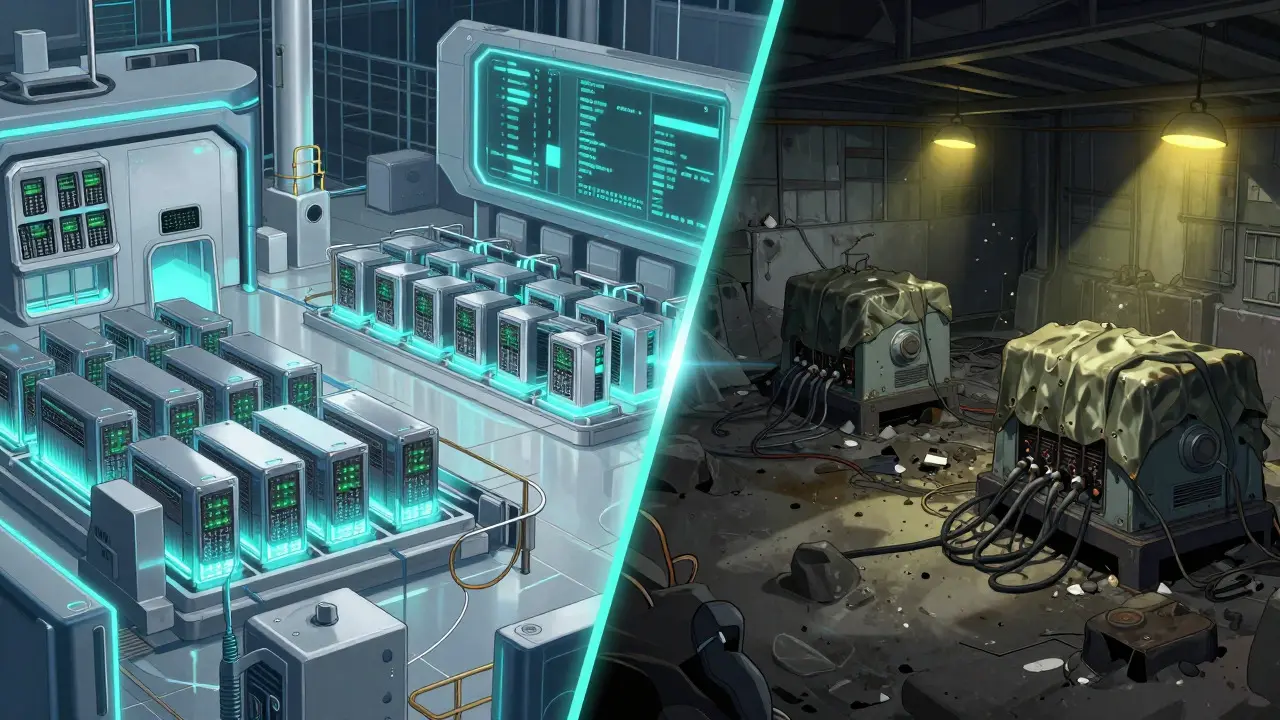
Not all miners are created equal. The post-halving landscape reveals a stark divide between industrial-scale operations and smaller, independent miners. This disparity determines who capitulates and who thrives.
| Feature | Industrial Miners (e.g., Bitdeer, Marathon) | Small/Independent Miners |
|---|---|---|
| Energy Cost | Below $0.05/kWh (often subsidized or renewable) | Above $0.08/kWh (retail rates) |
| Hardware Efficiency | Latest-gen ASICs (>30 TH/s per 3000W) | Older generation ASICs (less efficient) |
| Capital Reserves | 6-12 months of operating expenses | Limited cash flow, month-to-month survival |
| Post-Halving Outcome | Maintains operations, acquires distressed assets | High risk of capitulation/shutdown |
Major publicly-traded companies like Bitdeer, Marathon Digital, and Iris Energy saw their production drop significantly in May 2024 compared to April. For example, Bitdeer reported a 31% decrease in Bitcoin production. However, these drops were often strategic or due to maintenance, not bankruptcy. These giants have negotiated long-term energy contracts and possess the capital reserves to weather the storm. They view the halving as a temporary hurdle, not a death sentence.
In contrast, small-scale miners paying retail electricity rates face immediate crises. Discussions on the Bitcoin mining subreddit during mid-2024 revealed numerous reports of forced shutdowns. If you are running older ASIC models and paying standard residential power rates, the 50% revenue cut wipes out your margin instantly. These operators lack the economies of scale to negotiate better power deals or the cash reserves to wait for Bitcoin’s price to recover.
The Network’s Self-Correcting Mechanism
When miners capitulate, the Bitcoin network doesn’t collapse. Instead, it heals itself through a process called difficulty adjustment. This is one of Satoshi Nakamoto’s most brilliant design features. The network aims to produce one block every ten minutes, regardless of how much computing power is connected.
Here is how it works: As unprofitable miners shut down their rigs, the total global hash rate drops. The network detects this slowdown. Approximately every two weeks (or every 2,016 blocks), the protocol automatically lowers the mining difficulty. This makes it easier for the remaining miners to find blocks.
This rebalancing act typically takes 3 to 6 months to fully stabilize. During this period, the surviving miners-who are usually the most efficient ones-start earning more per unit of work because there is less competition. Essentially, the pie gets smaller (fewer new Bitcoins issued), but the number of people sharing the pie also shrinks. Eventually, the share each person gets returns to a sustainable level.
Experts from EY Switzerland note that this "cleansing" period is vital. It removes inefficient nodes from the network, ensuring that only those contributing genuine security and efficiency remain. While it hurts individual small miners, it strengthens the overall resilience of Bitcoin against attacks and centralization risks.
Strategies for Survival in a Post-Halving World
If you are looking to mine Bitcoin or invest in mining operations, understanding the survival strategies is crucial. The industry has evolved beyond just buying hardware. Successful operators focus on three key areas: efficiency, energy procurement, and financial resilience.
- Hardware Upgrades: To maintain pre-halving profitability levels, operations need to improve hash rate efficiency by 15-25%. This means upgrading to the latest-generation ASICs that can deliver over 30 TH/s while consuming around 3000 watts. Older machines become electronic waste if they can’t compete on efficiency.
- Energy Arbitrage: Electricity is the biggest variable cost. Surviving miners seek out stranded energy sources, such as hydroelectric dams with excess capacity or wind farms with curtailed power. Negotiating direct power purchase agreements (PPAs) to lock in rates below $0.04/kWh is the gold standard. Some miners even relocate to jurisdictions with subsidized industrial electricity rates.
- Capital Management: Cash flow is king. WiseTree’s mid-2024 analysis emphasized that miners must hold 6 to 12 months of operational expenses in reserve. This buffer allows them to keep running during periods of low Bitcoin prices without being forced to sell their holdings at a loss.
Additionally, some miners are diversifying revenue streams. With the approval of Bitcoin Spot ETFs in early 2024, institutional demand has increased, potentially accelerating price recovery. Miners are also exploring transaction fee optimization and participation in emerging Layer-2 protocols to supplement their reduced block rewards.

Consolidation and the Future Landscape
The aftermath of miner capitulation is almost always consolidation. As smaller players exit the market, larger firms acquire their infrastructure, energy contracts, and real estate at discounted prices. We are already seeing this trend accelerate post-2024 halving. Mergers and acquisitions are becoming common as industrial miners expand their footprint.
Looking ahead to the next halving in 2028, the pressure will intensify. With 94% of all Bitcoin already mined, only 1.35 million coins remain to be discovered. The competition for these last few coins will be fierce. Analysts predict that only operations with consistent energy costs below $0.03/kWh and cutting-edge hardware will survive subsequent cycles.
This could lead to an oligopolistic mining landscape dominated by a few large entities with massive renewable energy infrastructure. While this raises concerns about decentralization, the barrier to entry remains relatively low for individuals who can access cheap energy. Cloud mining providers and hosted solutions continue to offer ways for smaller participants to maintain exposure without managing physical hardware directly.
What This Means for Investors
For non-mining investors, miner capitulation signals important market dynamics. Historically, the period immediately following a halving is volatile. Miners often sell their Bitcoin reserves to cover operational costs, creating selling pressure. However, once the dust settles and the difficulty adjusts, the supply shock of fewer new Bitcoins entering the market often supports higher prices.
Fidelity Digital Assets research indicates that miners who fail to plan for halvings face bankruptcy. Therefore, investing in mining companies requires scrutinizing their balance sheets, energy contracts, and hardware age. A company with high debt and old equipment is a risky bet post-halving. Conversely, well-capitalized firms with efficient operations are positioned to capture market share from failing competitors.
Ultimately, miner capitulation is not a bug; it’s a feature. It ensures that the Bitcoin network remains secure, efficient, and resistant to inflation. While it causes short-term pain for vulnerable operators, it paves the way for long-term stability and value appreciation for the broader ecosystem.
What exactly is miner capitulation?
Miner capitulation refers to the phenomenon where less efficient or under-capitalized Bitcoin mining operations cease activities because they can no longer cover their operational costs after a halving event reduces their revenue by 50%.
How long does it take for the network to recover after capitulation?
The recovery process, driven by difficulty adjustments, typically takes 3 to 6 months. During this time, the network lowers mining difficulty to compensate for the reduced hash rate, restoring profitability for remaining miners.
Why do large mining companies survive while small ones fail?
Large companies benefit from economies of scale, access to cheaper energy contracts (often below $0.05/kWh), newer and more efficient ASIC hardware, and significant capital reserves that allow them to withstand periods of low profitability.
Does miner capitulation affect Bitcoin’s price?
Yes, initially it can create selling pressure as miners liquidate assets to cover costs. However, historically, the long-term effect is positive due to the reduced supply of new Bitcoins entering the market, which can support price appreciation once the market stabilizes.
What is the role of difficulty adjustment in miner capitulation?
Difficulty adjustment is Bitcoin’s self-correcting mechanism. When miners quit and the hash rate drops, the protocol lowers the mining difficulty every two weeks until the block time returns to 10 minutes, effectively increasing rewards for the remaining miners.
Comments (13)
oh my gosh this is so deep and profound like the universe itself is mining bitcoin or something?? i mean think about it... the halving is just nature's way of saying 'slow down you greedy humans' lol. its like a spiritual cleanse for the blockchain!! also i heard that if u mine with crystals it works better but idk im not an expert just vibing here. the energy costs are real tho, my electricity bill goes up when i leave the lights on so imagine these big machines?? wow. anyway love the article very insightful stuff.
boring
This is truly an excellent analysis of the current market dynamics! It is heartening to see such clarity amidst the chaos. The resilience of the network is nothing short of miraculous, don't you think? We must remain optimistic, for the future looks bright indeed! Let us embrace the change with open arms!
Typical narrative pushed by the central bankers to keep you docile while they consolidate power through these 'industrial miners'. You think Bitdeer is really just a mining company? Look at the supply chain. They are tracking every transaction, mapping the graph, and preparing for the CBDC rollout. The 'difficulty adjustment' is just a algorithmic leash to control volatility until they can flip the switch. Wake up sheeple. The oligopoly isn't an accident; it's the endgame for surveillance capitalism. Your privacy is already gone.
the hash rate drop is basically entropy in action right? systems tend toward disorder unless energy is applied. so the miners who fold are just returning to equilibrium. its fascinating how the protocol self-heals without a central authority. reminds me of biological evolution where only the fittest survive. the jargon around 'stranded energy' is interesting too, leveraging waste heat or excess hydro is smart resource allocation. decentralization vs efficiency tradeoff is always there.
it is morally bankrupt how these large corporations crush the little guy. small miners had a chance to participate in the network security but now they are forced out by industrial giants with subsidized power. this is not freedom this is monopoly disguised as technology. we should feel ashamed that our digital gold is being mined by entities that care only about profit margins. the soul of bitcoin is dying slowly.
look most people dont understand the math. if your cost is above 0.05/kwh you are dead. simple as that. stop crying about decentralization and upgrade your hardware or get out of the game. its business not charity. the ones who survive will make bank later. just basic economics.
Exactly! The HODLers need to wake up! The difficulty adjustment mechanism is critical for network stability! Do not panic sell! The institutional adoption via ETFs is a massive tailwind! Keep your ASICs running if you have cheap power! Efficiency is key! Upgrade to S19 XP or newer! Stop listening to FUD! The bull run is coming!
i guess its true though. i tried mining in my garage last year and the electric bill was insane. maybe its better for the planet if only efficient places do it? not trying to be controversial just thinking out loud. seems like a natural selection process for computers lol.
Oh wow, look at all these big boys playing with their toys! 😂 So the little guys gotta pack up and go home because they couldn't afford the fancy juice? Classic! 📉 But hey, at least the survivors get to eat the whole pie... wait, no, the pie got smaller? 🥧😅 This is why I love crypto, it's always a rollercoaster! Stay strong miners! 💪🚀
its important to respect the boundaries of the network design. satoshi knew this would happen. the difficulty adjustment is a feature not a bug. we should listen to the data rather than emotions. the consolidation is painful but necessary for long term security. let us observe with calm minds.
yo this is huge news man!!! everyone needs to read this!!!! the halving is gonna change everything!!! buy btc now before its too late!!!! i told u guys months ago!!! dont sleep on this opportunity!!! lets goooooo!!!
why does nobody talk about how stressful this is for the families involved?? i know a guy who lost his house cause he invested in mining rigs and now he cant pay rent. its not just numbers on a screen. people are suffering. the system is rigged against them. i feel so drained reading all this optimism while real lives are falling apart. its sad really.