
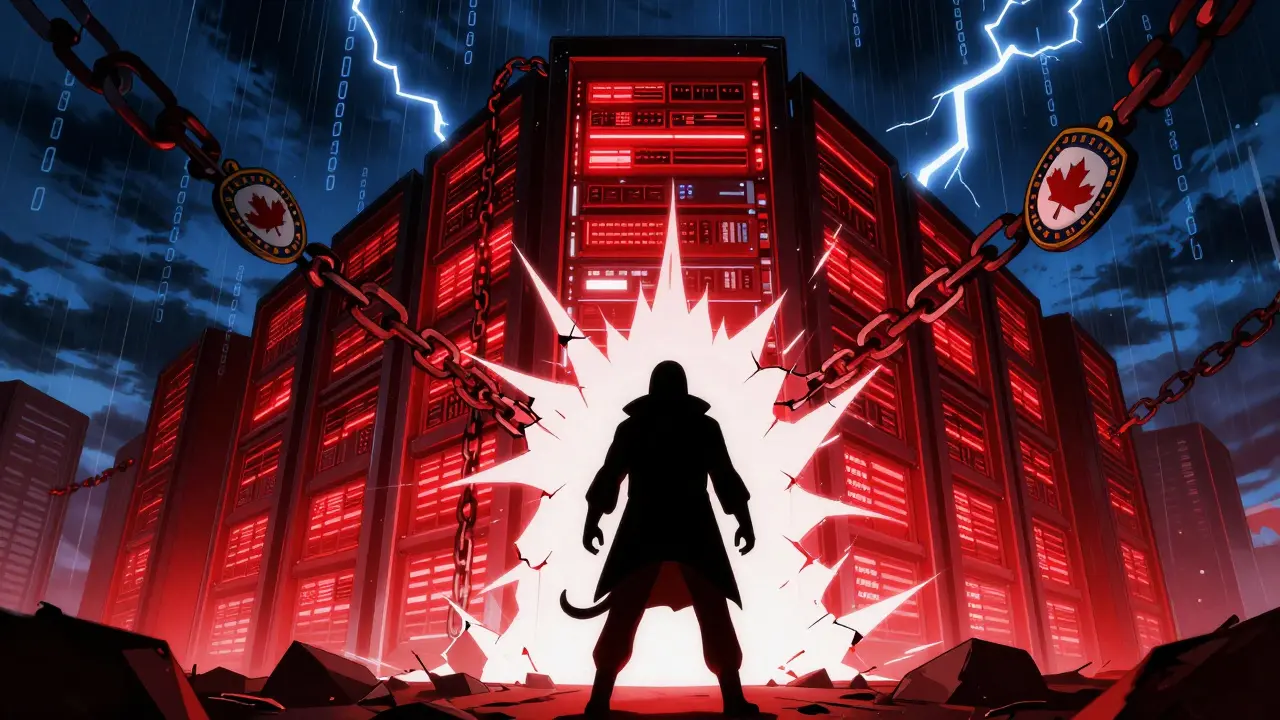
You might have heard of TradeOgre as a go-to spot for trading privacy coins without showing your ID. If you are looking to sign up right now, stop. The platform is dead. It went offline in July 2025 after Canadian authorities seized roughly $40 million in assets. This was not just a server glitch; it was Canada’s biggest crypto bust and the first time regulators shut down an entire centralized exchange.
This review isn't about whether you should deposit money there today. It is about understanding what happened, why it mattered to the privacy community, and what lessons we can take from its seven-year run. For years, TradeOgre was one of the few places where you could trade Monero (XMR) or other privacy-focused cryptocurrencies like Pirate Chain using only an email address. Its sudden end marks a major shift in how regulators treat non-KYC exchanges.
The End of an Era: How TradeOgre Shut Down
TradeOgre didn’t fade away slowly. It vanished abruptly. In May 2025, users noticed the website acting strangely, and the official X (formerly Twitter) account went silent. By July 30, 2025, reports confirmed that Canadian law enforcement had executed a seizure of approximately $40 million USD worth of cryptocurrency held on the platform.
According to ICO Bench, this action marked "Canada's biggest crypto bust and first-ever full exchange" shutdown. The authorities acted because TradeOgre operated without complying with financial regulations, specifically regarding Know Your Customer (KYC) rules. While the exact legal violations weren't fully detailed in public reports, the Financial Action Task Force (FATF) had been increasing pressure on platforms that allowed anonymous trading throughout 2024 and 2025. TradeOgre became a primary target because it refused to implement identity verification, positioning itself as a haven for privacy-conscious users.
For anyone who had funds on the platform at the time, those assets are likely frozen or confiscated. There is no customer support line to call, no email ticket system that works, and no recovery process available. The site is completely inaccessible.
Why People Used TradeOgre: The No-KYC Advantage
To understand why TradeOgre survived for seven years despite regulatory risks, you have to look at what it offered. Founded in 2018, the exchange carved out a niche by rejecting the standard industry practice of requiring government IDs, proof of address, or facial scans. All you needed was a valid email address.
This appealed to two main groups:
- Privacy Advocates: Users who believed that financial transactions should remain private and who used cryptocurrencies like Monero specifically to avoid blockchain surveillance.
- Users in Restricted Jurisdictions: People living in countries with strict capital controls or banned crypto activities often turned to TradeOgre because it did not check IP addresses against sanction lists as aggressively as mainstream exchanges.
At its peak, TradeOgre supported over 120 cryptocurrencies. However, its heart beat for privacy coins. It was one of the largest venues for trading Monero (XMR), Dero, Heron, and Pirate Chain. For these specific assets, TradeOgre often had better liquidity than other no-KYC alternatives. If you wanted to swap Bitcoin for Monero without revealing your identity, TradeOgre was frequently the top choice.

Fees and Trading Experience: Good Prices, Bad Reliability
When TradeOgre was operational, its fee structure was competitive. The exchange charged a flat 0.2% trading fee on all executed orders. This was in line with industry averages and cheaper than many decentralized exchanges (DEXs) which often charge higher gas fees or slippage costs.
| Fee Type | TradeOgre Rate | Industry Average |
|---|---|---|
| Trading Fee | 0.2% | 0.1% - 0.5% |
| BTC Withdrawal Fee | 0.00005 BTC | 0.0005 - 0.001 BTC |
| KYC Requirement | None | Mandatory |
Withdrawal fees were also a selling point. Bitcoin withdrawal fees were documented at 0.00005 BTC per transaction, which was significantly lower than the typical 0.0005-0.001 BTC charged by larger exchanges. However, the user experience was far from perfect.
The interface was described by users as "extremely basic but functional." It lacked advanced charting tools, deep order book visualization, and mobile app support. More critically, reliability was a major issue. Users frequently reported sudden liquidity drops. For example, in early 2024, traders holding Kaspa (KAS) found they could not sell their holdings. Despite setting competitive prices, orders would disappear from the order book, or buyers simply wouldn't appear. This left users trapped with assets they couldn't move.

Security Risks and User Complaints
Even before the shutdown, security experts warned against keeping significant funds on TradeOgre. The Crypto Father, a prominent YouTube commentator, called it a "risky place to keep your crypto" while acknowledging its utility for quick swaps. The lack of KYC meant there was no recourse if the exchange hacked you or ran away with your money.
User reviews on Trustpilot reflected this tension. With an average rating of 2.1 out of 5 stars based on 87 reviews, sentiment was sharply divided. Positive reviews praised the zero-KYC requirement and low withdrawal fees. Negative reviews, which made up 63% of the total, cited two main problems:
- Sudden Liquidity Disappearance: Users couldn't sell less popular coins even when willing to accept a loss.
- Withdrawal Delays: Processing times averaged 12-24 hours, with some users reporting funds stuck for days without explanation.
Customer support was virtually non-existent. Email inquiries took 72-96 hours to receive a response, and there was no live chat or phone support. For a platform handling millions in volume, this level of service was dangerously inadequate.
What This Means for No-KYC Exchanges
TradeOgre’s shutdown sends a clear message: the era of unregulated centralized exchanges is ending. According to Chainalysis data, no-KYC exchanges represented only 3.2% of total crypto trading volume by Q1 2025, down from 8.7% in 2022. Gartner predicts near-total elimination of centralized no-KYC exchanges in regulated jurisdictions by 2027.
If you rely on anonymity for trading, your options are shrinking. You now face a choice between:
- Decentralized Exchanges (DEXs): Platforms like SushiSwap or Uniswap allow trading without KYC, but you must manage your own keys and face high technical barriers.
- Peer-to-Peer (P2P) Markets: Services like Bisq or HodlHodl connect buyers and sellers directly, avoiding central custody risks.
- Compliant Exchanges: Major platforms like Kraken or Coinbase offer better security and liquidity but require full identity verification.
TradeOgre tried to bridge the gap by offering a centralized, easy-to-use interface without KYC. Regulators decided that convenience shouldn't come at the cost of compliance. As a result, the safest path for privacy-focused traders is moving toward non-custodial solutions where you control your private keys.
Is TradeOgre still working in 2026?
No. TradeOgre permanently shut down in July 2025 after Canadian authorities seized its assets. The website is offline, and no trading or withdrawals are possible.
Can I recover my funds from TradeOgre?
It is highly unlikely. The $40 million in assets were seized by law enforcement. There is no customer support channel active, and no official process has been announced for returning funds to users.
Why was TradeOgre shut down?
TradeOgre was shut down for operating without Know Your Customer (KYC) verification. Canadian authorities deemed it non-compliant with financial regulations, leading to the seizure of its cryptocurrency holdings.
What are safe alternatives to TradeOgre for privacy coins?
For privacy coins like Monero, consider using decentralized exchanges (DEXs) or peer-to-peer platforms like Bisq. These do not hold your funds centrally, reducing the risk of seizure or theft, though they require more technical knowledge to use safely.
Did TradeOgre ever require KYC?
No. Throughout its operation from 2018 to 2025, TradeOgre maintained a strict no-KYC policy. Users only needed an email address to create an account and trade.