

You bought Bitcoin in 2017. You probably made money. But what if you bought a token that promised to track the top 20 cryptocurrencies automatically? That was the pitch for CRYPTO20, or C20. It launched as the world’s first tokenized cryptocurrency index fund. The idea was simple: one token gives you exposure to the biggest coins without managing twenty separate wallets. Today, more than eight years later, C20 trades for fractions of a cent. So, what happened? Is it dead? Or is it still doing exactly what it was designed to do?
Key Takeaways
- C20 is an ERC-20 token on Ethereum that represents a share in a basket of the top 20 cryptocurrencies by market cap.
- The project raised over $37 million in its 2017 ICO at $1.00 per token but has since lost roughly 99.5% of its value.
- Unlike standard tokens, C20 holds actual underlying assets, offering a theoretical redemption mechanism via smart contract liquidation.
- Liquidity is extremely low; C20 is not listed on major centralized exchanges and must be traded via decentralized swaps.
- It serves as a historical case study in early DeFi innovation, highlighting both the promise and pitfalls of tokenized funds.
What Exactly Is CRYPTO20 (C20)?
To understand C20, you have to look past the price chart and look at the structure. CRYPTO20 is a tokenized index fund built on the Ethereum blockchain. Most crypto tokens are just receipts for network usage or governance rights. C20 is different. It is a utility token tied directly to the Net Asset Value (NAV) of a real-world portfolio. When you hold C20, you are holding a fractional claim on a diversified basket of the 20 largest cryptocurrencies.
This concept mirrors traditional finance. Think of an ETF like the S&P 500. Instead of buying shares in Apple, Microsoft, and Amazon separately, you buy one ticker symbol. C20 attempted this for crypto. The whitepaper describes it as an "autonomous cryptocurrency-only portfolio." This means the fund operates based on code and rules, not a human manager deciding which coin to buy next week. The goal was diversification. By holding the top 20 assets, the fund aimed to reduce the volatility associated with betting on a single coin.
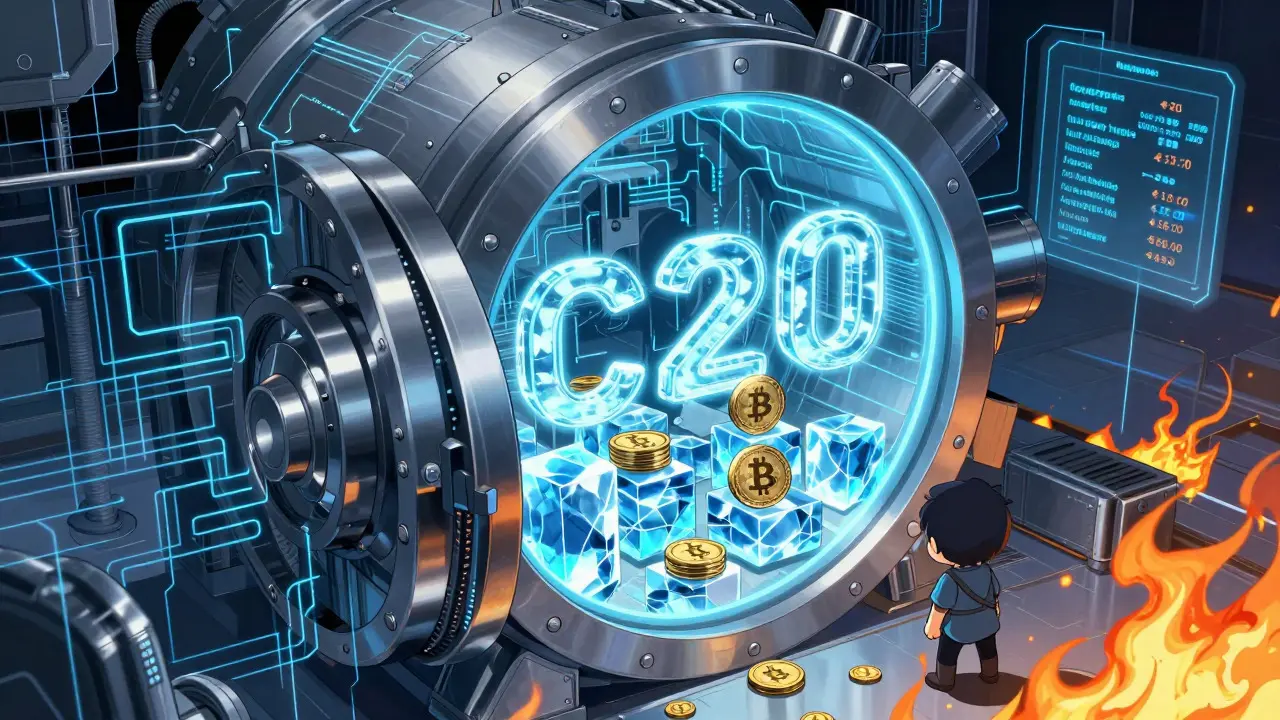
The technical backbone is the ERC-20 standard, which allows the token to be stored in any Ethereum-compatible wallet. However, unlike a meme coin that exists only as a number on a ledger, C20 was designed to back its value with actual holdings. The fund uses the capital raised from token sales to purchase Bitcoin, Ethereum, and other top-tier assets. These assets are then held in custody, mostly in cold storage for security, while the C20 tokens circulate freely on the secondary market.
The 2017 ICO Boom and Current Reality
The story of C20 begins in October 2017. The crypto market was euphoric. New projects were raising millions overnight. C20 conducted its Initial Coin Offering (ICO) between October 16 and November 30, 2017. The results were massive for the time. Investors purchased 37,698,373 tokens at a fixed price of $1.00 USD each. In total, the project raised approximately $37.7 million.
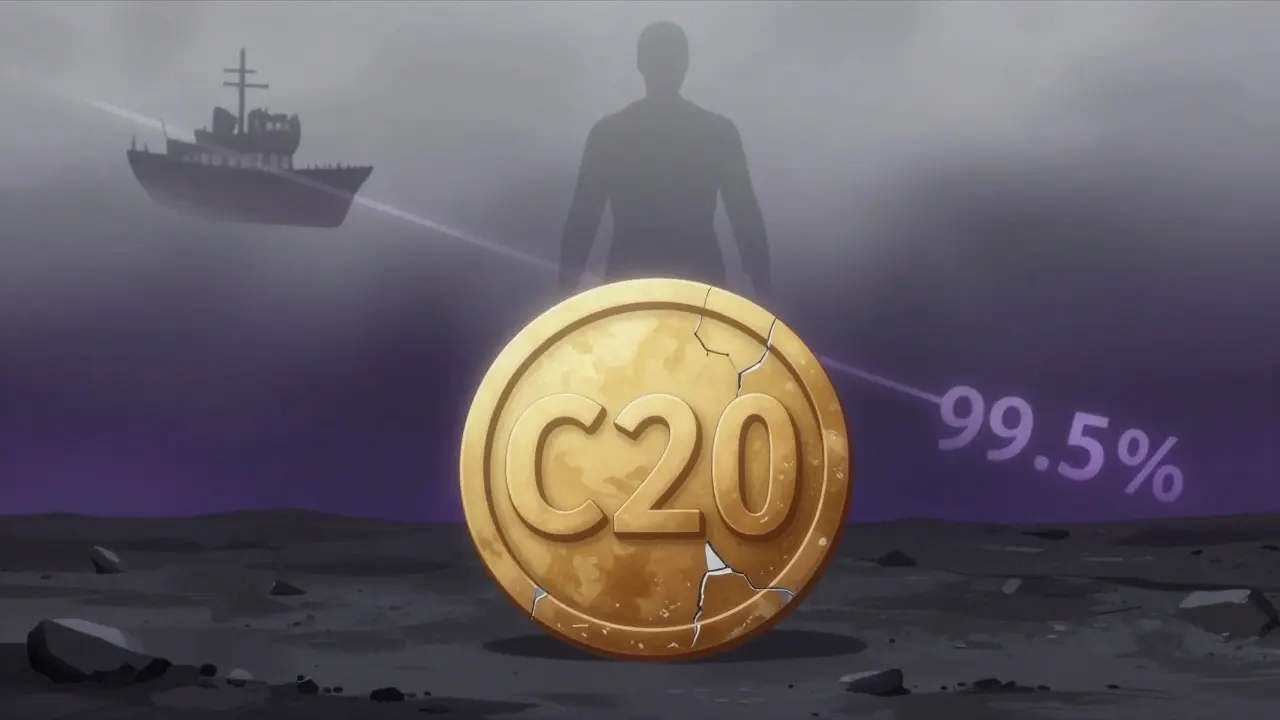
Fast forward to mid-2026. The picture looks starkly different. Data from trackers like Binance, CoinFi, and Bitget shows C20 trading around $0.0045 USD. That is a decline of roughly 99.5% from its issuance price. Even if we consider outlier data points suggesting a higher price in early 2026, the token remains a shadow of its former self. Why such a drastic drop when the underlying assets-Bitcoin and Ethereum-have seen multiple bull runs?
The answer lies in the difference between NAV and market price. While the fund holds valuable assets, the token itself can trade at a discount to that value. Several factors contribute to this. Liquidity is nearly non-existent. Trading volumes often hit zero on major aggregators. Without active buyers, the price drifts down. Additionally, operational friction, regulatory uncertainty, and the rise of simpler alternatives like spot ETFs have eroded demand for this specific type of complex, legacy DeFi product. The circulating supply has stabilized around 40.35 million tokens, out of a maximum possible supply of roughly 40.65 million. There is no new minting happening. The ship has stopped growing; it is just drifting.
| Metric | 2017 ICO | Mid-2026 Estimate |
|---|---|---|
| Price per Token | $1.00 USD | ~$0.0045 USD |
| Total Raised | $37.7 Million | N/A (Legacy) |
| Circulating Supply | 37.7 Million | ~40.35 Million |
| Market Cap | $37.7 Million | ~$180,000 - $500,000 |
| Exchange Presence | Major CEX Listings | DEX Only (e.g., Binance Web3 Wallet) |
How the Index Strategy Works
The core innovation of C20 was its automated rebalancing logic. The fund tracks the top 20 cryptocurrencies by market capitalization. This list changes over time. If a new coin enters the top 20, the fund buys it. If a coin falls out, the fund sells it. This removes emotional decision-making from investing. You don't need to watch charts all day. The smart contract handles the allocation.
The weighting is crucial. Typically, these indices are market-cap weighted. This means Bitcoin, being the largest, makes up the biggest chunk of the portfolio, followed by Ethereum, and so on. This provides broad exposure to the "blue chips" of crypto. The whitepaper emphasizes that this approach mitigates concentration risk. You aren't betting everything on one narrative. You are betting on the overall growth of the top tier of the asset class.
However, there is a catch. The fund charges fees. While significantly lower than traditional hedge funds (which often charge "2 and 20"), C20 still incurs management costs and Ethereum gas fees for transactions. These costs eat into the NAV over time. For a retail investor holding a small amount, the impact might be negligible. For large holders, the drag matters. More importantly, the complexity of the setup creates a barrier. You are trusting the fund operator to execute the trades correctly and keep the private keys safe.
Risks, Liquidity, and Redemption
If you are considering buying C20 today, you need to understand the risks. The biggest issue is liquidity. As mentioned, trading volume is often zero. This means if you want to sell, you might not find a buyer at a fair price. You could be stuck with tokens that are hard to offload. This is known as illiquidity risk. In a panic scenario, the price could crash further simply because there are no bids on the order book.
There is also counterparty risk. Although the assets are on-chain, they are managed by a central entity or a set of multi-sig wallets controlled by the fund operators. If those keys are lost or compromised, the underlying assets could be frozen or stolen. The whitepaper notes that most assets are in cold storage, which is good practice, but it doesn't eliminate the risk entirely. You are relying on their operational security.
On the bright side, C20 features a unique liquidation option. According to the smart contract design, holders can redeem their C20 tokens for a pro-rata share of the underlying assets. This is a powerful feature theoretically. If the token trades at a huge discount to the NAV, arbitrageurs could buy C20, redeem it for the actual Bitcoin and Ethereum, and sell those assets for a profit. This mechanism should keep the token price close to its true value. In practice, however, high transaction costs and minimum redemption thresholds may make this unfeasible for small investors, allowing the discount to persist.
How to Buy and Store C20 in 2026
Buying C20 is no longer as easy as clicking "Buy" on Coinbase or Binance's main exchange. The token has been delisted from most major centralized venues due to low volume. To acquire C20 today, you need to use a decentralized approach.
- Set Up a Web3 Wallet: You will need an Ethereum-compatible wallet. The Binance Web3 Wallet is a popular choice because it integrates seamlessly with DEXs. Alternatively, MetaMask works well. Make sure you secure your seed phrase offline.
- Fund Your Wallet: Transfer ETH or a stablecoin like USDT to your wallet address. You will need ETH to pay for gas fees (transaction costs) on the Ethereum network.
- Connect to a DEX: Use a decentralized exchange aggregator or a specific DEX that lists C20. The Binance Web3 Wallet interface simplifies this by scanning for available pairs. Look for a USDT/C20 or ETH/C20 pair.
- Execute the Swap: Enter the amount you wish to swap. Check the slippage tolerance carefully. Due to low liquidity, you might need to set a higher slippage percentage (e.g., 5-10%) to ensure the trade goes through, but be aware you might get fewer tokens than expected.
- Confirm Transaction: Sign the transaction in your wallet. Wait for the block confirmation. The C20 tokens will appear in your wallet assets.
Storing C20 is straightforward. Since it is an ERC-20 token, any hardware wallet like Ledger or Trezor that supports Ethereum will work. Keep your device firmware updated and never share your recovery phrase.
Is C20 Still Relevant?
In the grand scheme of crypto history, C20 is a pioneer. It proved that tokenized funds could exist on-chain. It paved the way for modern protocols like Yearn Finance, various index DAOs, and even regulated crypto ETFs. However, as an investment vehicle today, it struggles against newer, more efficient competitors.
Newer index products offer better transparency, lower fees, and deeper liquidity. They are built on more advanced smart contract standards and have active development teams. C20, by contrast, appears to be in maintenance mode. The original whitepaper is still the primary source of information. There are no major roadmap updates or new product launches reported in recent years. The community engagement is minimal, with very few social media mentions compared to active projects.
For the average investor, C20 is likely more of a collector's item or a speculative play on potential revitalization rather than a core portfolio holding. The discount to NAV offers a theoretical upside, but the execution risk is high. If you believe in the concept of decentralized index funds, there are likely better, more liquid options available in the current DeFi landscape. C20 remains a fascinating artifact of the 2017 boom-a reminder of how far the technology has come, and how quickly markets can move on.
What is the current price of C20?
As of mid-2026, C20 trades at approximately $0.0045 USD. Prices vary slightly between data aggregators like CoinFi, Binance, and Bitget, but generally remain below one cent. Note that trading volume is extremely low, so prices can be volatile or stale.
Can I buy C20 on Binance or Coinbase?
No, C20 is not available for direct purchase on the main centralized exchanges of Binance or Coinbase. You must use a decentralized exchange (DEX). The Binance Web3 Wallet allows you to swap stablecoins for C20 within the app, but this is not the same as buying on the central order book.
Is C20 a scam?
C20 is not considered a scam in the traditional sense. It is a legitimate ERC-20 token backed by a real portfolio of top cryptocurrencies. However, it suffers from severe underperformance relative to its ICO price and low liquidity. Investors face significant financial risk due to the discount to NAV and difficulty exiting positions.
What cryptocurrencies does C20 track?
C20 tracks the top 20 cryptocurrencies by market capitalization. This typically includes Bitcoin, Ethereum, Tether, BNB, Solana, and others, depending on the current rankings. The portfolio is rebalanced periodically to reflect changes in market cap.
How much did C20 raise in its ICO?
During its ICO in late 2017, CRYPTO20 raised approximately $37.7 million USD by selling 37.7 million tokens at $1.00 each. This was a significant sum during the 2017 crypto boom.
What is the total supply of C20?
The circulating supply is approximately 40.35 million C20 tokens. The total realized supply is capped around 40.65 million tokens. No new tokens are being minted.
Does C20 have a redemption feature?
Yes, the C20 smart contract includes a liquidation option that allows holders to redeem their tokens for a proportional share of the underlying crypto assets. This is intended to align the token price with the Net Asset Value (NAV), though practical barriers like gas fees may limit its use for small amounts.