

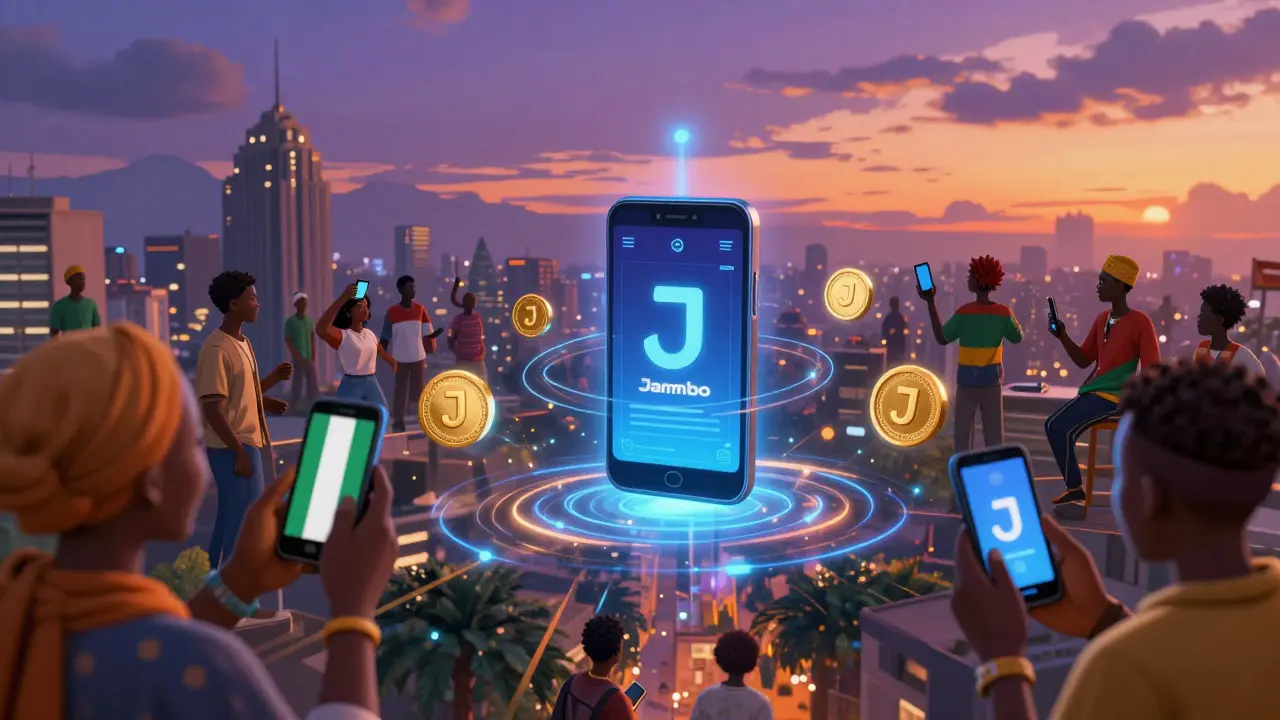
The Jambo (J) crypto coin isn't just another altcoin. It’s tied to a real hardware product - the Jambo phone - and built to solve a very specific problem: bringing decentralized finance to mobile users in regions where banks are hard to reach. Launched in January 2025 by an African Web3 company, Jambo combines a physical smartphone with a blockchain network to create a system where people can send money, stake tokens, and vote on platform changes - all from their phone, no bank account needed.
What the Jambo (J) token actually does
The Jambo token, symbol J, is the fuel for the entire ecosystem. It’s not just a tradable asset - it’s a tool for participation. Holders can stake their J tokens to earn rewards, vote on upgrades to the network, and get paid for helping grow the system. Unlike many crypto projects that exist only online, Jambo ties its token directly to a hardware device: the Jambo phone. This phone comes preloaded with the Jambo wallet, blockchain apps, and offline access tools so users in areas with spotty internet can still interact with the network.
Staking J tokens lets users earn more tokens over time. Governance votes - like changing transaction fees or adding new features - are decided by how many tokens you hold. The more J you have, the more influence you have. This creates a direct link between usage and ownership. If you use the phone to send money or pay for services, you’re not just consuming a product - you’re helping build it.
How Jambo’s tokenomics work (and why numbers vary so much)
Tokenomics for Jambo (J) are messy right now - and that’s telling. Different crypto tracking sites show wildly different prices as of March 2026:
- Coinbase reports J at $0.23, with a $30.18 million market cap and 130 million tokens in circulation.
- LiveCoinWatch says it’s $0.073, with an all-time high of $0.91.
- Investing.com lists a $38.59 million market cap and 161 million tokens circulating.
- Crypto.com shows J at just $0.011.
These aren’t typos. They reflect real differences in trading volume across exchanges. Jambo trades on LBank, Bybit, and HIBT - but liquidity is thin on most of them. Some exchanges have $100,000 in daily trading volume; others barely hit $10,000. That kind of inconsistency means prices swing wildly depending on where you look. The maximum supply is capped at 1 billion J tokens, but only about 130-160 million are circulating right now. That leaves a lot of room for future releases - and more volatility.
The token has lost 75-80% of its value since its peak. That’s not unusual for early-stage projects, but it does mean early adopters are still waiting to break even. The 24-hour trading volume across all exchanges combined is under $12 million - tiny compared to top-100 coins. This isn’t a market leader. It’s a testbed.

The Jambo phone: Why hardware matters
Most crypto projects rely on software alone. Jambo bets on hardware. The Jambo phone runs a custom Android OS with blockchain apps baked in. It has a built-in cold wallet, encrypted storage for private keys, and offline transaction signing so users don’t need to trust third-party apps. In places like Nigeria, Kenya, or Indonesia - where 80% of adults have smartphones but only 30% have bank accounts - this matters.
Imagine sending money to a family member in a rural village. Traditional apps like PayPal or Wise don’t work there. Mobile money services like M-Pesa are popular, but they’re controlled by telecom companies and charge high fees. With Jambo, you send J tokens directly from phone to phone. No intermediaries. No middleman fees. The transaction settles on-chain in seconds. And because the phone can work offline for a few hours, users don’t need constant internet.
It’s not just about convenience. It’s about control. With Jambo, you own your money. No bank can freeze your account. No government can devalue your savings through inflation. The Jambo phone isn’t a gimmick - it’s infrastructure for financial inclusion.
The roadmap: Where Jambo is headed
The project has a clear four-phase plan:
- Phase 1 (Completed): Launched the Jambo phone and the J token. Set up staking and initial liquidity pools.
- Phase 2 (Ongoing): Connecting Jambo’s blockchain to Ethereum, Solana, and Binance Chain. This lets users move J tokens between networks without losing value.
- Phase 3 (Coming Soon): Launching a decentralized exchange (DEX) so users can trade J for other tokens without relying on centralized exchanges like Binance.
- Phase 4 (Future): Full community governance. Token holders will vote on everything - from development budgets to new features. No company will control the network.
Phase 2 is the most important right now. Without interoperability, Jambo stays isolated. If it can link to other blockchains, J tokens become useful beyond just the Jambo phone. That’s when adoption could jump.
Who is Jambo really for?
Jambo isn’t for crypto traders looking to flip coins. It’s not for Wall Street investors. It’s for people who need a better way to move money - and don’t trust banks or governments.
Think of a small business owner in Lagos who gets paid in cash every day. She wants to save, but inflation eats 20% of her savings each year. With Jambo, she can convert cash to J tokens, stake them for 8% annual returns, and use them to pay suppliers across borders. No wire fees. No delays. No middlemen.
Or imagine a student in Accra who wants to earn money by helping new users set up their Jambo phones. The platform rewards them with J tokens for onboarding others. That’s real economic activity - not speculation.
Jambo’s entire design assumes users don’t have credit cards, bank apps, or high-speed internet. It works with what they do have: a smartphone, a fingerprint, and a need to get paid.
Is Jambo (J) a good investment?
Here’s the truth: if you’re looking for a safe, steady crypto bet - Jambo isn’t it. The price has dropped 75% in a year. Liquidity is low. Data across platforms is inconsistent. It’s still early, risky, and volatile.
But if you believe in financial inclusion for emerging markets - and think hardware + blockchain is the future - then Jambo might be worth watching. It’s one of the few crypto projects that actually solves a real-world problem with real-world tools. The phone isn’t a marketing stunt. It’s the core product.
Staking J tokens right now might give you better returns than holding stablecoins. The governance model could give you real influence over the network’s future. And if Jambo succeeds in linking to Ethereum and Solana, the token could gain serious traction.
But don’t buy it because you think it’ll hit $1. Buy it because you believe in a world where your phone is your bank - and you own it.
Is Jambo (J) a real cryptocurrency or just a scam?
Jambo (J) is a real cryptocurrency with a working product: the Jambo phone. It’s not a scam, but it’s still in its early, unstable phase. The project has a public roadmap, active development, and real users on the ground in Africa. However, its price volatility and inconsistent data across exchanges mean it carries high risk. Always do your own research before investing.
Can I buy Jambo (J) on Coinbase or Binance?
Yes, but not directly on Coinbase or Binance. Jambo (J) trades on smaller exchanges like LBank, Bybit, and HIBT. You can buy it using USDT or ETH on those platforms. Coinbase lists Jambo for price tracking but doesn’t allow trading. Always check the exchange’s official site before depositing funds.
Do I need the Jambo phone to use the J token?
No, you don’t need the Jambo phone to hold or trade J tokens. You can store them in any compatible wallet like MetaMask or Trust Wallet. But if you want to use the full ecosystem - staking, earning rewards, paying for services, or voting on governance - the Jambo phone gives you the best experience. It’s designed to make blockchain simple for people without tech skills.
How does Jambo compare to other mobile crypto projects like Solana Pay or Telegram’s TON?
Solana Pay and TON are software-only solutions that rely on existing smartphones. Jambo is different because it builds its own hardware. The Jambo phone has encrypted cold storage, offline transaction signing, and no reliance on third-party apps. It’s designed for users who can’t trust their phones to be secure. Jambo also focuses on emerging markets, while Solana Pay and TON target global users with existing banking access.
What’s the long-term potential of Jambo (J)?
If Jambo successfully links to Ethereum and Solana, and if its user base grows in Africa and Southeast Asia, the token could become a key utility asset for mobile DeFi. Its real edge is combining hardware, low fees, and offline access. If it achieves even 1% adoption in countries with 500 million unbanked adults, demand for J tokens could surge. But that’s a big "if." The next 12 months will determine whether it’s a breakthrough - or a footnote.
Comments (24)