

You see a yield of 50% APY. Maybe even 200%. It looks like free money sitting in a decentralized finance (DeFi) pool, waiting for you to deposit your assets. But here is the hard truth: if a return sounds too good to be true, it usually comes with a price tag you haven’t seen yet. Yield farming is not passive income; it is an active risk management exercise.
Yield farming involves locking up cryptocurrency in liquidity pools or lending protocols to earn rewards. These rewards come from trading fees or newly minted governance tokens. While the potential profits are real, so are the dangers. In 2026, the total value locked in DeFi remains high, but so does the sophistication of attackers. Understanding the specific risks-like smart contract bugs, impermanent loss, and rug pulls-is the only way to survive in this space without losing your principal investment.
The Silent Killer: Impermanent Loss
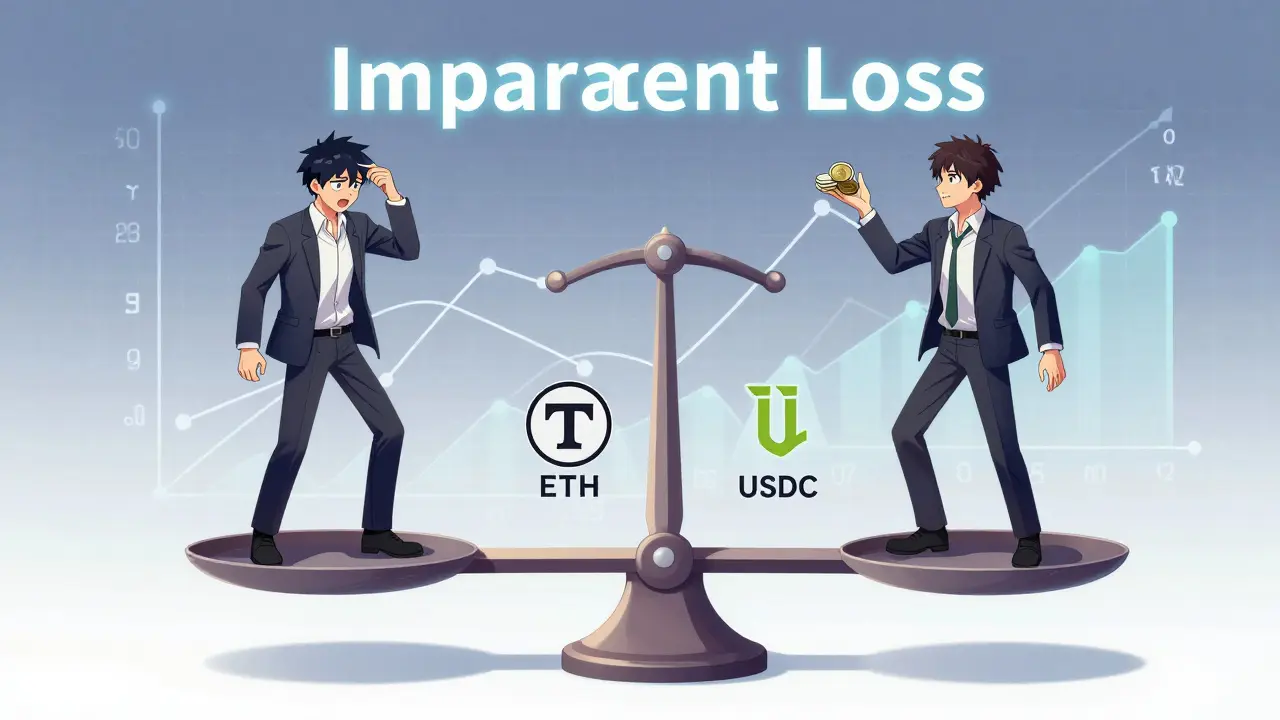
Most beginners think they can just hold their tokens in a pool and watch the balance grow. That is where the concept of impermanent loss hits them. This is not a hack or a scam; it is pure math. When you provide liquidity to a pool containing two different assets (like ETH and USDC), the protocol automatically rebalances your holdings based on price changes.
If the price of one asset drops significantly compared to the other, the pool sells the strong asset to buy more of the weak one. You end up holding more of the loser and less of the winner. If you had simply held those tokens in your wallet instead of farming them, you would likely have more value. This divergence between your farmed assets and your hypothetical "just holding" portfolio is impermanent loss. It becomes permanent if you withdraw while the prices are still skewed.
| Scenario | Action | Result after Price Drop |
|---|---|---|
| Holding | Keep 1 ETH + 1000 USDC in wallet | Value depends entirely on market price |
| Farming | Deposit into ETH/USDC Liquidity Pool | Pool auto-sells ETH as price drops; you hold more cheap ETH, fewer USDC |
To minimize this risk, stick to stablecoin pairs (like USDC/DAI) where price divergence is minimal. Alternatively, look for pools that offer high enough reward emissions to offset the mathematical loss. If the fees and token rewards don't cover the potential impermanent loss, the trade isn't worth it.
Smart Contract Vulnerabilities
DeFi runs on code, not banks. That code is called a smart contract. Smart contracts are immutable once deployed, meaning if there is a bug, it stays there until someone patches it-or exploits it. Hackers constantly scan new protocols for errors like reentrancy attacks or flash loan vulnerabilities.
Audits are essential, but they are not a guarantee of safety. An audit is a snapshot in time. A developer might patch a known issue but introduce a new one later. Or, the auditor might miss a subtle logic error. In 2023 and 2024, several major protocols suffered breaches despite having multiple audits because the underlying architecture was flawed.
How do you protect yourself? Check who audited the project. Reputable firms like CertiK, OpenZeppelin, or Trail of Bits carry weight. Look for public bug bounty programs. If a protocol offers no bounty, why would they pay hackers to find bugs before others do? Also, prefer established protocols with a long track record over shiny new launches promising massive yields.
Rug Pulls and Governance Attacks
Not all losses come from code errors. Sometimes, the developers themselves are the threat. A rug pull occurs when creators abandon a project and take the liquidity with them. This often happens with anonymous teams launching low-market-cap tokens. They hype the yield, attract deposits, and then drain the pool overnight.
Another subtle risk is governance manipulation. Many yield farming protocols distribute governance tokens to farmers. These tokens allow holders to vote on protocol changes. If a small group accumulates enough voting power, they can propose malicious changes, such as redirecting treasury funds to their own wallets. This happened in early DeFi experiments and remains a risk in smaller ecosystems.
Always research the team behind the protocol. Are they doxxed (publicly identified)? Do they have a history in the industry? Anonymous teams aren't automatically scams, but they require a much higher threshold of trust and proof of competence. Never invest in a project where you cannot verify the identity or reputation of the founders.
Market Volatility and Liquidation Risk
Cryptocurrency markets are notoriously volatile. Prices can swing 20% in a single day. In yield farming, especially when using leverage or borrowing against your collateral, this volatility can trigger liquidations. If you borrow stablecoins to buy more crypto for a yield strategy, and the crypto price drops, the protocol may sell your assets to repay the loan. You lose your position, and the yield doesn't matter anymore.
Interconnectedness amplifies this risk. DeFi protocols are linked. If one major lending platform fails, it can cause a cascade of failures across other platforms that rely on its assets. This systemic risk means that even if your specific pool is safe, the broader market collapse can wipe out your returns.
To mitigate this, avoid excessive leverage. Stick to strategies where you own the assets outright rather than borrowing against them. Keep a portion of your portfolio in stable assets to weather downturns. Diversify across different chains and protocols to reduce exposure to any single point of failure.

Regulatory Uncertainty
The regulatory landscape for DeFi is shifting rapidly. Governments worldwide are scrutinizing yield farming activities. Some jurisdictions classify certain yield-bearing tokens as securities. If a protocol is deemed non-compliant, it could face shutdowns, fines, or delisting from exchanges. This could trap your funds or drastically reduce their value.
While regulation aims to protect investors, it also introduces compliance risks. You might unknowingly participate in a scheme that violates local financial laws. Stay informed about regulations in your country. Consider using privacy-focused tools if necessary, but understand that complete anonymity in DeFi is becoming harder due to blockchain analysis techniques.
Practical Steps to Minimize Risks
You can't eliminate risk in yield farming, but you can manage it. Here is a checklist to keep your capital safer:
- Start Small: Test new protocols with amounts you can afford to lose completely. Treat it as tuition for learning.
- Verify Contracts: Use block explorers to check if contract addresses match official sources. Phishing sites often mimic legitimate dApps.
- Diversify: Don't put all your eggs in one basket. Spread investments across different types of pools (stable, volatile, blue-chip).
- Monitor Regularly: Set up alerts for price changes and protocol updates. Don't set it and forget it.
- Use Hardware Wallets: Keep your main funds in a hardware wallet. Only connect your hot wallet with the minimum amount needed for transactions.
- Check Liquidity Depth: Avoid pools with low liquidity. High slippage can eat into your profits when you try to exit.
Remember, yield farming is a tool, not a get-rich-quick scheme. The most successful farmers are those who prioritize capital preservation over chasing the highest APY. By understanding impermanent loss, vetting smart contracts, and staying aware of market dynamics, you can navigate the DeFi landscape with confidence.
What is the biggest risk in yield farming?
The biggest risk is often considered to be smart contract vulnerabilities, which can lead to total loss of funds through hacks. However, for many participants, impermanent loss is the most common and predictable risk, eroding profits over time due to price volatility.
Can I lose all my money in yield farming?
Yes. If a protocol suffers a severe hack, executes a rug pull, or if the value of the underlying assets crashes to near zero, you can lose your entire investment. Always assume that any capital deployed in DeFi is at risk of total loss.
How do I avoid impermanent loss?
You cannot completely avoid it, but you can minimize it by providing liquidity in stablecoin pairs (e.g., USDC/DAI) or correlated assets. Additionally, ensure that the yield earned covers the potential loss from price divergence.
Is yield farming legal?
Legality varies by jurisdiction. In some countries, yield farming is unregulated but legal. In others, certain tokens may be classified as securities, making participation potentially illegal. Consult local financial regulations before engaging.
What is a rug pull in DeFi?
A rug pull is a fraudulent scheme where developers abandon a project and remove the liquidity from the pool, causing the token's value to crash to zero and leaving investors with worthless assets.