
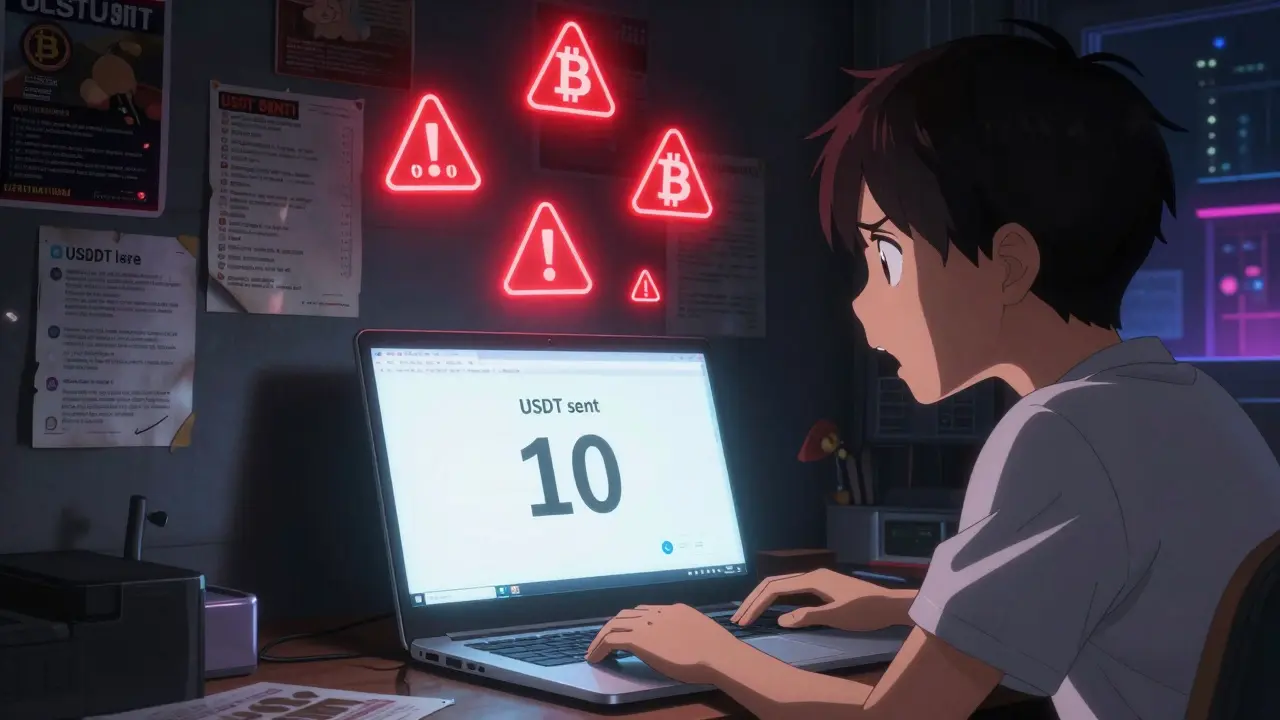
Myanmar doesn’t just discourage cryptocurrency-it actively destroys your financial life if you use it. If you’ve ever thought about buying Bitcoin, sending Ethereum, or even holding USDT in Myanmar, you need to understand one hard truth: your bank account can vanish overnight, and you could end up in jail. This isn’t a rumor. It’s happening right now.
How the Central Bank of Myanmar Enforces the Ban
The Central Bank of Myanmar (CBM) doesn’t waste time with warnings or fines. When they catch someone using crypto, they don’t send a letter. They shut down your bank account. No notice. No appeal. Just gone. This isn’t a minor penalty-it’s a financial execution. Your savings, your salary, your business funds-all locked or erased in a single move. This policy started as a quiet warning in 2020. Back then, the CBM said people who traded crypto did so at their own risk. No action. No enforcement. But on May 24, 2024, everything changed. The CBM issued a public notice: “We will close accounts and pursue legal action.” That wasn’t a threat. It was a declaration of war. They didn’t just target big traders. They went after everyday people. Students using Telegram to send USDT to family overseas. Shop owners accepting Bitcoin for goods. Even Facebook pages promoting crypto exchanges got shut down. The CBM doesn’t care if you’re making $10 or $10,000. If you touch crypto, you’re breaking the law.The Laws That Make Crypto Illegal
Myanmar’s crypto ban isn’t based on one rule. It’s built on a stack of laws that all point to the same conclusion: digital currencies are illegal.- Central Bank of Myanmar Law - Gives the CBM exclusive control over currency. No other money, not even Bitcoin, is allowed.
- Foreign Exchange Management Law - Makes it illegal to convert kyat into any foreign currency without approval. Crypto is treated as foreign currency.
- Financial Institutions Law - Bans banks from dealing with unregulated financial services. Crypto exchanges? Unregulated. So, no banking.
- Anti-Money Laundering Law - Used to charge people with criminal activity if they move crypto, even if it’s just sending money to a relative.
What Happens When Your Account Gets Closed
If the CBM flags your account, you won’t get a call. You won’t get an email. You’ll log in one day and find your balance at zero. Your debit card won’t work. Your salary won’t deposit. Your business payments bounce. And you won’t know why. People in Yangon and Mandalay have reported waking up to frozen accounts with no explanation. Some were told later, “You were involved in cryptocurrency transactions.” Others never got a reason at all. The CBM doesn’t need to prove anything in court first. They act first, investigate later. And once your account is closed, reopening it is nearly impossible. Banks refuse to talk to you. You can’t file a complaint. The system is designed to make you disappear from the financial system.Beyond the Account: Prison, Fines, and Criminal Charges
Closing your account isn’t the worst of it. You can be arrested. The CBM has already filed criminal cases under the Anti-Money Laundering Law. People have been detained for weeks while authorities review their phone records, Facebook messages, and wallet addresses. Some were charged with “illegal currency conversion.” Others were accused of “operating an unlicensed financial service.” Penalties? Up to 10 years in prison. Fines of up to 10 million kyat (roughly $5,000 USD). And in many cases, both. You don’t get a warning. You don’t get a chance to pay up. You go to jail. The CBM has specifically named Bitcoin, Ethereum, Litecoin, and Perfect Money as illegal. But they focus most on Tether (USDT). Why? Because it’s stable. Because it’s used for remittances. Because it’s the backbone of Myanmar’s underground economy.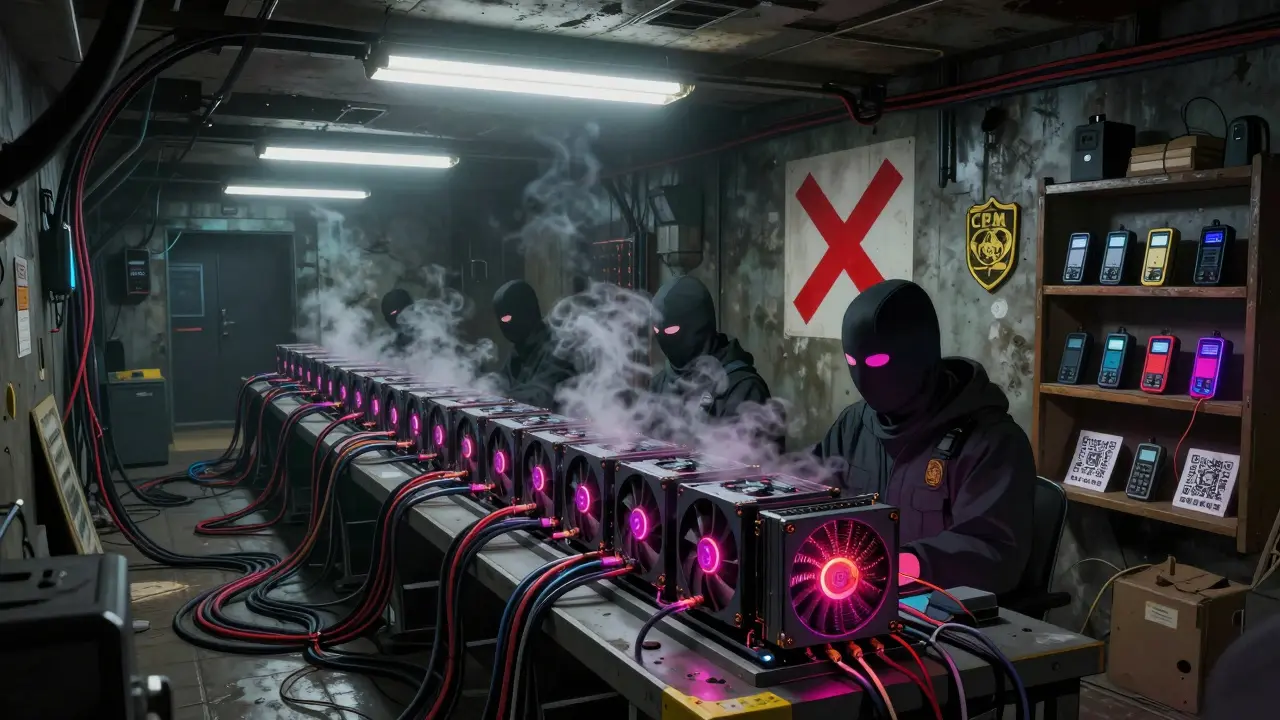
Why People Still Use Crypto Despite the Risk
You’d think with all this, people would give up. But they haven’t. Since the 2021 coup, the kyat has lost over 70% of its value. Inflation is above 30%. Salaries are paid in cash. Banks are unreliable. People need a way to save money, send money to family abroad, or pay for medical care overseas. Crypto became the answer. USDT on the Tron network became the most popular way to send money. People use Telegram to trade. They meet in coffee shops to swap cash for digital tokens. Some even mine Bitcoin in hidden rooms, using stolen electricity. The National Unity Government (NUG)-the opposition group that controls parts of the country-made USDT legal tender in 2021. That created a bizarre split: in one town, crypto is a crime. In the next, it’s the only way to survive.The Rise of the Underground Crypto Economy
Myanmar’s crypto scene is now a shadow economy. It’s not just individuals. It’s small businesses, NGOs, and even some doctors accepting crypto for payments. You’ll find crypto traders on Facebook groups with names like “Myanmar USDT Buyers” or “Kyat to USDT Exchange.” They use burner phones. They meet in public parks. They use peer-to-peer apps like Paxful and LocalBitcoins. Some even use QR codes to transfer money without leaving a digital trail. But the risks are real. The CBM has trained bank employees to look for crypto-related keywords in account activity. Words like “USDT,” “Tron,” “wallet,” or “exchange” trigger automatic flags. Even mentioning crypto in a chat with a friend can get you reported.Myanmar’s Own Digital Currency Is Coming
In June 2025, the CBM created the Central Committee for the Issuance of Central Bank Digital Currency. This group, led by the CBM Governor and top government officials, is working on a digital version of the kyat. This isn’t about innovation. It’s about control. The government doesn’t want you using crypto. They want you using their digital currency-something they can track, freeze, or shut off anytime. It’s a classic move: ban all alternatives, then offer your own version. The message is clear: you can have digital money. But only if we control it.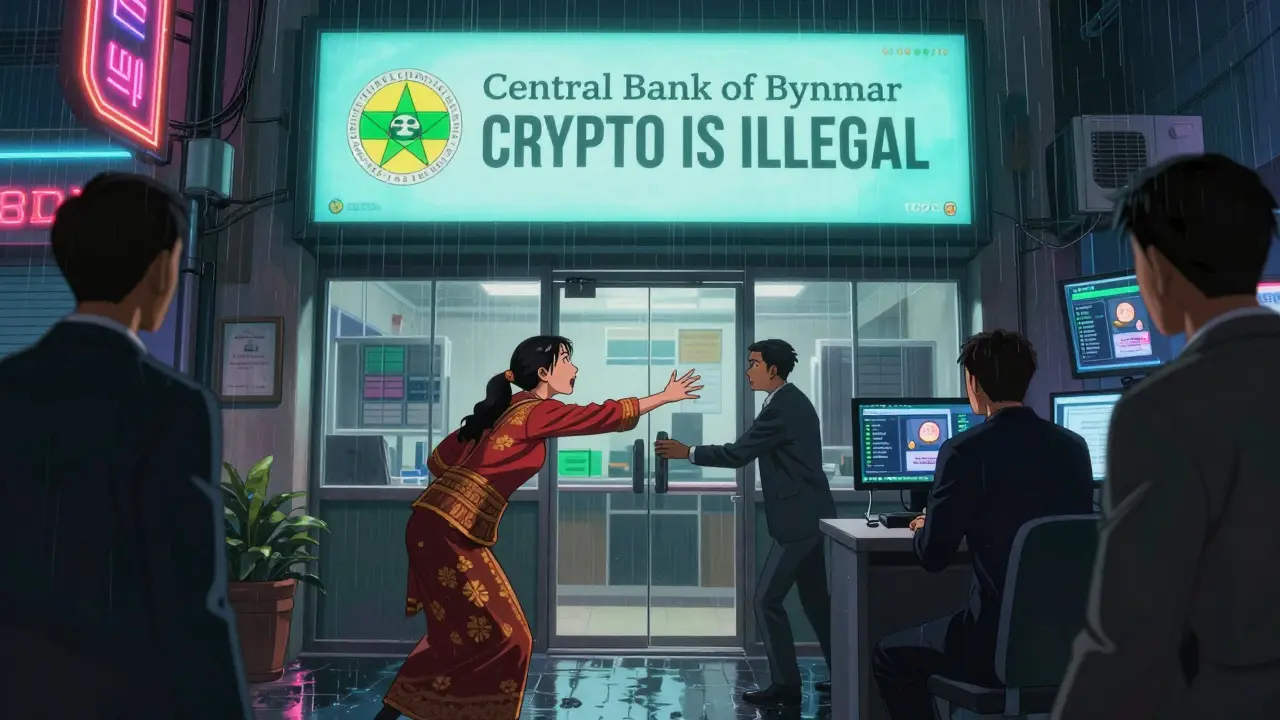
What Should You Do If You’re in Myanmar?
If you live in Myanmar and use crypto, stop. Now. Even if you’ve done it for years, the crackdown has intensified. The CBM is using AI to scan social media and bank transactions. They’re working with telecom companies to track phone numbers linked to crypto wallets. If you’ve already used crypto, don’t panic. But don’t keep using it. Don’t try to withdraw funds. Don’t explain yourself to banks. Just go silent. The less you do, the less they can find. If you’re thinking about starting, don’t. The penalties aren’t worth it. The risk of prison, fines, and losing your life savings is too high.What About Foreigners or Overseas Users?
If you’re outside Myanmar, you’re not at risk. The CBM can’t touch your foreign bank account. But if you’re sending money to someone in Myanmar, you’re part of the chain. The person receiving it could be arrested. Your transaction could be flagged. You might be asked to explain yourself if authorities investigate. There’s no safe way to move crypto into Myanmar. Not anymore.Final Reality Check
Myanmar’s crypto ban is one of the strictest in the world. No other country closes your bank account just for holding Bitcoin. No other country puts you in jail for sending USDT to a friend. The CBM isn’t trying to regulate crypto. They’re trying to erase it. And they’re winning. Mining operations have moved to Thailand. Exchanges have shut down. The number of active crypto users in Myanmar has dropped by over 60% since 2024. The truth is simple: crypto is illegal in Myanmar. Not risky. Not discouraged. Illegal. And the punishment isn’t just financial. It’s personal. It’s permanent. And it’s happening right now.Is it illegal to hold Bitcoin in Myanmar?
Yes. Holding Bitcoin, Ethereum, USDT, or any other cryptocurrency is illegal under Myanmar’s Central Bank of Myanmar Law. The CBM considers all digital currencies unauthorized financial instruments. Even storing crypto in a wallet without trading it can lead to account closure and legal investigation.
Can the CBM close your account without warning?
Yes. The CBM does not require prior notice. They monitor bank transactions for keywords linked to crypto, such as “USDT,” “Tron,” or “wallet.” If they detect activity, they freeze the account immediately. Many users report logging in one day to find their funds gone with no explanation.
What happens if you’re caught using crypto for remittances?
You face the same penalties as any other crypto user: account closure, fines up to 10 million kyat ($5,000 USD), and possible imprisonment under the Anti-Money Laundering Law. Even sending money to family abroad using USDT is treated as illegal currency conversion and can lead to criminal charges.
Is using Telegram or Facebook to trade crypto safe?
No. The CBM actively monitors social media for crypto-related activity. Posts, private messages, and public groups discussing crypto trading are flagged. Authorities have used screenshots from Facebook and Telegram as evidence in criminal cases. These platforms are not safe for crypto activity in Myanmar.
Why is USDT targeted more than other cryptocurrencies?
USDT (Tether) is the most widely used cryptocurrency in Myanmar because it’s stable and tied to the US dollar. It’s used for remittances, paying for goods, and bypassing currency controls. Its popularity makes it the easiest to track and the most visible to regulators. The CBM has publicly named USDT as a primary target for enforcement.
Can you open a new bank account after one is closed for crypto use?
It’s extremely difficult. Banks share information through the CBM’s financial monitoring system. If you’re flagged for crypto use, other banks will deny your application. Even if you try under a different name or with a different ID, the CBM’s internal database tracks individuals linked to crypto activity. Reopening an account is nearly impossible.
Does the National Unity Government’s stance on crypto affect the CBM’s enforcement?
No. The CBM operates under the military government and enforces its ban nationwide, even in areas controlled by the National Unity Government (NUG). While the NUG declared USDT legal in 2021, the CBM still treats all crypto activity as a criminal offense. There is no legal protection or immunity based on political alignment.
Is mining Bitcoin in Myanmar still happening?
Yes, but underground. Some entrepreneurs continue mining using hidden setups, often powered by stolen electricity. However, the risk is extreme. Authorities have raided homes and businesses for mining equipment. Those caught face imprisonment and asset seizure. Many miners have moved operations to Thailand and Laos where regulations are less strict.
Will the new digital kyat replace crypto?
Yes, but not as an alternative-it’s meant to eliminate crypto entirely. The CBM’s new Central Committee for the Digital Kyat is developing a state-controlled digital currency. Unlike Bitcoin or USDT, this digital kyat will be fully monitored, frozen, or blocked by authorities. It’s designed to replace crypto, not coexist with it.
Are foreign crypto exchanges allowed to operate in Myanmar?
No. All foreign exchanges are banned. The CBM has blocked access to major platforms like Binance, Kraken, and Coinbase within Myanmar. Even using a VPN to access them is considered a violation. The only legal financial activity is through CBM-approved institutions, and none of them offer crypto services.
Comments (17)