

To get this right, we first need to understand what we're dealing with. SSI is a user-centric approach to digital identity. Instead of a company like Google or Facebook holding your data in a silo, you hold it in your own digital wallet. You decide exactly what to share and who gets to see it. NFTs, on the other hand, are unique digital assets that prove ownership of a specific item. As a good rule of thumb, SSI is about proving who you are, while NFTs are about proving what you own.
The Technical Engine: DIDs and Verifiable Credentials
The magic of SSI doesn't happen by accident; it relies on a few specific building blocks. The first is Decentralized Identifiers (DIDs). Think of a DID as a permanent, globally unique address that you control. Unlike an email address, which can be deleted by a provider, a DID is independent of any central authority. You create it, you own the keys, and you use it to sign your digital interactions.
Then we have Verifiable Credentials (VCs). If a DID is your ID card, a VC is the stamp of approval on that card. For example, a university might issue a VC stating you graduated with a degree. This credential is cryptographically signed by the university, meaning anyone can verify it's real without having to call the school's registrar. These VCs live in your wallet, allowing you to share only the necessary parts-like proving you have a degree without revealing your GPA.
When you bring NFTs into the mix, you add a layer of provable ownership. Most NFTs follow standards like ERC-721 or ERC-1155
on networks like Ethereum. While an SSI credential might prove you are a licensed pilot, an NFT could represent the actual ownership of the aircraft. Integrating these means a system can check both: "Does this person have the legal license to fly (SSI), and do they actually own the plane (NFT)?"| Feature | Self-Sovereign Identity (SSI) | Non-Fungible Tokens (NFTs) |
|---|---|---|
| Primary Purpose | Identity verification & attribute proof | Ownership of unique digital assets |
| Privacy Level | High (Selective disclosure/Zero-Knowledge) | Low (Publicly viewable on-chain) |
| Blockchain Need | Optional (Can be used off-chain) | Mandatory |
| Transferability | Non-transferable (You are you) | Highly transferable/tradable |
Practical Use Cases: Beyond Digital Art
So, where does this actually matter in the real world? The most immediate impact is in "token-gating." We've seen early versions of this where owning an NFT grants access to a Discord channel. But with SSI, this becomes much more sophisticated. Imagine a professional network where you can only join if you possess an NFT representing a membership in a prestigious club and an SSI credential proving you passed a background check. You get the prestige of the asset and the trust of the identity.
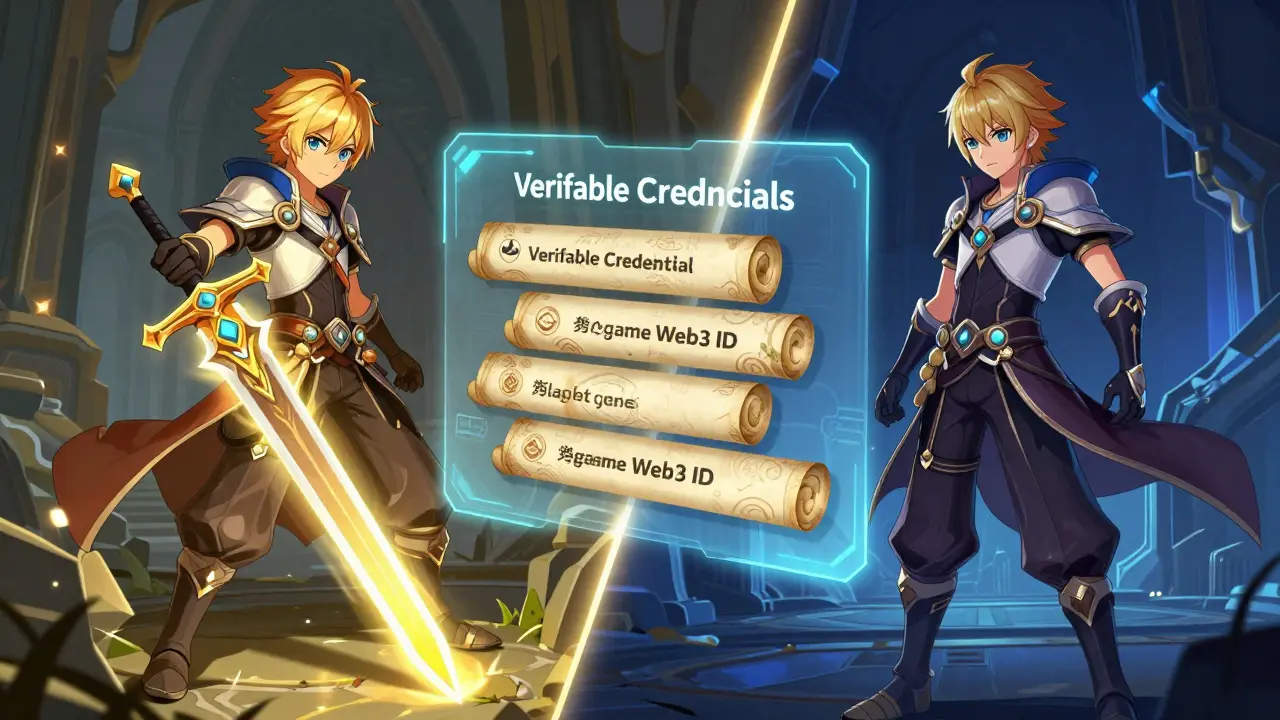
Gaming is another huge frontier. Many studios are moving toward cross-game identities. Instead of having ten different accounts for ten different games, you have one Web3 ID. Your achievements in one game could be issued as VCs, while your rare legendary sword is an NFT. When you move to a new game, the system recognizes your skill level via SSI and your gear via the NFT, giving you a tailored starting experience.
In the corporate world, loyalty programs are getting a makeover. About 41% of Fortune 500 companies are piloting these hybrid solutions. Instead of a plastic card with points, you get an NFT that evolves as you interact with the brand. To redeem a high-value reward, the company uses an SSI check to ensure the person claiming the reward is actually the original owner and meets specific residency or age requirements, preventing fraud in a way a simple token transfer cannot.
The Privacy Paradox: Public Ledgers vs. Private Lives
Here is where things get tricky. Blockchains are public by design. If you tie your real-world identity (SSI) directly to an NFT, everyone can see everything you own. If you buy a high-value asset, the whole world knows that "John Doe" just spent $50,000. This is why the industry is pivoting toward Zero-Knowledge Proofs (ZKPs). ZKPs allow you to prove a statement is true without revealing the data behind it.
For example, instead of showing the NFT itself, your wallet can generate a proof that says: "I own a token from this specific collection," without revealing which specific token number it is or which wallet address holds it. This balances the transparency of the blockchain with the privacy requirements of identity management. Without ZKPs, the integration of SSI and NFTs would be a privacy nightmare.
The Rise of Soulbound Tokens (SBTs)
If you're following the evolution of this space, you've likely heard of Soulbound Tokens (SBTs). Proposed by Vitalik Buterin, SBTs are essentially NFTs that cannot be transferred. They are "bound" to a specific identity. This is the ultimate bridge between SSI and NFTs. An SBT acts like a digital badge of honor or a permanent certification.
Think of an SBT as a non-tradable credential. If you earn a degree, it's issued as an SBT to your wallet. You can't sell your degree to someone else because the token is locked. This removes the "commercial" aspect of NFTs and turns them into purely "identiary" tools. By 2026, a huge majority of SSI developers are integrating SBTs because they solve the problem of "bought identities," where wealthy users simply purchase the credentials they want to fake.

Implementation Hurdles and Technical Reality
If you're a developer looking to build this, be prepared for some friction. It's not as simple as plugging in an API. The biggest headache is the lack of consistent credential formats across different networks. You might find that a VC issued on Polygon doesn't play nice with a wallet on Solana.
To get a basic SSI-NFT flow working, you'll need a wallet that supports JSON-LD signatures and a clear mapping of identity attributes to NFT metadata. You'll also need to decide on your "anchor." Some use a public blockchain for transparency, while others use permissioned networks like Hyperledger Indy for better compliance. Be warned: processing large sets of credentials can sometimes crash mobile wallets, as noted in recent developer reports. Optimization is key here.
Can I lose my identity if I lose my NFT wallet?
If your identity is tied strictly to a single wallet's private keys, then yes, losing those keys means losing access to those credentials. However, robust SSI frameworks use "key recovery" mechanisms and distributed guardianship, allowing you to recover your identity without needing the original seed phrase of a specific asset wallet.
Is an SBT the same thing as a Verifiable Credential?
Not exactly. A Verifiable Credential (VC) is a piece of data signed by an issuer that can exist off-chain. A Soulbound Token (SBT) is an on-chain token that cannot be transferred. You can think of an SBT as a way to "publish" a Verifiable Credential on the blockchain so that any smart contract can verify it instantly without needing an external API call.
Do I need a blockchain for SSI?
No. One of the biggest misconceptions is that SSI requires a blockchain. While blockchains are great for "anchoring" (providing a way to verify that a public key hasn't been revoked), SSI can operate using peer-to-peer encrypted exchanges. NFTs, however, absolutely require a blockchain to prove scarcity and ownership.
How does this impact my privacy?
It depends on the implementation. A naive integration where your real name is linked to your wallet address is a privacy disaster. However, using Zero-Knowledge Proofs (ZKPs) allows you to prove you own a certain NFT or possess a certain credential without revealing your identity or the specific asset, keeping your data private while remaining verifiable.
Which blockchains are best for SSI-NFTs?
Ethereum remains the standard for high-value assets, but Polygon and Solana are often preferred for identity applications due to lower transaction costs and faster verification speeds. The choice usually depends on whether you prioritize maximum security/liquidity (Ethereum) or scalability and user experience (Polygon/Solana).
What's Next for Your Digital Identity?
If you're just starting out, the first step is to move away from centralized logins. Look for wallets that support DIDs and start exploring the ecosystem of Verifiable Credentials. For developers, the focus should be on interoperability-building systems that don't lock users into a single chain. As the EU's eIDAS 2.0 framework begins to take effect, we'll likely see a surge in government-backed SSI credentials that can interact with the NFT assets we already own. The gap between "who you are" and "what you have" is closing, and that's a win for user autonomy.
Comments (24)
this stuff is actually pretty wild if you think about the UX implications... just imagine not having to deal with 2FA emails every time you log into something because your wallet just proves it's you
The integration of JSON-LD is where a lot of people trip up. If the schema isn't perfectly aligned between the issuer and the verifier, the whole credential check fails silently. It's a huge pain for devs right now.
Imagine thinking this is a 'revolution' 🙄. It's literally just a glorified database with more steps. The 'elite' Web3 crowd loves to overcomplicate things to feel smart while the actual utility is basically zero. 💅
I've been working with some of these frameworks and the interoperability is definitely the biggest hurdle. However, once we settle on a universal standard for VCs, it's going to be a game changer for professional licensing and certifications.
Absolute garbage. You think the 'government' is just gonna hand you an eIDAS 2.0 credential without embedding a backdoor for mass surveillance? This is just a fancy way to link your wallet's on-chain footprint to your real-world identity so the alphabet agencies can track every single satoshi you move. Wake up people, the ZKPs are just a smokescreen for the social credit system they're building in the background!
How quaint that we're still pretending that 'decentralization' isn't just another word for 'I have no customer support when I lose my keys.' I'm sure the 'autonomy' of owning a digital badge of honor will be a great comfort to everyone while they're locked out of their own identity.
I completely agree with the points made about the gaming industry and the potential for cross-game identities because it would save so much time for players who are tired of rebuilding their profiles from scratch in every new title and I think the synergy between SSI and NFTs is a very elegant solution to the trust problem in digital spaces.
ZKPs are a must!!! Without them, this is just a privacy disaster... period.
selective disclosure is the real winner here. getting rid of the 'all or nothing' approach to data sharing via zero knowledge proofs means we can finally kill the honeypot risk of centralized identity providers
There is something profoundly poetic about the idea of a 'soulbound' token. It transforms the cold, transactional nature of the blockchain into a living tapestry of our achievements and our essence! It's a digital rebirth of the human resume!
This sounds cool! I like the idea of not needing a plastic card.
Typical optimistic rubbish. The latency on these chains makes the 'instant' verification a joke. In the UK, we've seen plenty of 'innovations' that just add layers of bureaucracy under a different name. It's just more jargon for the same old inefficiency.
It can feel a bit overwhelming at first, but just taking it one step at a time with a good wallet makes it way easier. I'm here if anyone needs help figuring out which ones are safe to use.
Omg the idea of a legendary sword following me from game to game is literally a dream come true!! I can't wait to flex my gear in every single universe!! 🤩
hope people remember that not everyone has access to this tech yet... it would be nice to see these systems help people in underserved communities get their IDs recognized across borders
I believe this represents a significant step forward in user agency. By decoupling identity from corporate silos, we are fostering a more inclusive digital environment where merit and ownership are verifiable without compromise.
The audacity to suggest that the average person will manage their own private keys without losing them is staggering. We are moving from corporate incompetence to personal incompetence, and the industry is celebrating it as 'freedom.'
From a technical standpoint, the use of Hyperledger Indy for anchoring is often superior for enterprise compliance due to the permissioned nature of the ledger, though it sacrifices some of the censorship resistance found in public chains.
The distinction between SBTs and VCs is critical. On-chain verification allows for atomic transactions that off-chain VCs simply cannot support.
The geopolitical implications are massive, especially if we can leverage these standards to secure national identity frameworks against foreign adversarial interference while utilizing high-throughput L2 scaling solutions to ensure that the state's verification engine doesn't choke under the load of millions of concurrent requests during a national event.
Honestly, the part about 'bought identities' is so real. People will literally pay thousands just to look like they have a degree they didn't earn, and it's just disgusting how some people think that's a viable strategy in Web3.
i tried using one of these wallets last week and it totaly crashed my phone when i tried to load my credentials... definitely need more optimzation lol
It's interesting to see how different cultures might adopt this. In some places, a digital identity is more than a convenience; it's a lifeline.
Wait, so if I lose my wallet, I basically cease to exist digitally? That is actually terrifying but also kind of a vibe if you're trying to disappear from society! Haha!