

Remember when moving crypto between chains felt like a high-stakes gamble? You’d click “bridge,” hope the smart contract didn’t have a bug, and wait hours for your assets to appear. That era is over. In 2026, blockchain interoperability bridges are technical solutions that enable the seamless transfer of data and assets between different blockchain networks. They are no longer optional add-ons; they are the connective tissue holding the entire digital economy together.
We are living in a multi-chain world. Your assets might start on Ethereum, move to a Layer 2 rollup for speed, jump to Solana for gaming, and settle on an app-chain for specific utility. Without bridges, these ecosystems would remain isolated silos. With them, we see a unified experience where liquidity flows freely. The market reflects this shift dramatically. Projections show the bridge sector expanding from $202 million in 2024 to $911 million by 2032, growing at a compound annual rate of 22.5%. This isn’t just hype-it’s infrastructure maturation.
Why Bridges Are Now Critical Infrastructure
The reason behind this explosion is simple: users refuse to deal with fragmentation. If you want to use a decentralized finance (DeFi) application today, you expect it to work regardless of which chain your funds are on. About 65% of DeFi projects now rely on cross-chain bridges to enhance liquidity and user accessibility. Think about it-why should a trader choose a protocol because it’s on Polygon if their capital is on Arbitrum? Bridges remove that friction.
In 2026, cross-chain interoperability has become a fundamental expectation. It’s not a niche feature for developers anymore; it’s the default mode of interacting with cryptocurrency. Major platforms like Ethereum, Solana, and Polkadot have driven this demand by creating distinct environments that offer unique benefits but lack native communication. Over 40 new blockchain bridges launched in the past year alone, proving that builders are prioritizing connectivity over isolation.
Trusted vs. Trustless: The Security Shift
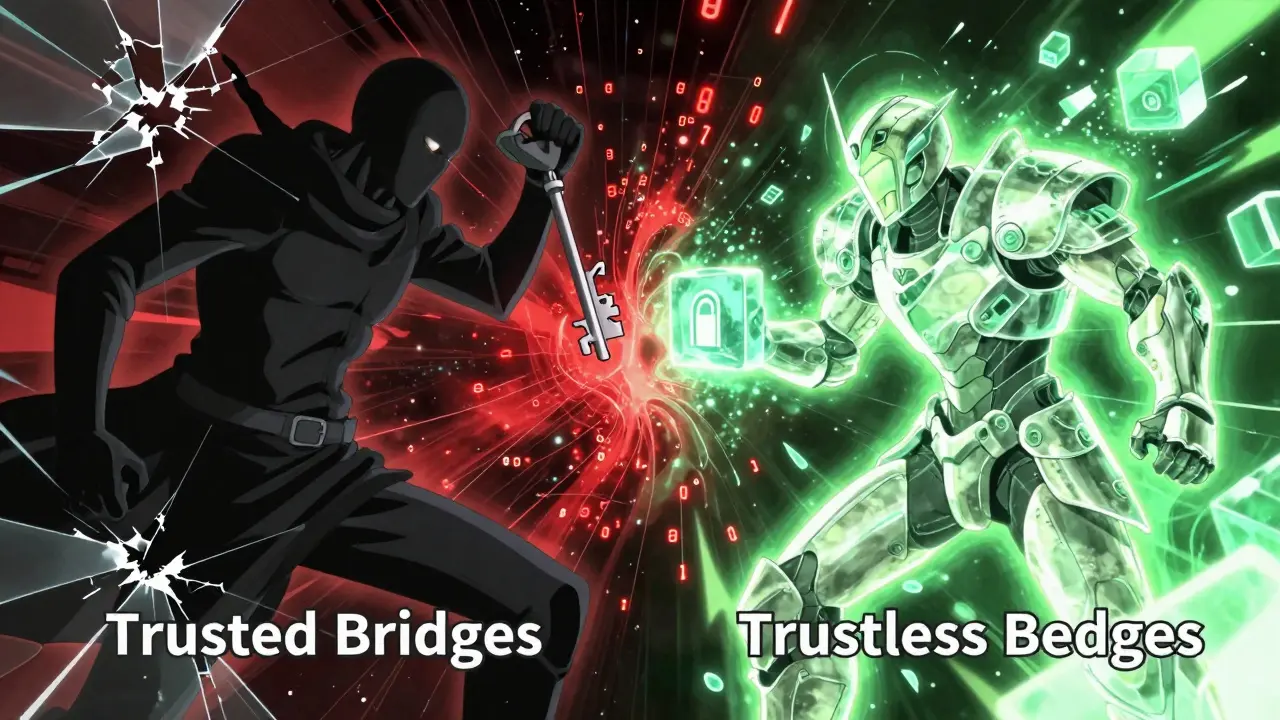
Not all bridges are created equal, and understanding the difference is crucial for anyone moving significant value. Historically, the market was dominated by trusted bridges. These rely on centralized intermediaries or multi-signature wallets to facilitate transactions. While faster, they introduce a single point of failure. If the central authority is hacked or acts maliciously, your funds are gone. We’ve seen this play out in several major exploits over the years.
The industry is rapidly pivoting toward trustless bridges. These operate through smart contracts for decentralized validation, removing human intermediaries from the equation. Projects like LI.FI and a leading bridge aggregator integrating over 20 bridges and DEXs across 60+ chains are driving this change. By leveraging smart contracts, trustless bridges ensure that no single entity controls the keys to your assets. This shift represents a significant trend in operational defense, as security becomes the primary metric for adoption rather than just speed or cost.
However, the line is blurring. New architectures combine elements of both. For instance, some systems use decentralized oracle networks to verify events on one chain before triggering actions on another, balancing security with efficiency. As we move toward 2032, the goal is to make trustless bridging as fast and cheap as trusted options, eliminating the trade-off entirely.
The Rise of Bridge Aggregators
If you’re manually selecting a bridge for every transaction, you’re doing it wrong. The most powerful development in this space is the rise of bridge aggregators. These platforms don’t just offer one path; they scan dozens of bridges and decentralized exchanges (DEXs) to find the best route for your specific transfer.
LI.FI is a pioneer in bridge aggregation, providing structural advantages through comprehensive ecosystem connectivity. It integrates more than 20 bridges and 20 DEX-aggregators. When you want to swap ETH on Ethereum for USDC on Arbitrum, LI.FI doesn’t just bridge it; it combines bridging with swapping functionality. This creates a cross-chain swap experience that is often cheaper and faster than using two separate tools. Similarly, Symbiosis Finance offers an all-in-one cross-chain solution combining bridging with AMM functionality across 30+ networks, supporting everything from Bitcoin to non-EVM environments.
This aggregation model dominates the market because it solves the liquidity fragmentation problem. Instead of each bridge needing deep liquidity pools on every chain, aggregators route orders to where the liquidity exists. This structural advantage allows them to capture significant value as the market matures. For users, it means better rates, lower fees, and fewer failed transactions.
New Architectures: Native Bridges and Omnichain Assets
The way assets launch and move is undergoing a structural transition. We are moving away from the old “lock-and-mint” design, where tokens were locked on Chain A and wrapped versions were minted on Chain B. Instead, we are seeing “mint-and-burn” solutions and, increasingly, omnichain native bridges.
Chains like Plasma and Monad are embedding interoperability providers at their core. For example, Monad uses Wormhole to power native bridge frontends, ecosystem connectivity, and asset minting via token standards. This means assets can exist natively across multiple chains without needing wrapped counterparts. LayerZero is another key player here, enabling universal messaging and asset transfers across heterogeneous blockchains.
This evolution reduces constraints and enhances benefits. When an asset is truly omnichain, settlement becomes cheaper, faster, and effectively 1:1 across multiple chains. Over time, these standards are expected to play a central role in crypto’s clearing infrastructure. Imagine a future where any asset issued on the same token standard can be settled seamlessly at a 1:1 ratio, regardless of the underlying chain. That is the trajectory we are on.
Key Players Shaping the Market
The landscape is highly fragmented, with specialized providers and major platforms competing for dominance. Here is how the key players stack up:
| Provider | Primary Focus | Key Feature | Network Support |
|---|---|---|---|
| Binance Bridge | High-volume transfers | Robust security protocols | Ethereum, BSC, others |
| Avalanche Bridge | Asset transfers | Sub-second finality | Ethereum, Avalanche |
| Allbridge Core | Stablecoin mobility | EVM to non-EVM focus | Multiple EVM & Non-EVM |
| Symbiosis | Cross-chain swaps | MPC node network | 30+ networks, 15,500+ assets |
| LI.FI | Aggregation | Best-route optimization | 60+ chains via integrations |
Binance leads in volume, processing massive amounts of asset transfers between Ethereum and Binance Smart Chain. Ava Labs’ Avalanche Bridge has gained traction for its speed, offering sub-second finality for transfers between Ethereum and Avalanche. Meanwhile, Allbridge Core specializes in stablecoins, addressing the most frequently bridged asset class due to its critical role in DeFi positioning and yield strategies. These examples show that specialization is still viable, even as aggregators grow.

Future Trends: Intent-Based Bridging and Chain Abstraction
What does the next phase look like? The current reality is that complex applications already operate across tens of chains, and liquidity moves seamlessly among them. But the user experience can still be clunky. The next wave involves intent-based bridging and chain abstraction.
Intent-based bridging allows users to specify what they want to achieve (“I want to buy this NFT on Chain B using ETH from Chain A”) rather than how to do it. The system then coordinates multiple complex actions in a single flow. This removes the need for users to understand gas fees, slippage, or intermediate steps. ERC-7683 is an interoperability standard emerging to support universal order types and cross-chain settlements, laying the groundwork for this functionality.
Chain abstraction goes further, hiding the complexity of blockchains entirely. Users interact with a unified interface, while the backend handles the routing across chains. This is essential for mass adoption. If everyday users cannot distinguish between Ethereum, Solana, or Polygon, then interoperability has succeeded. We are also seeing vaults that unify credit across chains and real-world assets (RWAs) accessible from any chain. These developments suggest a future where blockchain boundaries become invisible to the end-user.
Regulatory Considerations and Compliance
As cross-chain activity expands, compliance expectations matter more than ever. Bridge protocols must operate across jurisdictions with different rules while preserving decentralization goals and minimizing custody risk. For institutional workflows, bridging stablecoins connects to cross-border settlement and treasury operations. Institutions need to move tokenized cash equivalents across execution environments securely and compliantly.
Regulatory clarity is becoming a driver of growth, not just a hurdle. Protocols that integrate identity verification and transaction monitoring without compromising privacy will have a competitive edge. The World Economic Forum projects that in 2026, multi-chain ecosystems will allow public, private, and permissioned blockchains to work together seamlessly. This implies a hybrid model where enterprise-grade compliance meets decentralized innovation.
Conclusion: The Path to 2032
By 2032, blockchain interoperability will not be a “feature”; it will be the foundation. The market’s acceleration from $202 million to nearly $1 billion reflects this inevitability. We are moving from a fragmented ecosystem to a unified global computer. Bridges are the wires connecting the servers. As technology matures, security improves, and standards like ERC-7683 take hold, the friction of moving value will disappear. For developers, this means building once and deploying everywhere. For users, it means a seamless financial experience. The future of blockchain is interconnected, and bridges are making it possible.
What is the difference between trusted and trustless bridges?
Trusted bridges rely on centralized intermediaries or multi-signature wallets to validate transactions, introducing a single point of failure. Trustless bridges use smart contracts and decentralized validation mechanisms, ensuring no single entity controls the assets. Trustless bridges are generally considered more secure but can sometimes be slower or more expensive depending on the architecture.
Why are bridge aggregators important for users?
Bridge aggregators like LI.FI scan multiple bridges and decentralized exchanges to find the most efficient route for your transaction. This results in better exchange rates, lower fees, and higher success rates compared to using a single bridge directly. They solve the problem of liquidity fragmentation by routing orders to where the depth exists.
What is ERC-7683 and why does it matter?
ERC-7683 is an emerging interoperability standard that supports universal order types and cross-chain settlements. It matters because it enables intent-based bridging, allowing complex actions to be coordinated in a single flow. This simplifies the user experience and lays the groundwork for chain abstraction, where users don't need to manage individual chain interactions.
How do omnichain assets differ from wrapped tokens?
Wrapped tokens are copies of an asset created on a different chain after the original is locked on the source chain. Omnichain assets, enabled by new token standards and providers like LayerZero, exist natively across multiple chains simultaneously. This allows for 1:1 settlement ratios and eliminates the risks associated with wrapped assets, such as depegging or bridge hacks.
Is cross-chain bridging safe in 2026?
Safety depends on the type of bridge used. Trustless bridges and reputable aggregators significantly reduce risk by removing centralized custodians. However, users should always verify the security audits of the protocols they use, prefer non-custodial solutions, and stay updated on the latest security practices. The industry has improved drastically, but due diligence remains essential.