
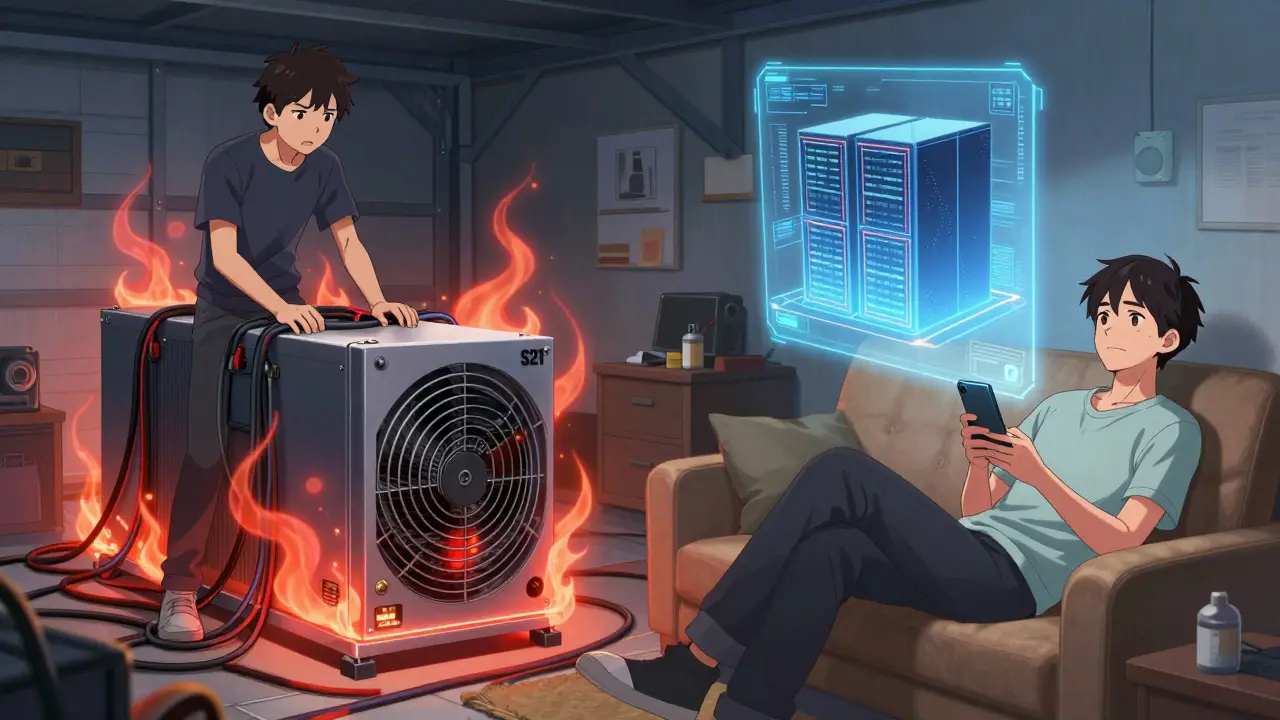
You want to mine Bitcoin. You’ve heard the stories of people getting rich overnight, but you also know the reality is messy, loud, and expensive. The big question isn’t just *if* you should mine-it’s *how*. Do you buy a noisy, power-hungry machine for your garage (home mining), or do you rent computing power from a remote data center (cloud mining)?
This isn’t a simple choice between ‘easy’ and ‘hard.’ It’s a trade-off between control and convenience, upfront cost and hidden fees, risk and reward. In 2026, the gap between these two methods has widened. Electricity prices are rising in many regions, hardware is getting more efficient but more expensive, and cloud providers are tightening their contracts. If you pick the wrong path, you could end up losing money instead of making it.
Let’s cut through the hype. We’ll look at the real costs, the technical hurdles, and the profit margins so you can decide which approach fits your situation.
The Core Difference: Ownership vs. Renting
At its heart, Home Mining is the practice of purchasing and operating your own cryptocurrency mining hardware, such as ASICs or GPUs, to validate transactions on a blockchain network. You own the machine. You plug it into your wall. You deal with the heat, the noise, and the maintenance. When the block reward comes in, it’s yours-minus electricity.
Cloud Mining is a service model where users lease hashing power from remote data centers operated by third-party providers, paying a fee to receive a share of the mining rewards without owning physical hardware. You don’t touch a machine. You sign a contract, pay an upfront fee, and receive payouts based on the hash rate you rented. The provider handles the electricity, cooling, and repairs.
Think of it like buying a house versus renting an apartment. Buying (home mining) gives you equity and control, but you’re responsible for every leaky pipe and broken window. Renting (cloud mining) means someone else fixes the roof, but you’re paying a premium for that convenience, and you never build ownership.
| Feature | Home Mining | Cloud Mining |
|---|---|---|
| Upfront Cost | High ($2,500-$4,200 per unit) | Low to Medium ($100-$5,000+ depending on contract) |
| Ongoing Costs | Electricity only (varies by region) | Maintenance fees + contract renewal costs |
| Control | Full (firmware, pool selection, settings) | Limited (provider dictates terms) |
| Technical Skill Required | High (setup, networking, troubleshooting) | None (click-to-start interface) |
| Risk Profile | Hardware failure, electricity spikes | Provider fraud, contract opacity, exit scams |
| Profit Potential | Higher if electricity is cheap (<$0.10/kWh) | Capped by provider fees; better if electricity is expensive |
The Real Cost of Home Mining in 2026
If you choose home mining, your biggest enemy isn’t the hardware-it’s the electric bill. Modern ASIC miners like the Bitmain Antminer S21 are incredibly efficient, but they still draw massive amounts of power. A single S21 consumes around 3,000 watts. That’s roughly equivalent to running ten space heaters at once.
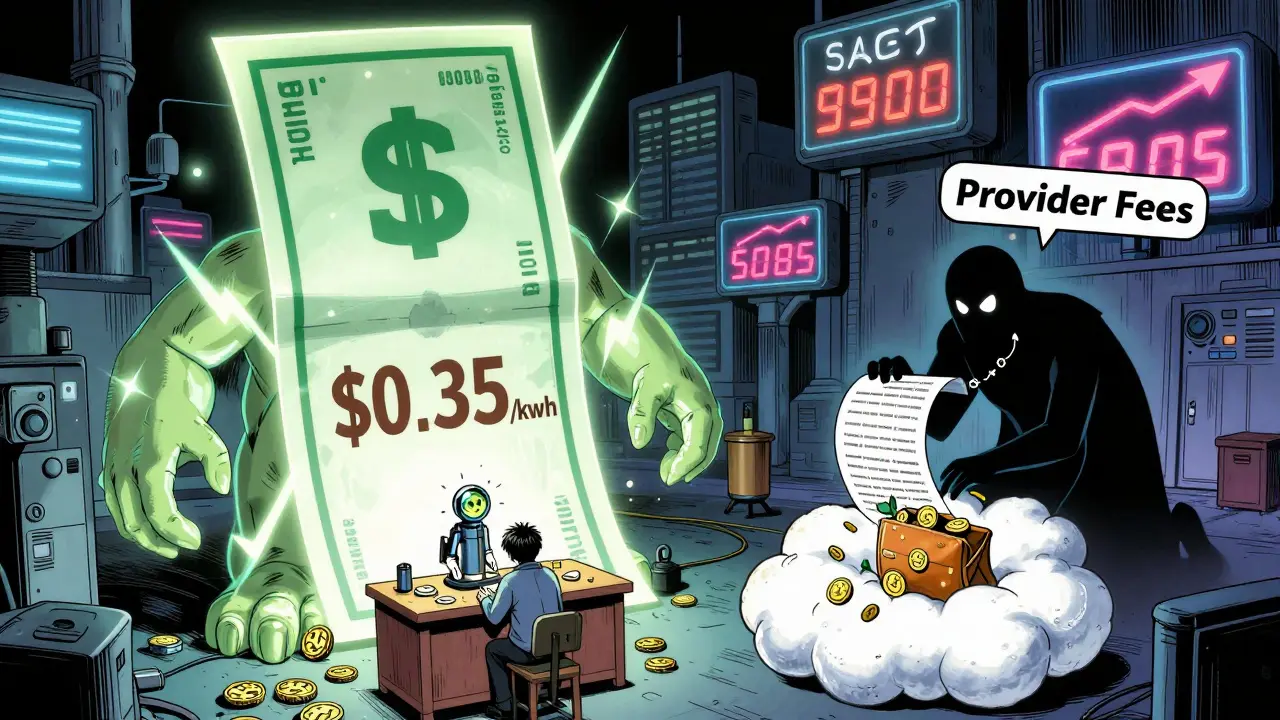
Here’s the math that matters: if you pay $0.12 per kWh (the U.S. average), running one S21 24/7 costs about $108 per month in electricity alone. If you live in Hawaii or parts of California, where rates hit $0.35/kWh, that same miner burns $315 a month before you make a cent in Bitcoin.
But if you have access to cheap power-say, $0.04/kWh in Washington State or solar setups in Texas-the story changes completely. At those rates, your monthly electricity cost drops to $36. Suddenly, the revenue from mining (which fluctuates with Bitcoin’s price and network difficulty) starts looking profitable. According to data from ViaBTC in late 2024, miners with electricity below $0.07/kWh saw their S21 units break even in under 10 months.
Beyond electricity, there are hidden costs:
- Hardware depreciation: ASICs lose value fast. An S19j Pro bought for $1,200 might be worth $400 after two years.
- Cooling and ventilation: These machines emit over 3,000 BTU of heat per hour. Without proper airflow, they throttle down or fail.
- Noise: Even newer models like the Canaan Avalon A1466 Pro run at 45 dB, which is quieter than older units but still louder than a vacuum cleaner. Most people can’t keep them in the living room.
Home mining is a business. Treat it like one. Calculate your breakeven point before plugging anything in.
How Cloud Mining Actually Works (And Where It Fails)
Cloud mining sounds easier because it is. You go to a platform like Bitdeer or ViaBTC, select a hash rate package, pay upfront, and start earning daily payouts. No fans, no wires, no technical headaches.
But here’s the catch: you’re not buying mining power. You’re leasing it under strict terms. Providers charge two main fees:
- Hash rate cost: Typically $0.08-$0.15 per TH/s per day.
- Maintenance fee: Usually $0.04-$0.08 per TH/s per day, covering electricity and upkeep.
These fees eat into your profits. For example, if you rent 100 TH/s for 360 days, you might pay $4,000 upfront. Over the year, maintenance fees alone could total $1,460-$2,920. Compare that to a home miner who pays only electricity-and if that electricity is cheap, the home miner keeps more of the reward.
More importantly, cloud mining carries significant counterparty risk. In 2023, 63% of fraudulent crypto platforms disguised themselves as cloud mining services. Users lost an average of $1,850 each when these sites vanished. Even legitimate providers can fail. If a provider runs out of cash during a Bitcoin crash, they may delay payouts or shut down entirely.
Also, you have zero control. You can’t switch mining pools to find better fees. You can’t undervolt your rig to save energy. You’re locked into the provider’s terms, which often include clauses allowing them to reduce your hash rate without notice.
Profitability Showdown: Who Wins?
So, which method makes more money? The answer depends entirely on your local electricity cost.
According to Blockchain.com’s Mining Calculator (updated November 2024), here’s how it breaks down:
- If electricity is above $0.15/kWh: Cloud mining is 27-33% more profitable. Why? Because industrial-scale farms negotiate bulk electricity rates far below residential prices.
- If electricity is below $0.10/kWh: Home mining delivers 15-20% higher returns. You avoid maintenance fees and benefit directly from any drop in network difficulty or rise in Bitcoin price.
There’s another factor: market cycles. During bull markets, when Bitcoin doubles in price, home miners see immediate profit expansion. Their fixed costs stay the same, but revenue skyrockets. Cloud mining contracts, however, remain fixed-cost obligations. You paid for 100 TH/s at the start of the contract-you don’t get extra power just because Bitcoin went up.
Conversely, in bear markets, cloud mining can feel safer. Your losses are capped at the contract price. With home mining, if Bitcoin crashes and difficulty stays high, you’re still paying electricity bills on a machine that generates little income.
Technical Barriers: Are You Ready?
Home mining isn’t just about buying a box. It requires skills most people don’t have.
You need to understand electrical safety. A modern ASIC needs a dedicated 15-20 amp circuit. Plugging multiple units into standard outlets is a fire hazard. You need to configure static IPs, set up mining software like BBMiner or Braiins OS+, and monitor temperatures remotely.
ViaBTC’s 2024 survey found that 78% of new home miners needed external help during setup. The learning curve spans 40-60 hours. But once you’re running, you gain deep knowledge that pays off. You can tweak firmware to improve efficiency by 12-15%, as shown in case studies from MiningRigRentals.
Cloud mining requires none of this. Bitdeer lets you start mining within 15 minutes of payment. But that simplicity comes at a cost: you’re dependent on their support team. While Bitdeer resolves 82% of tickets within 48 hours, 33% of users report communication breakdowns during disputes. And if the site goes down, you’re stuck waiting.

Risks You Can’t Ignore
Both methods carry serious risks. Ignoring them is how people lose money.
For home miners:
- Hardware failures are common. Power supply units (PSUs) fail in 32% of cases, according to Reddit community polls.
- Thermal throttling reduces performance by 27% if cooling is inadequate.
- Regulatory changes can kill profitability. California’s Assembly Bill 1816 imposes extra fees on residential electricity use above 2,000 kWh/month, squeezing home miners.
For cloud miners:
- Fraud is rampant. The Blockchain Association found 22% of cloud platforms had opaque ownership structures.
- Exit scams happen. Providers may stop paying when Bitcoin drops.
- SEC regulations now classify some cloud contracts as unregistered securities, forcing platforms to leave the U.S. market.
Always verify proof-of-mining infrastructure. Legitimate providers show real-time hash rate stats and allow third-party audits. If a site hides its location or server details, walk away.
Which Path Should You Choose?
Ask yourself three questions:
- What is my electricity cost? Below $0.10/kWh? Lean toward home mining. Above $0.15/kWh? Cloud mining may be smarter.
- Do I have technical skills? If yes, home mining offers greater control and long-term gains. If no, cloud mining removes the learning curve-but accept lower returns.
- How much risk can I tolerate? Home mining risks hardware failure and regulatory shifts. Cloud mining risks fraud and provider collapse. Neither is safe, but one aligns better with your comfort level.
In 2026, the trend is clear: cloud mining is growing due to rising complexity and energy costs, projected to reach 35% market share by 2026. But home mining remains viable for skilled operators in low-cost regions, holding 10-12% of the network hash rate.
There’s no perfect choice. Only the right choice for your circumstances.
Is cloud mining legal in the United States?
Yes, but with restrictions. The SEC classified certain cloud mining contracts as unregistered securities in October 2024, causing 17 platforms to cease U.S. operations. Legitimate providers must comply with financial regulations, offer transparent terms, and provide verifiable proof of mining infrastructure. Always check if a platform is registered with state authorities before investing.
Can I mine Bitcoin with a GPU at home?
Not profitably. Since the 2017 Ethereum merge, GPU mining has become largely unprofitable for Bitcoin due to ASIC dominance. GPUs are still used for altcoins like Ravencoin or Ergo, but Bitcoin mining requires ASICs like the Antminer S21 or Avalon A1466 Pro. Attempting to mine Bitcoin with a GPU will result in negligible earnings and high electricity costs.
What happens if my home miner breaks down?
You bear the full cost of repair or replacement. Unlike cloud mining, where the provider handles maintenance, home miners must diagnose issues, order parts, and perform repairs. Common failures include power supply units (PSUs), cooling fans, and control boards. Warranty coverage varies by manufacturer, but Bitmain typically offers 12-18 months of limited warranty on new ASICs.
Are cloud mining contracts renewable?
Most contracts are fixed-term, ranging from 30 to 360 days. Renewal is optional but often discouraged due to declining hash rate efficiency over time. Bitdeer reported only 41% user renewal beyond initial terms in Q3 2024. Some platforms offer auto-renewal options, but these come with renewed fees and no guarantee of improved profitability.
How do I verify a cloud mining provider is legitimate?
Look for three things: real-time hash rate statistics, verifiable data center locations, and third-party audit reports. Legitimate providers like Bitdeer and ViaBTC publish operational metrics and allow independent verification. Avoid platforms that hide ownership details, lack customer reviews, or promise unrealistic returns. Check Trustpilot ratings and Reddit discussions for red flags.
Can I combine home and cloud mining?
Yes, many experienced miners diversify across both methods. This spreads risk: if one ASIC fails, cloud contracts continue generating income. Conversely, if a cloud provider shuts down, home rigs maintain steady output. However, managing both increases complexity and capital requirements. Start with one method, master it, then consider expansion.
What is the best ASIC miner for home use in 2026?
The Bitmain Antminer S21 remains the top choice for efficiency, delivering 190-200 TH/s at 3,000W. For budget-conscious buyers, the S19j Pro (100 TH/s) offers decent performance at lower cost. Newer models like the Canaan Avalon A1466 Pro prioritize noise reduction (45 dB) for residential use. Always calculate ROI based on your local electricity rate before purchasing.
Does cloud mining contribute to decentralization?
No. Cloud mining centralizes hash power among large providers, reducing network decentralization. Home mining distributes computational power across individual operators, supporting a healthier blockchain ecosystem. Regulatory bodies increasingly view concentrated cloud mining as a systemic risk, potentially leading to stricter oversight in the future.