

Staking vs Mining Profitability Calculator
Your Inputs
Staking Overview
Staking requires only a wallet and crypto holdings with no specialized hardware. With platforms like Coinbase, you can start with just $1. Earnings are stable and predictable with minimal operational costs.
Results
When you first hear about earning crypto just by holding it, it sounds too good to be true. Why would anyone pay you for doing nothing? But that’s exactly what staking does-no loud fans, no electricity bills, no $10,000 machines. Mining, on the other hand, still feels like the old-school version: expensive, noisy, and exhausting. If you’re trying to get into crypto beyond just buying Bitcoin, understanding the difference between staking and mining isn’t just useful-it’s essential. And right now, the barrier to entry couldn’t be more different between the two.
What You Actually Need to Start
Mining Bitcoin or other Proof of Work coins means buying hardware that’s built for one thing: solving math problems. The best ASIC miners today, like the Bitmain Antminer S21 Hyd, cost over $12,500. Even if you go cheaper with GPUs, you need at least six NVIDIA RTX 4090s just to compete. That’s $9,600 before you even plug it in. Then there’s the electricity. Each rig uses between 3,200 and 5,500 kWh per month. At $0.10 per kWh, that’s $320 to $550 every single month-just to keep the machine warm. And it’s not like you can turn it off on weekends. These things run 24/7, needing constant cooling, clean air, and stable power. Most people don’t realize they’ll need to upgrade their home circuitry just to handle it. Staking? You need a wallet and some crypto. That’s it. No special hardware. No cooling system. No electrician. You can stake Ethereum with 32 ETH-which is around $104,000 right now-but you don’t have to do it alone. Most people use staking pools or exchanges like Coinbase, Lido, or Kraken. With Coinbase, you can start with just $1. On Cardano, you can stake with 10 ADA, which is less than 40 cents. Even a $50 investment gets you in the game. Your laptop or a $55 Raspberry Pi is all you need to run the software. The energy used? About 15 to 30 watts. That’s less than a lightbulb.Costs That Don’t Show Up on the Price Tag
Mining’s hidden costs are brutal. You’re not just paying for electricity-you’re paying for noise, heat, and wear and tear. One Reddit user spent $8,200 on ASIC miners and made $320 in profit after three months-after paying for power. That’s less than 4% return on hardware alone. And ASICs don’t last. They become unprofitable in 12 to 18 months. By then, you’re stuck with a brick you can’t sell for more than $1,000. Mining isn’t an investment-it’s a high-risk utility bill with crypto as a side effect. Staking doesn’t have those same operational costs. There’s no monthly power bill. No maintenance. No replacement parts. The only cost is the price of the crypto you lock up. And even that isn’t gone forever. You can usually unstake after a short waiting period. Some platforms even let you trade your staked tokens as derivatives-like stETH on Lido-so you can use them in DeFi while still earning rewards. You’re not losing access to your money. You’re just locking it temporarily to help secure the network.Who Can Actually Do This?
Mining is no longer for individuals. It’s for factories. The top 10 mining pools now control over 83% of Bitcoin’s total computing power. That means if you’re not part of a massive operation with cheap power in Kazakhstan, Texas, or Georgia, you’re competing against corporate-scale machines. The average person doesn’t stand a chance. And with countries like China banning mining outright and the EU forcing carbon offsets at $50 per ton, the legal and environmental hurdles keep rising. Staking is global. You don’t need cheap electricity. You don’t need a warehouse. You just need internet. The biggest staking nations today are the U.S., Germany, and the UK. In the UK alone, over 8% of all validators are based here. That’s because anyone with a smartphone and a crypto wallet can participate. Students, retirees, small business owners-they’re all staking. A user on Reddit said they started with $50 on Coinbase Earn and earned $2.30 a month. It’s not life-changing money, but it’s risk-free income. No hardware to break. No bills to pay. Just passive growth.
Technical Skills: A Night and Day Difference
Mining is a technical nightmare. You need to know how to install drivers, configure mining software, set up cooling, monitor temperatures, and troubleshoot hardware failures. Coin Bureau’s 2025 survey found 78% of miners needed professional IT help just to get started. You’re not just learning crypto-you’re learning electrical engineering on the fly. One user on Bitcoin Talk spent weeks trying to get his rig to stop overheating. He finally gave up and sold the hardware for scrap. Staking is the opposite. If you can log into a wallet, click a button, and confirm a transaction, you can stake. Coinbase’s staking onboarding takes under two minutes and requires four clicks. No terminal commands. No config files. No IP addresses. ChainLabo’s research shows 89% of stakers didn’t need to learn any new technical skills. The hardest part? Choosing which coin to stake. That’s it.What Happens When Things Go Wrong?
Mining failures are expensive. A power outage for an hour? Your rig shuts down. You lose potential earnings. A fan dies? Your ASIC overheats and fries. Replacement parts are hard to find, and shipping takes weeks. And if your electricity rate goes up? Your profit vanishes overnight. Staking has its own risks-but they’re different. The biggest one is slashing. If your validator node goes offline for too long-say, more than four hours-you can lose a small portion of your stake. One Ethereum validator lost 0.5 ETH ($1,625) because their server crashed. That’s painful. But it’s rare. Most people use professional staking services that handle uptime for you. And even if you do get slashed, you’re not losing your entire investment. You’re losing pennies, not thousands.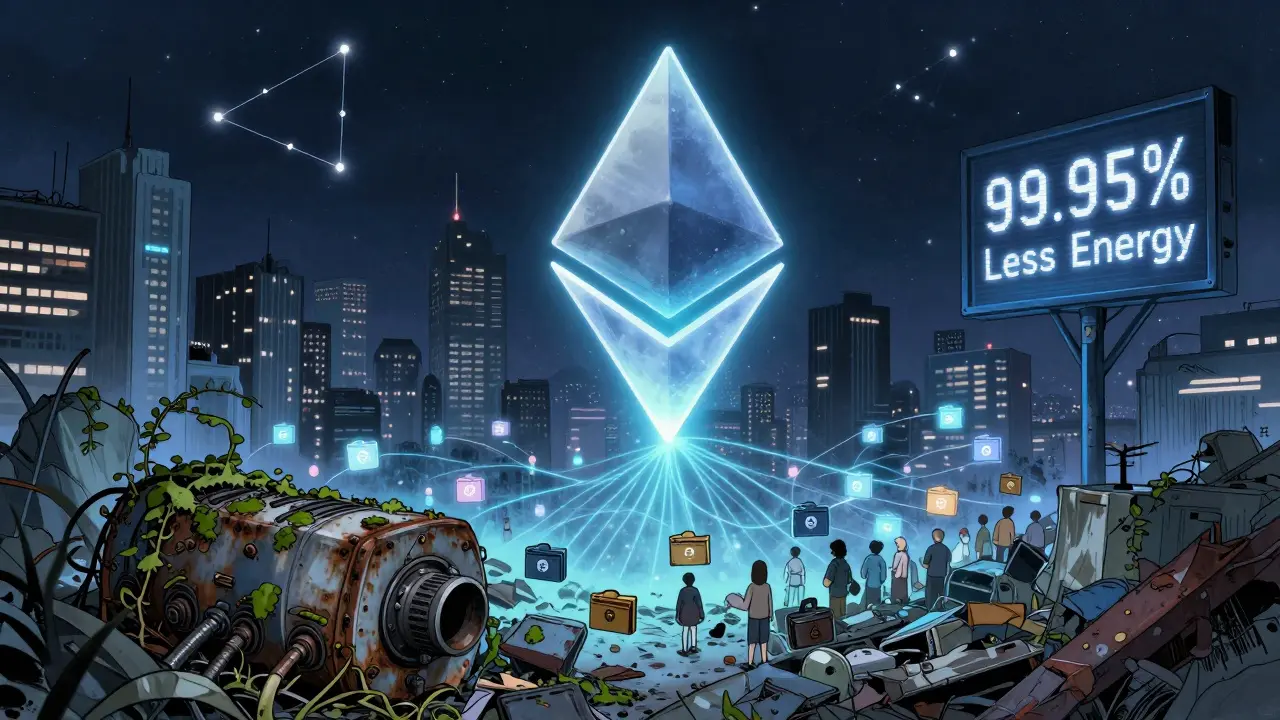
Where the Industry Is Headed
Ethereum’s switch to Proof of Stake in 2022 changed everything. Before the Merge, Ethereum used as much energy as the entire country of the Netherlands. After? It dropped to the level of a small town. That’s a 99.95% reduction. It wasn’t just a technical upgrade-it was a moral one. Investors, regulators, and everyday users all started favoring networks that didn’t burn power like a coal plant. Now, 29% of the top 100 cryptocurrencies use Proof of Stake. That’s up from 19% in 2020. Meanwhile, Proof of Work’s share has dropped from 55% to 38%. Gartner predicts 80% of new blockchains will use staking-based models by 2027. Even big companies are jumping in. JPMorgan, Microsoft, and IBM are all staking crypto. Not mining. Staking. Why? Because it’s efficient, sustainable, and scalable. The future isn’t about who can afford the most powerful rig. It’s about who can afford to hold the most tokens. And with staking pools and liquid staking derivatives, even someone with $100 can now act like a validator. The rich still earn more-but now, the poor can earn something too.So What Should You Do?
If you’re thinking about getting into crypto beyond buying and holding, staking is the clear choice for almost everyone. It’s cheaper, easier, cleaner, and more accessible. Mining only makes sense if you’re already in the energy business, have access to near-free power, and treat it like a full-time industrial operation. For the rest of us? It’s a money pit. Start small. Pick a coin you already hold-Ethereum, Cardano, Polkadot. Use Coinbase, Kraken, or Lido. Stake $10. See how it feels. Earn a few dollars a month. Learn how it works. Then scale up. You’re not risking your life savings. You’re not buying a machine that’ll be obsolete in a year. You’re just participating in a network that’s changing how money works. The barriers to entry in crypto used to be high. Now, they’re disappearing. Staking didn’t just lower the barrier-it tore it down.Can I mine crypto at home and still make money in 2025?
Almost no. Home mining is no longer profitable for Bitcoin or most major Proof of Work coins. The cost of electricity, hardware, and cooling far outweighs the rewards unless you have access to industrial-scale power at under $0.05 per kWh. Even then, ASIC miners depreciate quickly and become unprofitable within 12-18 months. Most home miners end up losing money after paying bills. Staking is a far better option for individuals.
Do I need 32 ETH to stake Ethereum?
No. While 32 ETH is the amount needed to run your own validator node, most people use staking pools like Lido or Coinbase, which let you stake any amount-even $1. These platforms combine your ETH with others to meet the 32 ETH threshold, and you earn proportional rewards. Your ETH remains liquid through derivatives like stETH, which you can trade or use in DeFi while still earning staking rewards.
Is staking safer than mining?
Staking is safer in terms of cost, complexity, and environmental impact. You don’t risk hardware failure or massive electricity bills. But there’s a different risk: slashing. If your validator goes offline for too long, you can lose a small portion of your stake. However, using reputable staking services like Coinbase or Lido eliminates this risk because they manage uptime for you. Mining carries higher financial and operational risks with no similar safety nets.
Which is better for beginners: staking or mining?
Staking is vastly better for beginners. It requires no technical knowledge, no special equipment, and no upfront investment beyond the crypto you already own. Mining demands expensive hardware, electrical upgrades, constant monitoring, and troubleshooting. Beginners who try mining often lose money. Those who start with staking learn how blockchain networks work without the stress or cost.
Can I stake any cryptocurrency?
No, only cryptocurrencies that use Proof of Stake or similar consensus mechanisms allow staking. Ethereum, Cardano, Polkadot, Solana, and Avalanche all support it. Bitcoin, Dogecoin, and Litecoin do not-they still use Proof of Work. Always check if a coin is stakable before buying. Most major exchanges list which coins you can stake directly in their app.
Are staking rewards taxable?
In many countries, including the U.S. and U.K., staking rewards are treated as taxable income when you receive them. The value of the crypto at the time you earn it is added to your income for that year. Some countries are considering changes-like the SEC’s proposed ‘Staking Safe Harbor’ in late 2025-but as of now, you should track your rewards and report them. Always consult a tax professional familiar with crypto.
Will mining disappear completely?
Not entirely, but it will become niche. Bitcoin will likely remain Proof of Work because its security model relies on massive computational power. Other PoW coins may survive if they serve specific use cases or have strong communities. But for new projects, staking is the default. Over 80% of new blockchains launching after 2025 are expected to use staking. Mining’s days as a mainstream way to earn crypto are over.
How much can I realistically earn from staking?
Annual returns vary by coin. Ethereum staking yields around 3-5%. Cardano offers 2-4%, and Polkadot gives 12-15%. These are annualized rates, not monthly. So if you stake $1,000 in Ethereum, you’d earn about $30-$50 per year. It’s not get-rich-quick money, but it’s passive income with no effort. Compare that to mining, where you might earn $50 a month but spend $400 on electricity.
Staking isn’t just easier-it’s the future. Mining was the first step. Staking is the next one.
Comments (13)