

Back in September 2021, thousands of crypto users signed up for what looked like a simple chance to get free tokens: the SMAK airdrop on CoinMarketCap. For a few days, you could claim SMAK tokens just by following a few steps on CoinMarketCap’s platform. It felt like free money - and for a while, it was. But what happened after the airdrop ended tells a much darker story about how most crypto projects fail to turn hype into real adoption.
What Was the SMAK Airdrop?
The SMAK X CoinMarketCap airdrop was a promotional campaign by Smartlink, a decentralized escrow platform built on the Tezos blockchain. The goal? Give away $20,000 worth of SMAK tokens to users who participated. The campaign ran from September 13 to September 23, 2021. It wasn’t hidden - Smartlink pushed it hard on YouTube and social media, even releasing videos a week before the airdrop went live to build buzz. Participants had to complete basic tasks: follow Smartlink’s social accounts, join their Telegram group, and verify their CoinMarketCap profile. Nothing complicated. No KYC, no wallet deposits. Just a few clicks. Around 10,000 people claimed tokens. That’s a lot of attention for a brand-new project. Smartlink positioned SMAK as the fuel for its escrow service. The idea was simple: if you wanted to safely trade crypto, NFTs, or digital goods without trusting a middleman, Smartlink would hold your funds in a smart contract until both sides fulfilled their side of the deal. It was meant for C2C, B2C, and even B2B transactions. You’d pay fees in SMAK, and holding the token gave you discounts. It sounded practical. But practical doesn’t always mean popular.Why Tezos? And Why Did It Matter?
Smartlink chose Tezos over Ethereum or Solana for one big reason: low fees and energy efficiency. Tezos uses a proof-of-stake system called Liquid Proof of Stake (LPoS), which keeps transaction costs under $0.01. That’s a huge advantage for a platform built around small, frequent escrow transactions. Imagine paying $5 in gas fees just to lock $20 in a smart contract - that kills usability. Tezos solved that. But here’s the catch: Tezos was (and still is) a niche chain. Most users don’t hold Tezos-based assets. Most exchanges don’t list them. Most DeFi apps don’t support them. So even if Smartlink built a solid escrow tool, users had to first buy XTZ, bridge it to Smartlink’s platform, and then use SMAK. That’s three steps too many for the average person.The Token’s Price Collapse - A Reality Check
Here’s where things went off the rails. After the airdrop, SMAK traded briefly at around $0.02. That’s not crazy for a new token. But by January 2022, it dropped to $0.004. By mid-2023, it was below $0.001. As of December 2025, SMAK trades at $0.000113 to $0.000137 - a 99% drop from its post-airdrop high. The numbers don’t lie. The 24-hour trading volume is $0.00. That means nobody is buying or selling. The token is dead on the markets. Even Gate.io, one of the few exchanges that still lists SMAK, shows almost no activity. The token’s supply is also confusing: CoinMarketCap says 305 million SMAK are circulating. Other sources say zero. That kind of inconsistency destroys trust. Worse, over the last seven days, SMAK lost 47% of its value. Over the last month? Down 60%. This isn’t a slow decline - it’s a freefall. And it’s not because of market-wide crashes. Bitcoin and Ethereum have been stable. SMAK is collapsing on its own.
What Went Wrong? No One Used the Platform
Here’s the brutal truth: the airdrop didn’t create users. It created speculators. People claimed the tokens, dumped them on exchanges, and moved on. They didn’t try the escrow service. They didn’t list items on the marketplace. They didn’t use the payment gateway. They didn’t even hold the token to get fee discounts. Smartlink’s product was real. But it solved a problem most people didn’t feel. Web 3.0 escrow sounds great in theory. In practice, most people still use PayPal, Venmo, or even crypto-to-crypto trades with no escrow at all. Why? Because friction matters. If you’re buying a digital art NFT, you’re not going to wait 3 days for a smart contract to release funds. You’re going to use OpenSea’s built-in escrow - or trust the seller. Smartlink never cracked user onboarding. No tutorials. No support. No marketing after the airdrop. The team vanished from social media. The website stopped updating. The Discord server went quiet. When a project stops talking after the airdrop, it’s a red flag.Why CoinMarketCap Didn’t Save It
CoinMarketCap is trusted. Millions use it daily. Airdrops on CoinMarketCap used to be a golden ticket. But in 2021, everyone was doing them. Thousands of projects ran airdrops. CoinMarketCap became a crowded marketplace for free tokens. Users didn’t care which project they claimed - they just wanted to claim as many as possible. Smartlink got exposure, yes. But exposure doesn’t equal adoption. CoinMarketCap doesn’t verify project quality. It doesn’t track if users actually use the product. It just lists the airdrop. So Smartlink got thousands of wallets with SMAK tokens - and zero active users.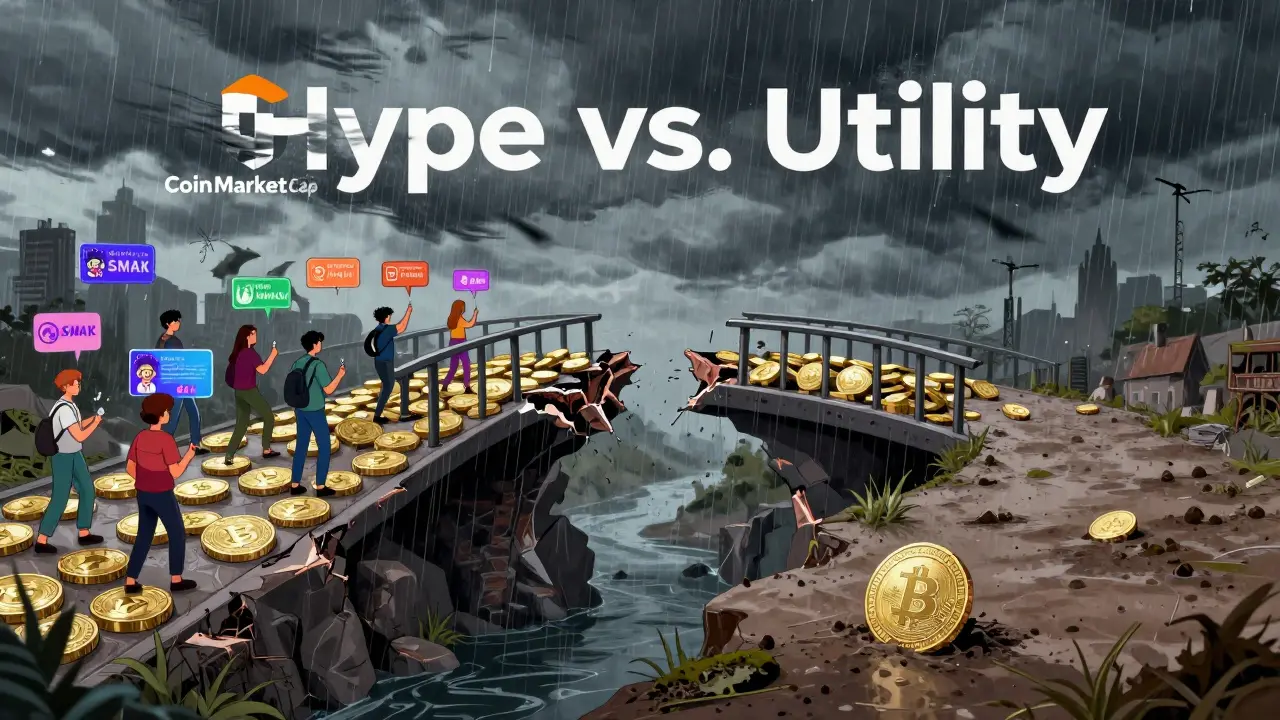
The Bigger Lesson: Airdrops Don’t Build Projects
This isn’t just about SMAK. It’s about the entire crypto airdrop culture. Projects think: “If we give away tokens, people will love us.” But that’s backwards. People don’t love tokens. They love products that solve real problems. SMAK had a solid idea - decentralized escrow for Web 3.0. But it never built a product people wanted to use. It didn’t fix a pain point. It didn’t make transactions easier. It didn’t reduce risk better than existing tools. It just gave away tokens. Compare it to projects like Uniswap or Compound. They didn’t rely on airdrops to survive. They built tools people needed - and then rewarded users for using them. Smartlink did the opposite. They rewarded users for signing up - and then disappeared.Where Is SMAK Now?
As of late 2025, SMAK is essentially dead. No new development. No team updates. No exchange listings beyond Gate.io. No community activity. The token is still listed on CoinMarketCap, but it’s a ghost. The blockchain still records transactions - but no one is making them. The $20,000 airdrop didn’t fail because of bad timing. It failed because the product had no real users. No utility. No reason to stay. If you’re thinking about joining a future airdrop, ask yourself: “Will I actually use this?” If the answer is no, don’t bother. Claiming free tokens is fun - but holding onto them when they’re worthless? That’s a lesson in patience you don’t want to learn the hard way.What You Can Learn From SMAK’s Failure
- Airdrops are marketing tools, not business models.
- Low fees on Tezos won’t save a product nobody uses.
- Token supply discrepancies? That’s a warning sign.
- If a project stops posting after the airdrop, it’s already dead.
- Don’t chase free tokens - chase real utility.
Was the SMAK airdrop real?
Yes, the SMAK airdrop on CoinMarketCap was real and ran from September 13 to September 23, 2021. It distributed $20,000 worth of SMAK tokens to participants who completed basic tasks like following Smartlink’s social media and verifying their CoinMarketCap profile. Thousands claimed tokens, but the project failed to retain users afterward.
Can I still claim SMAK tokens from the airdrop?
No, the airdrop ended in September 2021. The claim period is long closed. Any website or social media post claiming you can still claim SMAK tokens is a scam. The original campaign page on CoinMarketCap has been archived.
Is SMAK worth holding today?
As of December 2025, SMAK trades at around $0.00012, with zero trading volume. The project has no active development, no team updates, and minimal exchange support. Holding SMAK offers no utility, no rewards, and no upside. It’s effectively a dead asset. Selling it is the only rational choice.
Why did Smartlink choose Tezos for SMAK?
Smartlink chose Tezos because of its low transaction fees (under $0.01 per transaction) and energy-efficient proof-of-stake system. This made it ideal for a decentralized escrow service that needed to handle many small, frequent transactions without high gas costs. However, Tezos’ small user base limited adoption, since most crypto users don’t hold or use Tezos-based assets.
What was the purpose of the SMAK token?
The SMAK token was designed as the native utility token for Smartlink’s ecosystem. It was meant to be used for paying escrow fees, earning rewards for acting as an escrow agent, and participating in platform governance. Holding SMAK was supposed to give users discounts on transaction fees. But since almost no one used the platform, the token never gained real utility.
Why is there confusion about SMAK’s circulating supply?
There’s a major discrepancy between sources. CoinMarketCap reports a circulating supply of 305 million SMAK tokens, but other blockchain explorers show a supply of zero. This likely means the token was either never fully deployed, locked away, or the data was misreported. Such inconsistencies erode trust and are common in failed crypto projects.
Did Smartlink ever launch its marketplace or payment tools?
Smartlink announced a decentralized marketplace and payment processing tools as part of its ecosystem. But there’s no evidence these were ever fully launched or used by real customers. The website is outdated, no transaction data exists on the blockchain, and community forums are silent. The escrow service may have been tested internally, but it never reached public adoption.
Is there any chance SMAK will recover?
Almost certainly not. Recovery requires active development, team engagement, exchange listings, and user growth - none of which exist. The token has been inactive for years. Even if someone bought all the remaining supply, there’s no infrastructure to support it. SMAK is a historical footnote, not an investment opportunity.
Comments (17)