

Imagine you’re sitting on a massive profit from a Bitcoin rally. The market is volatile, and one wrong move could wipe out your gains. You need to park that value somewhere safe, but you also want to keep earning yield or be ready to jump back into trades instantly. This is where stablecoins come in. They are the bedrock of decentralized finance (DeFi) and cryptocurrency trading, offering the stability of fiat currency with the speed and programmability of blockchain assets.
But not all stablecoins are created equal. Some are backed by cash in a bank account, others by overcollateralized crypto, and some use complex derivatives strategies. Choosing the wrong one can mean missing out on yield, facing unexpected depegs, or dealing with centralization risks. In this guide, we break down the best stablecoins for DeFi and trading in 2026, helping you decide which ones fit your strategy.
Why Stablecoin Selection Matters in DeFi
In traditional finance, you might move money between checking and savings accounts. In DeFi, your choice of stablecoin determines your access to liquidity, the fees you pay, and the yields you earn. A stablecoin isn’t just a store of value; it’s a tool. If you’re providing liquidity on a decentralized exchange like Uniswap, using a stablecoin with low liquidity might result in high slippage, eating into your profits. If you’re lending on Aave, different stablecoins offer different interest rates based on supply and demand.
The total stablecoin market cap has surpassed $150 billion, representing a critical infrastructure layer for the crypto economy. With over $50 billion locked in DeFi protocols, the choice of stablecoin directly impacts your financial health. We need to look at three main categories: fiat-collateralized, crypto-collateralized, and synthetic stablecoins. Each has distinct advantages and risks.
Fiat-Collateralized Giants: USDC and USDT
When people talk about stablecoins, they usually start with USDC (USD Coin) and USDT (Tether). These are fiat-collateralized, meaning for every token in circulation, there should be an equivalent amount of US dollars or cash equivalents held in reserve. This model offers the highest price stability because it’s directly tied to real-world assets.
USDC is often the go-to for traders who prioritize transparency and regulatory compliance. Issued by Circle, USDC provides monthly attestations from accounting firms like Grant Thornton, giving users confidence in its backing. It has over $30 billion in circulation and dominates liquidity pools on many centralized exchanges and DeFi platforms. For large trades, USDC typically offers the tightest spreads and lowest slippage. However, this convenience comes with centralization risks. Circle can freeze addresses if required by law enforcement, which contradicts the censorship-resistant ethos of crypto for some users.
USDT, issued by Tether, remains the most widely used stablecoin by volume. It’s deeply integrated into almost every exchange and trading pair. While it offers immense liquidity, concerns about the transparency of its reserves have persisted since its inception. Despite these concerns, its sheer dominance makes it indispensable for certain trading strategies, especially on older or less regulated platforms. If you’re day trading and need instant execution across multiple venues, USDT is often unavoidable.
| Feature | USDC | USDT |
|---|---|---|
| Issuer | Circle | Tether |
| Backing | Cash & Short-term Treasuries | Cash & Commercial Paper |
| Transparency | Monthly Attestations | Quarterly Reports |
| Centralization Risk | High (Freezable) | High (Freezable) |
| Best For | Regulatory Compliance, Large Trades | Maximum Liquidity, Exchange Pairs |
The Decentralized Standard: DAI
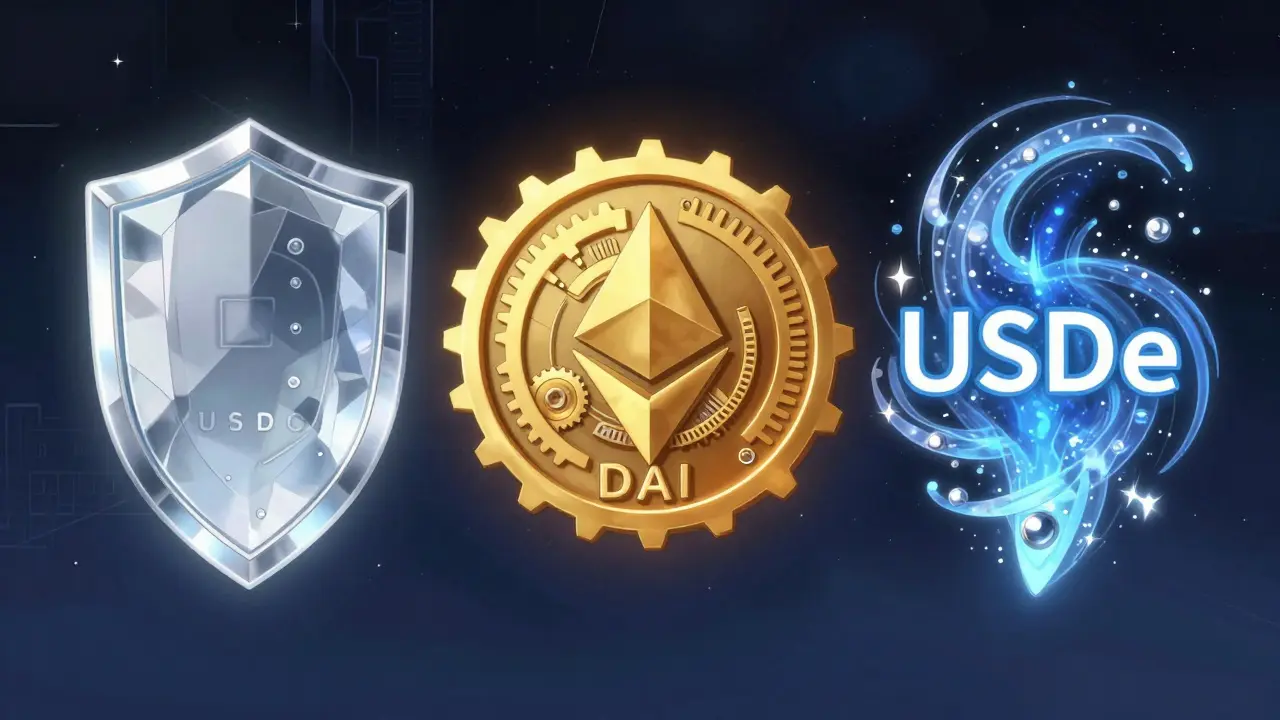
If you value decentralization above all else, DAI is likely your best option. Created by MakerDAO, DAI is a crypto-collateralized stablecoin. Instead of holding cash in a bank, users lock up Ethereum (ETH) and other cryptocurrencies in smart contracts to mint DAI. To account for volatility, DAI requires overcollateralization-typically around 150% to 200%. This means if you want to mint $100 worth of DAI, you must deposit at least $150 worth of collateral.
This mechanism ensures that even if the underlying crypto crashes, there’s enough buffer to cover the DAI debt. DAI is governed by MKR token holders, making it resistant to single points of failure. It integrates seamlessly with over 400 DeFi protocols, including Compound and MakerDAO. One recent development is MakerDAO’s transition to the Sky protocol, aimed at improving governance and efficiency while maintaining DAI’s stability. For users worried about government intervention or bank failures, DAI offers a truly decentralized alternative. However, managing DAI can be slightly more complex if you’re minting it yourself, as you need to monitor collateral ratios to avoid liquidation.
Synthetic Yield: Ethena’s USDe
A newer player has emerged in 2025 and gained significant traction in 2026: USDe from the Ethena protocol. USDe is a synthetic dollar, not backed by fiat or direct crypto collateral, but by a delta-neutral strategy. When you buy USDe, Ethena holds an equivalent amount of Ethereum in spot markets and shorts Ethereum perpetual futures contracts. This hedges against price movements, keeping the value stable relative to the USD.
The big draw here is yield. Because Ethena earns funding rates from the short positions, it passes a portion of that yield back to USDe holders. As of 2026, USDe has offered attractive annual percentage yields (APYs) ranging from 8% to 15%, depending on market conditions. This makes it incredibly popular among yield farmers. However, this complexity introduces new risks. Smart contract bugs, exchange insolvency, or extreme market dislocations could threaten the peg. Users should understand that they are taking on counterparty risk with the exchanges and protocols involved. It’s not for the faint of heart, but for those comfortable with DeFi mechanics, the rewards can be substantial.
Trading Efficiency: Curve Finance and Slippage
When trading stablecoins, slippage-the difference between the expected price and the executed price-is your enemy. Curve Finance was built specifically to solve this. Its automated market maker (AMM) algorithm is optimized for assets that trade near parity, like stablecoins. Curve processes over $100 million in daily stablecoin volume across 13 blockchain networks, offering slippage under 0.1% for trades up to $100,000.
If you’re moving large amounts between USDC, USDT, and DAI, Curve is often the most cost-effective route. It minimizes the impact of your trade on the pool’s price, ensuring you get close to the $1:$1 ratio you expect. For smaller trades, aggregators like 1inch can split orders across multiple DEXs to find the best rate, further reducing costs.

Risks and Considerations for 2026
No stablecoin is without risk. Algorithmic stablecoins, which relied on code rather than collateral to maintain their peg, suffered a catastrophic collapse with TerraUSD (UST) in 2022. While hybrid models like FRAX have adjusted to include more collateral, pure algorithmic mechanisms remain largely distrusted. Regulatory landscapes are also shifting. The EU’s MiCA regulation has increased demand for compliant stablecoins like USDC, while the US continues to develop comprehensive legislation. Always diversify your stablecoin holdings. Don’t put all your eggs in one basket. Holding a mix of USDC for liquidity, DAI for decentralization, and perhaps a small amount of USDe for yield can balance risk and reward.
How to Choose the Right Stablecoin
Your choice depends on your primary goal. Are you looking for safety, yield, or decentralization? Here’s a quick decision framework:
- For Maximum Safety & Simplicity: Stick with USDC. It’s transparent, widely accepted, and easy to buy on major exchanges.
- For Decentralization & Censorship Resistance: Choose DAI. It’s governed by a community and doesn’t rely on a central issuer.
- For High Yield & Advanced Strategies: Consider USDe. Understand the delta-neutral mechanics and accept the higher complexity.
- For Day Trading & Liquidity: Use USDT or USDC depending on the exchange pairs available.
Remember, DeFi is evolving rapidly. Stay informed about protocol updates, such as MakerDAO’s Sky migration or new features from Ethena. Regularly review your exposure and adjust your strategy as market conditions change.
What is the safest stablecoin for DeFi?
USDC is generally considered the safest due to its full fiat backing and regular audits. However, for users prioritizing decentralization and resistance to censorship, DAI is the top choice. Safety also depends on how you store them; using hardware wallets adds an extra layer of security.
Can I earn yield on stablecoins?
Yes. You can lend stablecoins on platforms like Aave or Compound to earn interest. Alternatively, synthetic stablecoins like USDe offer built-in yields through delta-neutral strategies. Providing liquidity on Curve Finance also generates fees and CRV tokens.
What is the risk of using USDe?
USDe carries smart contract risk and counterparty risk. Since it relies on hedging strategies involving perpetual futures, extreme market volatility or exchange issues could potentially affect its peg. It is more complex than fiat-backed stablecoins and requires understanding of derivatives.
Is DAI better than USDC?
It depends on your priorities. DAI is better if you want decentralization and no central point of failure. USDC is better if you prioritize regulatory compliance, transparency, and ease of use on centralized exchanges. Both are highly reputable and widely used in DeFi.
How do I swap stablecoins with low slippage?
Use specialized AMMs like Curve Finance, which are designed for stablecoin swaps. For optimal pricing, use aggregators like 1inch that route your trade across multiple decentralized exchanges to minimize slippage and gas fees.