

You deposited your hard-earned tokens into a centralized exchange (CEX) expecting easy trading and quick fiat conversion. But did you realize that technically, those coins aren't yours while they sit on the platform? This is the core of centralized exchange token risks. Unlike holding keys in your own wallet, a CEX holds them for you. That convenience comes with hidden dangers: hacks, frozen withdrawals, and regulatory surprises. Understanding these vulnerabilities isn't just for tech experts; it's essential for anyone keeping significant value in crypto.
The Custodial Trap: Why Your Keys Matter Less Here
Centralized Exchanges are platforms where a central authority facilitates the buying, selling, and trading of digital assets through a custodial model. The biggest risk starts with custody. When you use a service like Binance or Coinbase, you hand over your private keys. In traditional banking, if the bank fails, the government often steps in. In crypto, there is no such safety net unless the exchange specifically insures its assets, which is rare and limited.
This creates a "single point of failure." If the exchange gets hacked, goes bankrupt, or faces sudden legal trouble, your access to funds can vanish instantly. Remember Mt. Gox? It collapsed in 2014 after losing 850,000 BTC. More recently, FTX impacted 1.2 million users across 180 countries. These aren't hypothetical scenarios; they are documented history. The fundamental conflict is that until you withdraw to self-custody, you are trusting a third party with total control over your assets.
Hacks and Security Vulnerabilities: The $3.8 Billion Problem
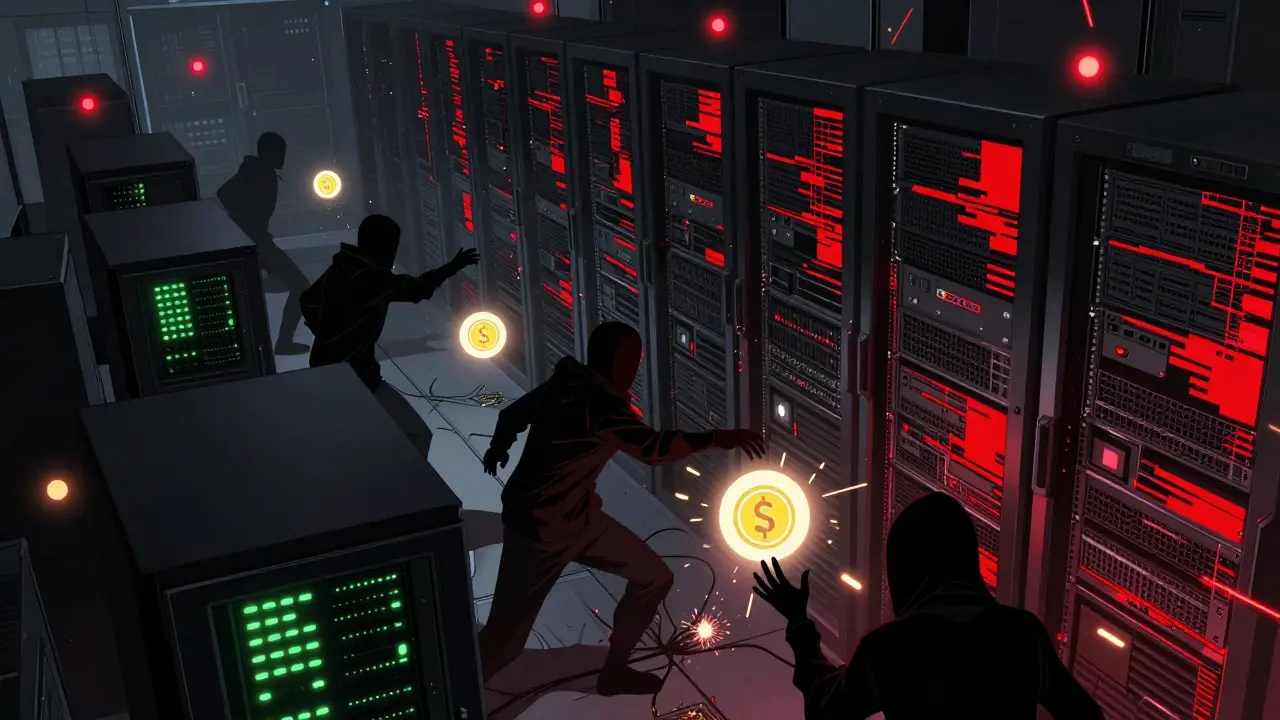
Security breaches remain the most visible threat. According to Chainalysis' 2024 Crypto Crime Report, exchanges accounted for 100% of the $3.8 billion stolen through breaches in 2023. Why do hackers target them so heavily? Because they hold massive pools of unsecured assets.
- Inadequate Cold Storage: The recommended practice is to keep 95% or more of assets in cold storage (offline). However, the average exchange only keeps about 63% offline, leaving a significant portion vulnerable to online attacks.
- Patching Delays: CoinGecko’s 2023 Exchange Security Index found that the average time to fix known vulnerabilities is 47 days. In the fast-moving world of crypto, that’s an eternity for hackers.
- Social Engineering: It’s not always code that fails. In Q1 2024, a fake Google Ads scam stole $85 million from users of 12 major exchanges by tricking them into clicking fake support links.
Dr. Michal Zandberg, CTO at Chainalysis, noted that 68% of recent hacks exploited known vulnerabilities that should have been patched. This suggests that many losses are preventable but ignored due to cost or complexity.
Operational Risks: Withdrawals, Support, and Trust
Even without a hack, operational failures can lock you out of your money. Have you ever tried to withdraw during a market crash? Many users recall the May 2021 volatility when Coinbase restricted withdrawals, affecting 1.2 million users. This is a classic operational risk: the platform works fine in calm times but struggles under pressure.
Support quality varies wildly. Tier-1 exchanges (those processing over $1 billion daily) have an average response time of 8.2 hours. Tier-3 exchanges can take up to 72 hours. If something goes wrong, that delay can be costly. Furthermore, transparency is low. Only 27% of exchanges publish detailed security whitepapers as required by new regulations like MiCA. Kraken leads with 92 pages of documentation, while others offer minimal overviews. This lack of clarity makes it hard for you to verify if your funds are actually safe.
Regulatory Shifts: How Laws Impact Your Tokens
Regulation is no longer just paperwork; it directly affects your ability to trade and withdraw. The EU’s MiCA regulations, effective June 2024, require exchanges to maintain minimum capital reserves of €150,000 and implement real-time monitoring. While this adds stability, it also increases compliance costs, which might be passed on to users via fees.
In the U.S., the SEC filed 57 enforcement actions against exchanges in 2023, up from 29 in 2022. This aggressive stance can lead to sudden changes in how exchanges operate. For example, Binance had to exit Canada in 2023 due to regulatory pressure. If your favorite exchange loses its license in your country, what happens to your tokens? Often, you face forced liquidations or lengthy withdrawal processes. Regulatory arbitrage remains a risk, especially for smaller exchanges operating in jurisdictions with lax oversight.
CEX vs. DEX: Comparing the Risk Profiles
Many users ask if they should switch to Decentralized Exchanges (DEXs) to avoid these risks. The answer isn't simple. DEXs eliminate custodial risk because you never give up your keys. However, they introduce smart contract risks and lower liquidity.
| Risk Factor | Centralized Exchange (CEX) | Decentralized Exchange (DEX) |
|---|---|---|
| Custodial Risk | High (Platform holds keys) | None (User holds keys) |
| Hack Frequency (2023) | $3.8B stolen | $0 stolen (via exchange breach) |
| Liquidity | Very High ($13.5T volume in 2023) | Moderate (Uniswap: $54B monthly) |
| User Experience | Easy onboarding, fiat ramps | Complex, requires gas fees |
| Smart Contract Risk | Low (Proprietary code) | High (Open-source bugs) |
| Regulatory Exposure | High (Directly regulated) | Variable (Often unregulated) |
For beginners, CEXs are still the best entry point due to ease of use. But for long-term holders, moving assets to self-custody (like hardware wallets) is the safest bet. Institutional investors are already doing this; 68% of firms managing over $100 million in crypto use third-party custodians like Fireblocks instead of exchange wallets.

How to Mitigate Your Token Risks Today
You don’t have to quit CEXs entirely, but you need to change how you use them. Think of them as tools for trading, not vaults for saving. Here are practical steps to reduce your exposure:
- Use Hardware Wallets: Move long-term holdings to a Ledger or Trezor. Only 12% of users do this, but it eliminates custodial risk.
- Enable Strong 2FA: Avoid SMS verification. Use an authenticator app or hardware key. Only 41% of users currently use apps, while 59% rely on vulnerable SMS codes.
- Whitelist Addresses: Most exchanges allow you to whitelist specific withdrawal addresses. This prevents funds from being sent to a hacker’s address if your account is compromised.
- Diversify Across Platforms: Don’t keep all your eggs in one basket. Split assets between two reputable exchanges and a self-custody wallet.
- Monitor Insurance Policies: Check if the exchange offers insurance. Kraken launched real-time hack insurance covering 100% of assets up to $1 million per user in April 2024. Verify these terms carefully.
It takes 3-5 hours to set up these protections initially, plus 15-20 minutes monthly for reviews. Is it worth it? Given that 87% of users were unaware their funds weren’t FDIC-insured, the answer is yes.
Frequently Asked Questions
Are centralized exchange tokens insured?
Generally, no. Unlike banks, crypto exchanges do not offer FDIC insurance. Some platforms like Kraken offer limited internal insurance (up to $1M per user), but most do not. Always check the specific terms of service for any coverage details.
Which is safer: CEX or DEX?
It depends on the risk type. DEXs are safer from custodial hacks since you hold your keys, but they carry smart contract risks. CEXs are easier to use and have higher liquidity but introduce counterparty risk. For pure asset safety, self-custody is superior to both.
What happened in the WazirX hack?
In November 2023, WazirX suffered a $235 million breach. Customer support took 17 days to respond, and many users reported receiving little to no compensation. This incident highlighted the systemic risks in emerging market exchanges where insurance coverage is typically low (15-25% of assets).
How much should I keep on a centralized exchange?
Only what you plan to trade in the short term (e.g., next few weeks). For long-term investments, move assets to a hardware wallet or institutional-grade custodian. A common rule of thumb is to keep less than 10-20% of your portfolio on any single CEX.
Do regulations like MiCA make exchanges safer?
Yes, significantly. MiCA requires minimum capital reserves and real-time monitoring, reducing the likelihood of insolvent operations. However, it also increases compliance costs, which may lead to higher fees or consolidation among smaller exchanges.