

When you're looking for a crypto exchange in 2026, you don't just want another platform that says it's "secure" and "easy." You want to know if it actually works - for real people, with real money, in real markets. That’s the question behind CODEX Exchange. Is it a legit option, or just another name in a crowded field with little proof to back it up?
CODEX Exchange markets itself as a one-stop shop for crypto trading. It claims to offer everything from buying Bitcoin with a credit card to leveraged margin trades and even decentralized exchange features. Sounds impressive? Maybe. But here’s the problem: there’s almost no public data to verify any of it.
What CODEX Exchange Actually Offers
Based on what’s available, CODEX Exchange tries to cover every major feature modern traders expect:
- Fiat Gateway: Lets you deposit and withdraw traditional currencies like USD, EUR, or GBP directly into your account. No need to buy crypto first on another exchange.
- Credit Card Purchases: You can buy Bitcoin, Ethereum, and other top coins instantly using your debit or credit card - useful for beginners who want to get started fast.
- Margin and Leverage Trading: Allows users to trade with borrowed funds, up to 10x leverage. This is advanced stuff. It can multiply profits, but also losses. Not for beginners.
- Decentralized Exchange (DEX) Mode: Claims to offer a non-custodial trading option. That means you keep control of your keys. But there’s zero detail on how this works, which blockchains it supports, or what wallets are compatible.
- Launchpad: Lets users participate in new token sales. No public list of projects that have launched here. No track record. No transparency.
- OTC Trading: For large trades ($10K+), CODEX offers over-the-counter deals. This is common among institutional players, but again - no info on minimums, pricing, or how it’s handled.
- Desktop and Mobile Apps: Available for Windows, macOS, iOS, and Android. But user reports on app stability, speed, or bugs are nonexistent.
On paper, it looks like CODEX is trying to be the Swiss Army knife of crypto exchanges. But without details on fees, supported coins, or how security actually works, it’s hard to trust the specs.
The Missing Details - And Why They Matter
Every major exchange publishes clear answers to these questions:
- Which countries can use it?
- What are the trading fees? (maker/taker, withdrawal fees)
- How many cryptocurrencies are listed?
- What’s the minimum deposit?
- Is KYC required? How strict is it?
- Where are funds stored? Cold wallets? Insurance?
CODEX Exchange gives none of this. Not even a rough estimate.
They say they have "all necessary licenses." Which ones? From where? The UK? The EU? The Cayman Islands? No answer. Compare that to Coinbase, which clearly states it’s licensed in 100+ countries and regulated by the SEC, FinCEN, and state-level agencies. Or Kraken, which is licensed in the U.S., EU, Canada, and Australia. CODEX’s silence on regulation is a red flag.
Even more concerning: there are only two user reviews on Cryptogeek. Both give it a 3 out of 5. That’s average - but with only two data points, it’s meaningless. A real platform with thousands of users has hundreds of reviews across Trustpilot, Reddit, and crypto forums. CODEX doesn’t.
Is it because it’s new? Maybe. But in 2026, even new exchanges like MEXC or CoinEx have hundreds of active users and public feedback. CODEX has none. That’s not just quiet - it’s suspicious.
How CODEX Compares to the Competition
Let’s put CODEX next to two well-known exchanges:
| Feature | CODEX Exchange | Coinbase | Kraken |
|---|---|---|---|
| Trading Fees | Unknown | 0.00% - 0.60% | 0.00% - 0.26% |
| Supported Countries | Unknown | Over 100 | Over 190 |
| Supported Cryptocurrencies | Unknown | 200+ | 250+ |
| KYC Required | Unknown | Yes | Yes |
| Leverage Trading | Up to 10x | Up to 3x | Up to 5x |
| Decentralized Trading | Claimed, but no details | No | No |
| User Reviews | 2 reviews (3/5) | 10,000+ reviews | 8,000+ reviews |
| Regulatory Transparency | None | High | High |
CODEX’s only advantage? It claims to offer both centralized and decentralized trading in one place. But without knowing how the DEX side works - whether it’s just a thin wrapper around a third-party protocol or something real - it’s a marketing gimmick, not a feature.
Meanwhile, Coinbase and Kraken have proven track records. They’ve survived market crashes, regulatory crackdowns, and hacks. CODEX has no history. Zero.

Security: What We Know (and What We Don’t)
Crypto exchanges live or die by trust. And trust comes from transparency.
Coinbase stores 98% of user funds in cold storage. Kraken uses multi-sig wallets and has a $750M insurance fund. Both publish regular proof-of-reserves audits.
CODEX says nothing. No cold storage details. No insurance. No audits. No security whitepaper. No bug bounty program. No penetration test results.
If you’re depositing thousands into CODEX, you’re trusting a black box. That’s not a platform - it’s a gamble.
Who Is CODEX Exchange Really For?
There are only two types of people who might consider CODEX:
- Early adopters who don’t mind risk: If you’re the type who tried Solana or Avalanche when they were new, and you’re okay with losing money if it fails - maybe you’ll give CODEX a small test deposit.
- People in restricted regions: If you live in a country where Coinbase or Kraken aren’t available, and you’re desperate for a fiat gateway, CODEX might be your only option - even if it’s unproven.
For everyone else? There’s no reason to choose CODEX over the alternatives.
Let’s say you’re in the UK. You want to buy Ethereum with GBP. You can use Coinbase, Kraken, or even Revolut. All have lower fees, better support, and proven security. Why risk your funds on a platform with two reviews and zero transparency?
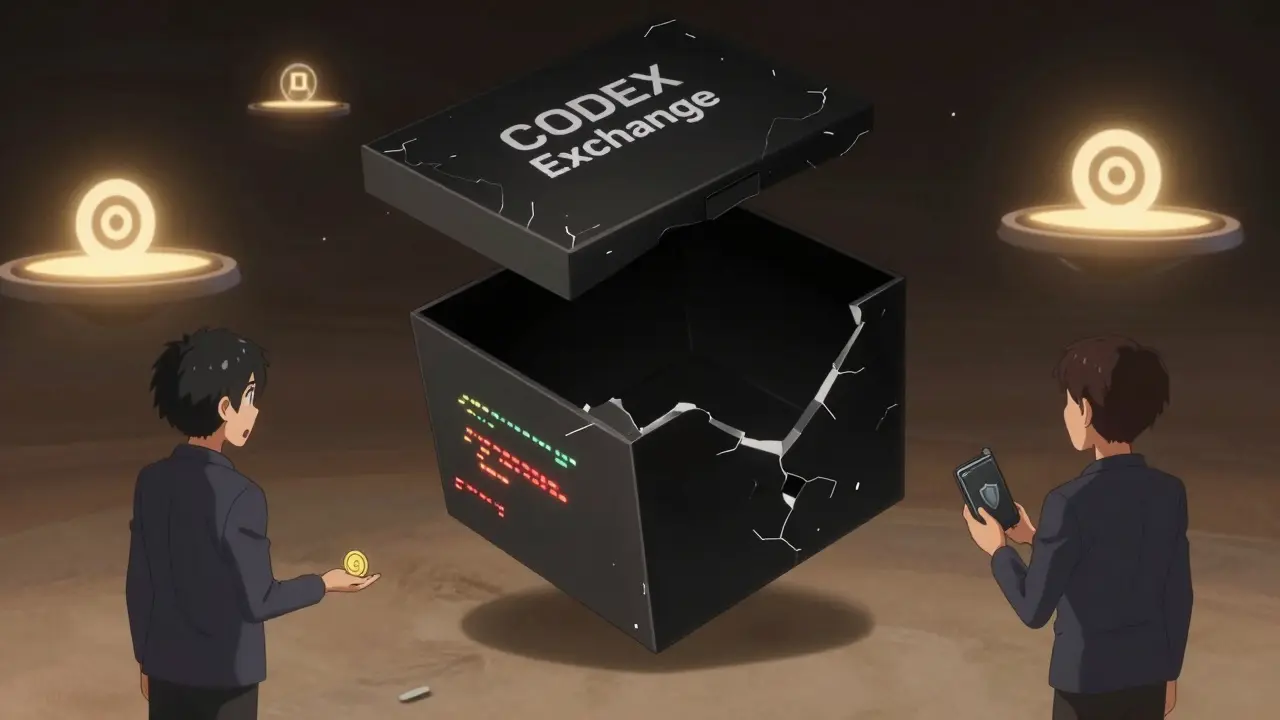
Final Verdict: Too Many Unknowns
CODEX Exchange doesn’t feel like a finished product. It feels like a prototype with flashy marketing.
It promises a lot: fiat on-ramps, margin trading, DeFi access, OTC, launchpad. But it delivers nothing verifiable. No fees. No supported coins. No licenses. No user feedback. No security details.
That’s not innovation. That’s opacity.
If you’re serious about trading crypto, you need certainty. You need to know your funds are safe. You need to know what you’re paying. You need to know the platform won’t vanish overnight.
CODEX Exchange doesn’t give you any of that.
For now, treat it like a high-risk experiment. Put in only what you can afford to lose - and keep your expectations low.
Until CODEX publishes real data - fees, licenses, audits, user volume - it’s not a trustworthy exchange. It’s a question mark with a website.
Is CODEX Exchange safe to use?
There’s not enough public information to confirm CODEX Exchange is safe. It claims to have licenses and security measures, but provides no details on what those are. No audits, no proof-of-reserves, no insurance details, and no transparency on where funds are stored. With only two user reviews and no track record, it’s impossible to verify its safety. Use extreme caution - if you deposit funds, treat it as high-risk.
Does CODEX Exchange support fiat currencies like GBP or EUR?
CODEX claims to have a fiat gateway, which suggests it supports currencies like GBP, EUR, or USD. But it doesn’t list which ones are accepted, what the deposit limits are, or how long withdrawals take. Without this information, you can’t plan your trades. Compare this to Coinbase, which clearly states supported currencies and processing times.
Are there any hidden fees on CODEX Exchange?
All fees on CODEX Exchange are undisclosed. Trading fees, withdrawal fees, deposit fees - none are listed anywhere. This is a major red flag. Legitimate exchanges publish their fee schedules upfront. If a platform hides its fees, it’s either trying to trick users or it’s not ready for prime time. Never deposit money without knowing the full cost structure.
Can I trade on CODEX without KYC?
It’s unclear. CODEX doesn’t state whether KYC is required. Most regulated exchanges require identity verification, especially for fiat deposits. If you’re looking for a no-KYC exchange, platforms like MEXC or dYdX are better documented. CODEX’s silence on this issue makes it risky for privacy-focused users.
Is CODEX Exchange better than Coinbase or Kraken?
No, not based on current evidence. Coinbase and Kraken have years of proven performance, hundreds of thousands of users, clear fee structures, regulatory compliance, and public security audits. CODEX offers no comparable proof. Its only claimed advantage - combining centralized and decentralized trading - lacks technical details. For reliability, transparency, and safety, established exchanges are far superior.
Why are there so few reviews for CODEX Exchange?
There are only two reviews, which suggests either the platform is very new or it has very low user adoption. Most exchanges with similar features have thousands of reviews across multiple sites. The lack of feedback isn’t just quiet - it’s a warning sign. If no one is using it, or no one is willing to talk about it, there’s likely a reason.
Does CODEX Exchange have a mobile app?
CODEX claims to have mobile apps for iOS and Android. But there are no app store ratings, no user reports on performance, and no details on features like push notifications, order types, or security controls. A mobile app alone doesn’t mean it’s reliable. Many shady platforms have polished apps to appear legitimate.
Can I use CODEX Exchange to trade altcoins?
CODEX doesn’t list which cryptocurrencies it supports. You can’t know if your favorite altcoin - like Solana, Polygon, or Arbitrum - is available. Established exchanges publish full coin lists. CODEX’s silence here makes it impossible to plan your portfolio or trade strategically.
Is CODEX Exchange regulated?
CODEX claims to have "all necessary licenses," but refuses to say which ones, from which country, or under what authority. Regulation isn’t a buzzword - it’s a legal requirement. Without knowing who oversees CODEX, you can’t verify if it’s following anti-money laundering rules, user protection laws, or financial reporting standards. This level of secrecy is unacceptable for any financial platform.
Should I invest in a CODEX Launchpad token?
No - not without extreme caution. CODEX’s launchpad is completely unverified. There’s no list of past projects, no performance data, no team backgrounds, and no audit reports for any tokens sold. Launchpads on established exchanges like Binance or KuCoin have track records. CODEX’s is a black box. Investing here is gambling, not trading.
Next Steps
If you’re still considering CODEX Exchange:
- Start with a tiny deposit - under $50.
- Test withdrawals before depositing more.
- Never store large amounts on the platform.
- Use a hardware wallet for long-term holdings.
- Watch for sudden changes in app behavior or support response times.
And if you see any red flags - delays, unexplained fees, or support silence - pull your funds out immediately.
Until CODEX publishes real data, treat it like a startup with no financial backing - not a trusted exchange.
Comments (19)
This exchange is a scam waiting to happen.
They don't show fees? That's not incompetence - that's theft by design.
I've seen this before. New platform, flashy website, zero transparency. They'll vanish after a few big deposits.
Remember Mt. Gox? Same script. Different name.
They claim to have licenses? Prove it. Name the regulator. Show the document.
Two reviews? On Cryptogeek? That's not low adoption - that's a ghost town.
If you're putting money in here, you're not investing - you're donating to a guy in a basement with a Fiverr logo.
And don't even get me started on that 'DEX mode' nonsense. It's a fake toggle button with no code behind it.
I'd rather give my crypto to a meme coin with no whitepaper than this.
Stop trusting marketing. Start demanding proof.
I get why people are skeptical - honestly, I am too.
But maybe… just maybe… it's not a scam. Maybe it's just really, really quiet.
Some of the best tech startups start with zero buzz. No reviews. No press. Just a team working in the dark.
CODEX could be one of those. Maybe they're building something revolutionary - and they don't want to shout about it until it's solid.
Yes, the lack of info is frustrating. But jumping to 'scam' feels… lazy.
What if they're avoiding noise because they're under regulatory review? What if they're waiting to launch with full transparency - not because they're hiding, but because they're careful?
I'm not saying trust it. I'm saying: don't assume the worst. Give it time. Test with $20. See what happens.
Not every quiet thing is dead. Sometimes… it's just building.
Hey, I love that you're being cautious - seriously, that’s smart.
But let’s not throw the baby out with the bathwater.
CODEX might be rough around the edges, but the features they *are* offering? That’s actually bold.
Fiat on-ramp + margin + DEX mode in one app? That’s not something Coinbase or Kraken are doing.
Maybe they’re ahead of the curve. Maybe they’re trying to merge the best of both worlds.
Yeah, the details are missing. But that doesn’t mean it’s fake - it means it’s unfinished.
Look at early Tesla. No one knew how the batteries worked. No one knew the supply chain. But people still bought in - because the vision was clear.
CODEX’s vision? One platform for everything. That’s huge.
Don’t dismiss it. Watch it. If it starts releasing audits, even one at a time - that’s a sign.
Be smart. Be patient. Don’t panic.
It's funny how we all rush to judge.
CODEX doesn't have reviews? Neither did Binance in 2017.
They don't show fees? Neither did KuCoin at first.
Maybe they're just not marketing. Maybe they're focused on the product.
Let's not forget: most exchanges that scream the loudest are the ones that get hacked first.
Quiet doesn't mean dead. It just means not on TikTok.
I'm not saying invest. I'm saying: don't write it off before you even try.
Give it $10. Deposit. Withdraw. See if it works.
That's the real test - not the reviews.
Oh please.
Another one of these 'mystery exchange' fairy tales.
CODEX claims to be everything? Then why not list the coins? Why not show the fee schedule? Why not even name the jurisdiction?
This isn't innovation - it's obfuscation.
Real platforms don't hide their licenses. They plaster them on the footer.
Real platforms don't make you guess if your money is safe. They publish proof-of-reserves every quarter.
And real platforms don't have two reviews on a site no one uses.
This isn't a startup. It's a phishing page with a UI kit.
If you're still considering this - you're either a beginner or you're already broke.
And if you're both? Well. Good luck.
I'm kinda torn
I hate how shady it feels
But I also hate how everyone just screams 'scam' without trying
Maybe I'll put $20 in just to see if withdrawals work
If it takes 3 days? I'm out
If it's instant? Maybe there's something here
But I'm not trusting it with more than I'd lose on a slot machine
And I'm not telling anyone else to do it
Just… maybe
Everyone says CODEX is bad
But what if it's actually better than Coinbase
Think about it
Coinbase charges you $5 to deposit
Kraken has 100+ coins you'll never trade
CODEX might be quiet because it's focused
Not because it's fake
Maybe the real scam is paying fees for coins you don't use
Just saying
Let's be precise: the absence of disclosed fees, regulatory licenses, and audit reports constitutes a material breach of fiduciary transparency standards expected of any financial services provider in the digital asset space.
Furthermore, the lack of verifiable user volume, paired with an absence of third-party security certifications, elevates operational risk to an unacceptable level for any rational actor.
Claiming decentralized functionality without providing smart contract addresses, blockchain interoperability details, or wallet compatibility matrices is not merely incomplete - it is deceptive.
Until CODEX publishes a public, timestamped, third-party attestation of its reserve holdings, any engagement with the platform constitutes a non-informed financial decision.
There is no such thing as 'quiet innovation' when the foundation is built on silence.
Regulation is not bureaucracy - it is consumer protection.
Transparency is not optional.
This is not a gray area.
Okay but like
what if they're just really bad at marketing
and not evil
i mean
they have a mobile app
they have margin
they have fiat
so… maybe they're just… lazy
not scammy
like… they forgot to write the FAQ
not that they're stealing your ETH
maybe?
Oh wow.
A platform with zero transparency.
Zero reviews.
Zero audits.
Zero fees listed.
Zero regulatory info.
And you're seriously considering it?
Let me guess - you saw a TikTok ad that said 'Trade like a pro with CODEX!' and now you're ready to mortgage your dog.
There's a reason Coinbase and Kraken have 10,000+ reviews.
Because they're not hiding.
They're not pretending.
They're not hoping you don't notice the empty vault.
CODEX isn't a new exchange.
It's a trap.
So… you're saying…
CODEX is…
like… a crypto ghost?
It exists
but no one has seen it
and it doesn't leave receipts
and it promises to teleport your money
but you have to believe
…
…
…
okay I'm out
Yesss!! 🙌
I'm so glad someone finally said this!!
Look - I'm not saying CODEX is perfect
but maybe… just maybe… it's trying
and that's more than most platforms do 😊
They have a mobile app!!
They have margin trading!!
They even have a launchpad!!
That's like… 3 major features!!
Yeah the website is bare
but maybe they're just shy?? 🥺
Give them a chance!!
Put in $10!!
See what happens!!
And if it vanishes??
At least you tried!! 💖
bro i tried to sign up
it asked for my social security number
then crashed
then my phone died
then i got a text from my bank saying 'suspicious activity'
so i deleted the app
and now i think it's a scam
or a spyware farm
or both
idk
People like this are why America is falling apart.
You want to risk your life savings on some anonymous website?
Where's the American values? Where's the discipline?
We don't gamble on unregulated crypto platforms!
We build businesses!
We trust institutions!
Not some guy in a basement with a .xyz domain!
Get a job. Save money. Buy stocks.
Not this nonsense.
🇺🇸
One must acknowledge the ontological vacuum presented by this entity.
The absence of verifiable data does not merely indicate incompleteness - it signifies epistemological negation.
One cannot invest in a void.
One cannot trust a silence.
One cannot participate in a mirage.
CODEX Exchange is not a platform.
It is a linguistic construct - a semantic shadow.
To engage with it is to surrender reason to rhetoric.
And that… is not innovation.
That is surrender.
They're not a scam.
They're a psyop.
They're owned by the same people who ran the last 3 fake exchanges.
They're waiting for 500 people to deposit.
Then they vanish.
And the next one comes out with the same name.
It's a loop.
Don't be the 501st.
USA has Coinbase.
EU has Kraken.
China has Binance.
India has WazirX.
Who the hell is CODEX?
Some third-world scam site with a .com domain.
Stop giving legitimacy to this nonsense.
Real traders use regulated platforms.
Not this.
There is a deeper metaphysical truth here.
CODEX Exchange is not a platform.
It is a mirror.
It reflects the collective anxiety of a generation that seeks security in chaos.
We crave the illusion of control - a single app that does everything.
We ignore the warnings - because we want to believe.
We trade our sovereignty for convenience.
CODEX does not deceive.
It simply reveals.
And what it reveals… is not a scam.
It is us.