

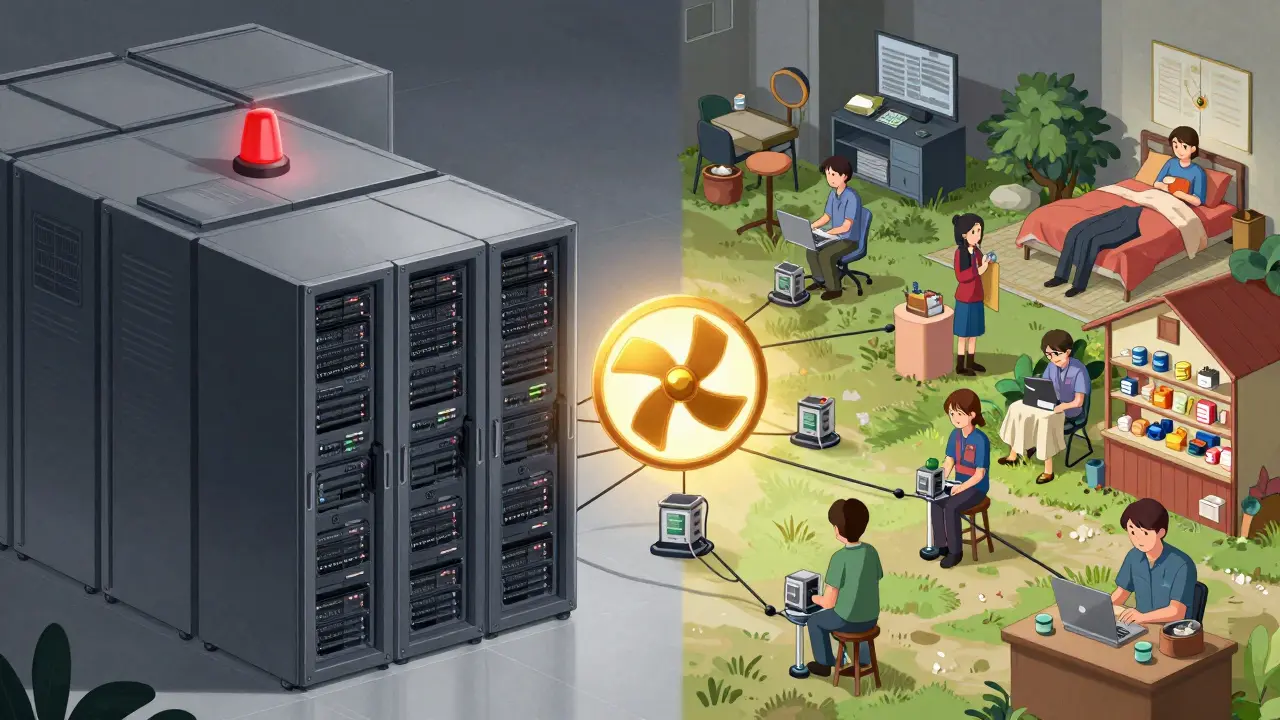
At its heart, a DePIN project is about bridging the gap between digital tokens and physical atoms. Traditionally, building a wireless network or a cloud storage system requires billions in upfront capital, a central headquarters, and a mountain of bureaucracy. DePIN flips this. It uses tokenomics to incentivize thousands of independent individuals to buy the hardware, install it in their homes, and maintain it. In exchange, these "providers" earn cryptocurrency. The result is a network that grows organically, scales rapidly, and doesn't have a single point of failure.
The Engine Under the Hood: How it Actually Works
To understand how these projects function, you have to look at them as a three-part machine. First, there is the hardware layer-the actual physical devices like sensors, routers, or servers. Second is the blockchain layer, which acts as the brain. Third is the incentive layer, which is the "carrot" that makes people want to participate.
The blockchain performs three critical jobs simultaneously. It acts as an administrative office, letting anyone join without asking for permission. It serves as a payment processor, sending rewards to providers automatically. Finally, it works as a public ledger, recording exactly who provided what service and for how long. This is all handled by Smart Contracts, which are self-executing scripts that ensure a provider gets paid the moment they prove their hardware is online and functioning. There is no invoice, no waiting for a check, and no human manager to approve the payment.
PRNs vs DRNs: Not All Infrastructure is the Same
Depending on what the network is trying to achieve, DePIN projects generally fall into two buckets: Physical Resource Networks (PRNs) and Digital Resource Networks (DRNs). The main difference is whether the location of the hardware matters.
PRNs are all about geography. If you're building a decentralized wireless network or a map of the world, the physical location of the device is everything. A weather station in Bristol is useless for someone wanting to know the temperature in Tokyo. These resources are "non-fungible" because they are tied to a specific spot on earth. For example, Helium is a prime example of a PRN; it rewards people for placing hotspots in specific areas to provide LoRaWAN and 5G coverage.
DRNs, on the other hand, deal with resources that can be used from anywhere. Computing power, disk space, and bandwidth are "fungible." It doesn't matter if the server providing the processing power is in a basement in London or a data center in Singapore; the output is the same. These networks compete directly with giants like Amazon Web Services (AWS) or Google Cloud by offering a distributed alternative.
| Feature | Physical Resource Networks (PRN) | Digital Resource Networks (DRN) |
|---|---|---|
| Key Asset | Location-based hardware (Towers, Sensors) | Generic digital power (CPU, GPU, Storage) |
| Location Importance | Critical (Must be in a specific spot) | Irrelevant (Global availability) |
| Example | Helium (Wireless Connectivity) | Filecoin (Decentralized Storage) |
| Primary Value | Local coverage and proximity | Computational efficiency and redundancy |

How You Actually Earn: The Incentive Models
Why would someone spend $200 on a hardware device to provide a service to strangers? The answer is the incentive model. Most DePIN projects use a "flywheel" effect: more providers lead to a better network, which attracts more users, which increases the demand for the token, which attracts more providers.
There are three main ways to earn in these ecosystems:
- Resource Sharing: This is the "passive" route. You share something you already have. For instance, if you have solar panels producing more energy than you need, you can feed that excess back into a decentralized energy grid and earn tokens.
- Infrastructure Building: This is for the pioneers. Some projects pay higher rewards to people who set up hardware in "under-served" areas. If no one in your neighborhood has a hotspot, the network might offer a multiplier on your rewards to encourage you to fill that gap.
- Service Provision: This is active work. You might earn tokens by performing specific tasks, like verifying the accuracy of a map or processing a complex mathematical calculation for a researcher using a decentralized computing network.
Breaking the Corporate Monopoly
The real magic of DePIN is that it solves the "cold start problem" of infrastructure. Usually, a company has to spend years and millions of dollars building a network before it's useful. DePIN uses tokens to crowdsource that initial investment. This creates a system that is far more resilient than a centralized one. If a central data center goes offline, half the internet might break. In a DePIN world, if one person's server in Bristol goes offline, there are ten thousand other servers globally to pick up the slack.
Beyond resilience, there's the issue of cost. By removing the need for executive salaries, fancy corporate offices, and massive marketing budgets, DePIN can often offer services at a fraction of the cost of traditional providers. It also opens the door for people in developing nations to build their own infrastructure without needing a loan from a global bank or permission from a government-backed monopoly.
Governance: Who Decides the Rules?
In a traditional company, a CEO or a board of directors decides how the network evolves. In DePIN, this is replaced by Decentralized Governance. Token holders typically get to vote on protocol upgrades, reward structures, and technical standards.
For example, if the community decides that the network needs to prioritize 5G over LoRaWAN, they can propose a change to the smart contracts. Those who hold the tokens vote on the proposal, and once passed, the code updates automatically. This ensures that the people who actually maintain the hardware-the providers-have a say in how the system is run, rather than some distant corporate entity.
Potential Pitfalls and Reality Checks
It sounds perfect, but DePIN isn't without its hurdles. The biggest risk is the volatility of the reward token. If the price of the token crashes, providers might find that the electricity cost of running their hardware is higher than the tokens they are earning, leading them to shut down their machines. This is why sustainable tokenomics are the make-or-break factor for any project.
There's also the "hardware hurdle." Unlike purely software-based crypto projects, DePIN requires people to buy and plug in physical things. This creates a friction point. If a device is too expensive or too hard to set up, the network won't grow. The most successful projects are those that make the hardware "plug-and-play," allowing regular people to participate without needing a degree in network engineering.
Is DePIN the same as a DAO?
Not exactly. A DAO (Decentralized Autonomous Organization) is a way to govern a community or a project. DePIN is the actual physical infrastructure (the hardware and the network). However, most DePIN projects use a DAO to handle their governance and decision-making processes.
Do I need to be a tech expert to join a DePIN project?
Generally, no. Most modern DePIN projects design their hardware for the average consumer. If you can set up a Wi-Fi router or plug in a USB drive, you can likely operate most DePIN hardware. The complexity is handled by the blockchain and smart contracts in the background.
How are DePIN rewards calculated?
Rewards are usually based on "Proof of Physical Work." The network monitors your device's uptime, the quality of the service it provides, and sometimes its location. If your device is providing high-value coverage in a needed area, you earn more tokens than someone in a saturated area with a low-quality connection.
What happens if the token price drops?
This is a significant risk. If the token value falls below the cost of electricity and maintenance, providers may turn off their hardware. To prevent this, some projects are implementing "burn-and-mint" equilibrium models where users pay for services in tokens, which are then burned to stabilize the price.
Can DePIN replace AWS or Google Cloud?
In some niches, yes. While a fully decentralized network might struggle with the extreme low-latency requirements of some enterprise apps, for storage (like Filecoin) or general computing, DePIN offers a cheaper, more private, and more resilient alternative that doesn't rely on a single company's terms of service.
Comments (13)
Sounds really promising.
This is a great breakdown!!! I've actually helped a few people set up Helium hotspots... and the most important thing to remember is the placement... if you're too close to another node, your rewards tank!!! Always check the map first!!!
While the conceptual framework is sound, the author glosses over the extreme volatility of reward tokens. One cannot simply ignore that the economic viability of these networks depends entirely on speculative assets. If the token value plummets, the 'flywheel' becomes a downward spiral of disconnected hardware. It is a systemic risk that requires a more rigorous analysis than a simple mention of 'pitfalls.'
Only US companies will actually make this work. Everyone else is just copying. It's our tech, our way.
Oh sure, because letting a bunch of random people with cheap routers run the global internet is just such a brilliant idea. I'm sure the latency will be just fantastic while my data hops through some guy's basement in a different timezone. Truly a masterpiece of decentralization if you ignore how the actual internet works. But hey, as long as we get some magic tokens, who cares if the service actually functions, right?
The distinction between PRNs and DRNs is quite illuminating. It provides a necessary clarity for those attempting to enter the space without a technical background.
The sheer audacity of calling this a 'guide' is laughable. This is basic surface-level fluff for the masses who think they've discovered a goldmine. It lacks any intellectual rigor or deep dive into the actual cryptographic proofs required for Proof of Physical Work. It's simply a pedestrian summary that adds nothing to the existing discourse for anyone with a modicum of actual knowledge. Truly a banal exercise in content generation that serves only to lure the gullible into another token scheme. I find it utterly exhausting that such mediocre summaries are treated as educational resources in this day and age. It is a tragedy of the modern digital age that we value quantity of 'guides' over quality of insight. One would hope for a more sophisticated analysis of the game theory involved in the incentive layers. Instead, we get a children's book version of infrastructure. The prose is dry and the insight is shallow. I cannot in good conscience call this a comprehensive overview. It is a shadow of a real analysis. A mere ghost of a technical paper. Utterly devoid of substance.
India will dominate this. Our scale is unmatched.
The real philosophical shift here is the movement from corporate trust to algorithmic trust. We are essentially outsourcing the maintenance of the physical world to a series of smart contracts. This removes the human element of failure-the lazy manager or the greedy executive-and replaces it with a mathematical certainty of payment. However, we must consider if we are simply replacing one form of centralization (corporate) with another (the developers who write the initial protocol code).
I tried this and lost money. Now I'm stressed. My life is a mess.
Love the energy here! Let's all look into how we can support these networks and push the boundaries of what's possible together!
It's a nice way to earn a bit extra on the side if you have the gear.
This is such a cool concept, really love how it lets regular people get involved!