
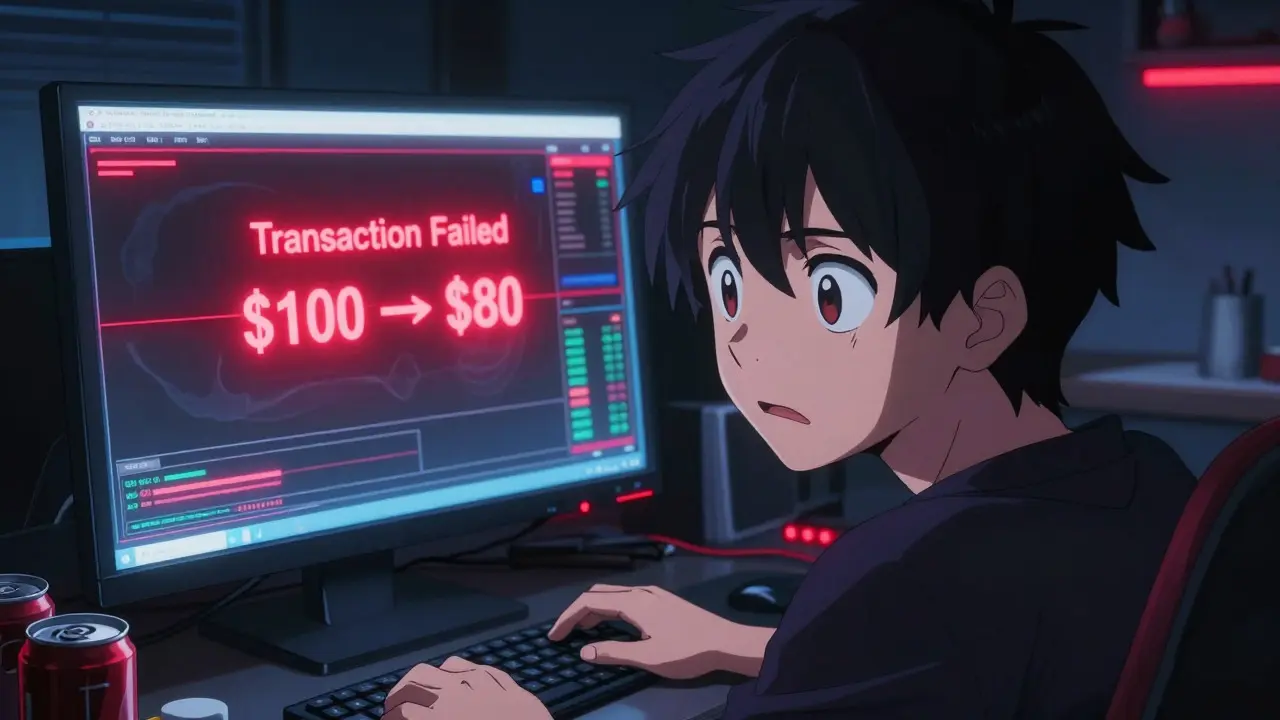
You click on a link to swap your tokens, see a promising "low fee" banner, and connect your wallet. Then you try to trade $100 worth of assets, and the interface tells you that you’ll receive less than $80 back due to slippage. Or worse, the transaction fails entirely because there is simply no one on the other side of the trade. This is the harsh reality for users who stumble upon CroSwap is a decentralized cryptocurrency exchange (DEX) operating as an Automated Market Maker (AMM) primarily built on the Cronos Network. While it sounds like a legitimate place to earn yields or swap coins cheaply, the data paints a very different picture in mid-2026.
We are going to look past the marketing claims and dig into the actual metrics. If you are holding Cronos is the native blockchain network developed by Crypto.com where CroSwap operates tokens or looking to explore DeFi on this chain, you need to know if CroSwap is a hidden gem or a ghost town. Spoiler alert: the numbers suggest the latter.
The Core Problem: Zero Liquidity
In the world of decentralized exchanges, liquidity is king. Without it, fees don't matter because you can't trade at all. Let’s look at the hard data from major trackers like CoinGecko and CoinMarketCap as of early 2024, which remains largely unchanged through 2025 and 2026.
CroSwap reports a 24-hour trading volume of roughly $36.52. Yes, thirty-six dollars. To put that in perspective, Uniswap processes over $1 billion daily. PancakeSwap handles hundreds of millions. Even smaller niche DEXs usually clear thousands of dollars a day. With only $36 in volume spread across essentially one trading pair (WCRO/USDC is Wrapped CRO paired with USD Coin, the primary tradable asset on CroSwap), the platform is statistically invisible.
Why does this matter to you? Because of slippage. When liquidity is low, buying even a small amount of an asset pushes the price up drastically, meaning you get fewer tokens than expected. Selling pushes the price down. On CroSwap, the order book depth is reported at just $21 at a 2% price deviation. If you try to move more than that, you will lose significant value instantly. For most traders, this makes the platform unusable for anything beyond microscopic experiments.
Fees vs. Reality: The 0.2% Trap
CroSwap markets itself heavily on its fee structure. They claim a 0.2% trading fee, which they position as "one of the lowest on the Cronos Network." On paper, this looks attractive compared to competitors like PancakeSwap (which often charges 0.25%) or standard Ethereum DEXs that can spike during congestion.
However, a low fee is useless if the trade doesn’t execute efficiently. Here is the trap:
- Theoretical Cost: You pay 0.2% to swap.
- Actual Cost: Due to extreme slippage from lack of liquidity, you might lose 5%, 10%, or even 20% of your value in price impact.
- The Result: You end up paying far more than the advertised fee.
Furthermore, while some specialized DEXs like Trader Joe on Avalanche offer 0.15% fees with deep liquidity pools, CroSwap offers 0.2% with near-zero liquidity. The lower fee number is a marketing hook that distracts from the fundamental flaw: there is no market here to trade in.
Tokenomics and the CROS Token
Every DEX has a governance or utility token, and CroSwap uses CROS is the native utility token of the CroSwap ecosystem. Understanding the supply dynamics helps you assess the risk of holding or staking these tokens.
| Metric | Value |
|---|---|
| Total Supply | 26.76 Million Tokens |
| Circulating Supply (Q2 2024) | 17.35 Million Tokens |
| Primary Use Case | Governance and Yield Farming Incentives |
| Exchange Listings | Extremely Limited (Only ~3 minor exchanges) |
The limited availability of CROS on major centralized exchanges adds another layer of difficulty. According to recent guides from platforms like WEEX, finding a reputable place to buy or sell CROS outside of CroSwap itself is nearly impossible due to negligible trading volume. This creates a closed loop where users are trapped within the ecosystem, unable to easily exit their positions without suffering massive losses.

Security and Anonymity Risks
When reviewing any crypto project, especially a new or obscure one, the team behind it matters. CroSwap was established in 2022 by an anonymous team. There are no public founders, no company registration details, and no verified identities linked to the development.
In the early days of DeFi, anonymity was common. But in 2026, after numerous rug pulls and exploits involving anonymous projects, it is a major red flag. Without accountability, if the smart contracts have bugs-or if the developers decide to pull the plug-users have no recourse. Unlike centralized exchanges like Coinbase or Kraken, which are regulated entities, or top-tier DEXs like Uniswap which have years of audited code and open-source community oversight, CroSwap lacks these safety nets.
The platform requires you to connect a Web3 wallet, such as MetaMask is a popular browser extension wallet used to interact with decentralized applications or the Crypto.com DeFi Wallet. While connecting a wallet doesn't inherently mean you are hacked, interacting with unverified smart contracts always carries the risk of approval exploits. Given the lack of independent audits mentioned in authoritative sources, proceed with extreme caution.
How CroSwap Compares to Real Competitors
To understand why CroSwap struggles, we need to compare it against what actually works on the Cronos network and broader DeFi space. Most users seeking low fees and fast transactions on Cronos turn to other options.
| Feature | CroSwap | VVS Finance (Cronos Native) | Uniswap (Ethereum/Arbitrum) |
|---|---|---|---|
| Daily Volume | ~$36 | Millions ($M+) | Billions ($B+) |
| Trading Pairs | 1 (WCRO/USDC) | Dozens | Thousands |
| Liquidity Depth | Negligible | High | Very High |
| User Community | Non-existent | Active Discord/Twitter | Massive Global Community |
| Trust Score | Unlisted (-) | Established | Industry Standard |
If you are on the Cronos network, VVS Finance is a leading decentralized exchange on the Cronos blockchain with significant liquidity is a much safer bet. It has real volume, multiple pairs, and an active community. If you want the absolute best liquidity regardless of chain, aggregators like Symbiosis Finance is a cross-chain bridge and aggregator that routes swaps across multiple blockchains or THORSwap is a non-custodial cross-chain DEX supporting Bitcoin, Ethereum, and others provide better execution rates by sourcing liquidity from the deepest pools available.
User Experience and Support
Let’s talk about what happens when things go wrong. Since CroSwap is a DEX, there is no customer support hotline. You rely on documentation, community forums, and social media channels.
Here is the problem: CroSwap has virtually no digital footprint in terms of user engagement.
- Reddit: Only 17 mentions between Jan 2023 and May 2024. No substantive threads.
- Trustpilot/Sitejabber: Zero reviews.
- Social Media: No official Discord or Telegram channels with meaningful membership counts.
Compare this to Uniswap, which has thousands of daily discussions and active developer updates. The silence around CroSwap suggests that either the user base has abandoned the platform, or it never truly gained traction. For a beginner, this is terrifying. If you get stuck in a transaction or face a contract error, there is no one to ask for help.
Verdict: Should You Use CroSwap?
Based on the evidence, the answer is a firm **no** for anyone looking to trade serious amounts of capital. CroSwap currently functions more as a technical demo than a viable financial tool. The combination of anonymous developers, single-pair limitation, and sub-$100 daily volume creates a high-risk environment with little to no reward.
The only scenario where CroSwap might make sense is if you are a hardcore Cronos enthusiast trying to farm yield on a brand-new pool before others notice, and you are willing to risk total loss of funds. But even then, the lack of liquidity means the yields are likely unsustainable or illusory.
For 99% of users, stick to established DEXs with proven track records, transparent teams, and deep liquidity. Your money is safer, and your trades will execute closer to the market price.
Is CroSwap safe to use in 2026?
Safety in DeFi depends on code audits and liquidity. CroSwap lacks public audits and has near-zero liquidity. While the smart contract may not be malicious, the economic risk is high due to slippage and the potential for the platform to cease operations without warning. It is considered high-risk.
What is the minimum trade size on CroSwap?
There is no enforced minimum, but practically, trades larger than $20-$50 will suffer from extreme slippage due to the thin order book depth. Trades under $10 are the only ones that might execute without significant price impact.
Can I withdraw my funds from CroSwap?
Yes, because it is a non-custodial DEX, your funds are always in your wallet until you approve a swap. However, swapping out of illiquid pools can be expensive or impossible if there is no counter-party liquidity available.
Why is CroSwap's volume so low?
Low volume is likely due to a lack of marketing, anonymous development team, and competition from more established DEXs on the Cronos network like VVS Finance. Users naturally gravitate toward platforms with deeper liquidity and better security assurances.
Does CroSwap require KYC?
No, CroSwap does not require Know Your Customer (KYC) verification. As a decentralized exchange, it allows users to connect wallets anonymously. This preserves privacy but also removes consumer protections associated with regulated centralized exchanges.