
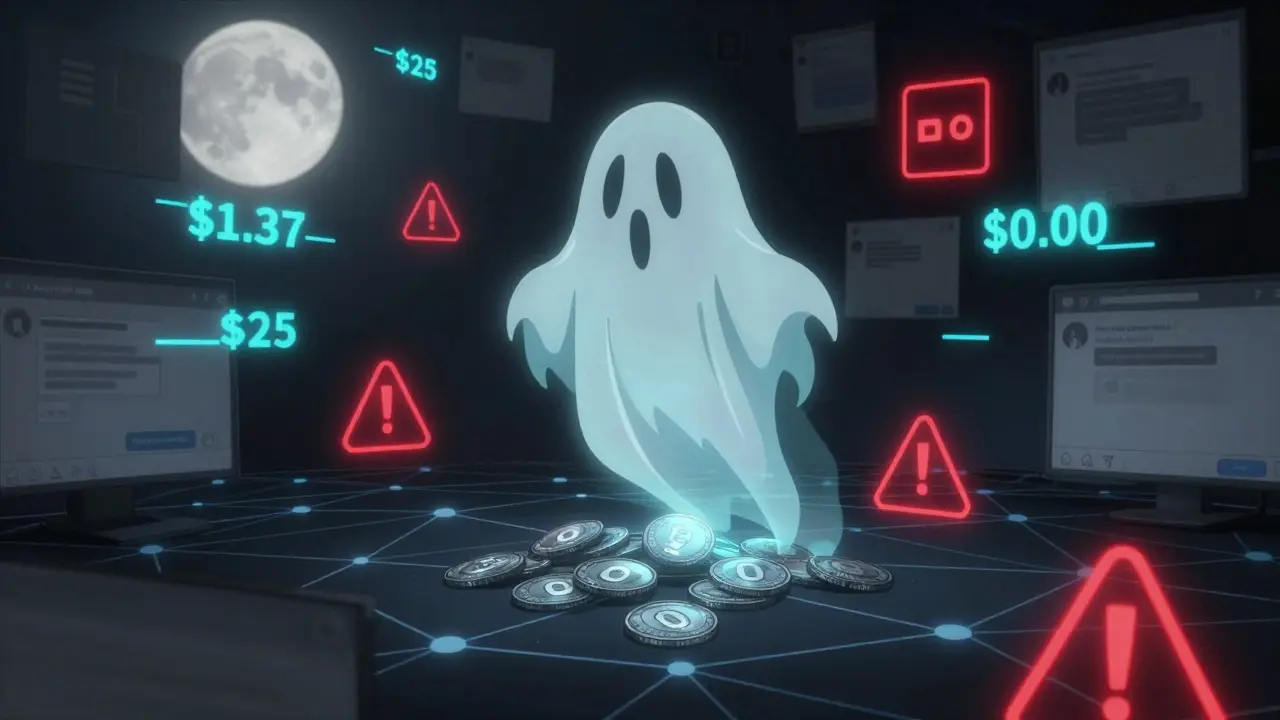
There’s a crypto coin called Falcons (FAH) that’s been floating around online with no clear story. You’ll see it listed on exchanges like Binance and PancakeSwap, with a price around $1.37. But if you dig deeper, something doesn’t add up. The token claims to be part of a Web3 membership ecosystem, promising rewards for user engagement. Yet, no one can explain how it actually works. No whitepaper. No team. No website. Just a price chart and a lot of silence.
What is Falcons (FAH)?
Falcons (FAH) is an ERC-20 token built on what appears to be Coinbase’s Base blockchain-not Ethereum, despite being labeled as ERC-20. It was launched without any public documentation, and there’s no official team behind it. The project says it’s designed to reward community participation, but there’s zero proof of how users earn those rewards. No app. No dashboard. No instructions. Just a token symbol and a trading pair.
What makes FAH strange is that it has a maximum supply of 500 million coins. That sounds big. But here’s the twist: every major data site-CoinGecko, CoinDataFlow, Binance, Bybit-lists its circulating supply as zero. That means, technically, no coins are in anyone’s wallet. Yet, people are buying and selling it. How? That’s the mystery. If no coins are circulating, how is there trading volume? The answer might be manipulation. Or maybe it’s just a glitch. Either way, it’s a red flag.
The price and trading data don’t add up
Falcons (FAH) trades between $1.35 and $1.38 most days. Its all-time high was around $1.52, reached sometime in late 2024 or possibly August 2025-which is impossible if today is February 2026. Some sites even claim it hit a high on a date that hasn’t happened yet. That’s not a data error. That’s a sign the numbers are made up.
The 24-hour trading volume varies wildly depending on the source. CoinGecko says $3,381. Binance says $13,080. CoinDataFlow says $10,130. And yet, the actual trading activity on PancakeSwap V3 (Base) for the FAH/USDC pair was only $19 in one day. That’s not trading. That’s one person making a few small buys and sells. It’s the kind of volume you see when someone is trying to fake interest.
The fully diluted valuation (FDV) is listed at around $690 million. That’s based on multiplying the $1.37 price by the 500 million max supply. But if no coins are circulating, that number is meaningless. It’s like saying a company is worth $1 billion because it’s authorized to issue 1 billion shares-even though it’s only issued one.
Why no one talks about it
Legit crypto projects-even tiny ones-have communities. You’ll find Reddit threads, Telegram groups, Twitter chatter, YouTube explainers. FAH has none. Search for "Falcons crypto" on Twitter. Nothing. On Reddit? No posts. On YouTube? No tutorials. On Medium? No deep dives. Not even a single user review on CoinGecko or CoinDataFlow.
Compare that to Friends With Benefits (FWB), another membership token. FWB has thousands of active members, regular events, and real use cases. FAH has zero. Not even a GitHub repo. No developer updates. No roadmap. No blog. Just a token symbol and a price chart that moves slowly.

Who’s behind it? No one knows
There’s no team name. No LinkedIn profiles. No legal entity registered anywhere. No contact email. No Discord admin. No announcement from a founder. This isn’t just a quiet launch-it’s a ghost project. Legitimate crypto projects, even anonymous ones like early Bitcoin, have some trail: code commits, forum posts, social media activity. FAH has none.
That’s dangerous. If you send your money to a contract and something goes wrong-like a bug, a hack, or a rug pull-there’s no one to ask for help. No customer service. No support team. No refund policy. You’re completely on your own.
Is it a scam?
It’s not officially labeled a scam. But it ticks every box for one.
- Zero circulating supply but active trading
- Conflicting and impossible price dates
- No website or documentation
- No community or user feedback
- No team or transparency
- Extremely low liquidity
Some sites predict FAH will hit $3 by the end of 2025, $13 by 2032, and $25 by 2034. But those numbers come from the same source that claims FAH dropped below $0.00 in January 2025-which is impossible. That’s not forecasting. That’s fiction.
Meanwhile, CoinCodex’s model says FAH could fall below $1. Binance’s data shows an all-time low of $0.80. That’s a 40% drop from current prices. And if the circulating supply remains zero, the whole thing could vanish overnight.

What can you do with FAH?
Nothing. Really.
You can’t use it to pay for anything. There are no dApps built on it. No wallets support it for staking. No NFTs are tied to it. No loyalty programs accept it. The only thing you can do is trade it on decentralized exchanges like PancakeSwap V3 on the Base chain. And even that’s risky. You need to bridge your funds from Ethereum to Base. You need a Web3 wallet. You need to understand slippage and gas fees. And for what? A coin with no utility, no community, and no future.
It’s like buying a ticket to a concert that doesn’t exist. You can trade the ticket. But there’s no band. No venue. No show.
Why does it even exist?
Low-liquidity tokens like FAH thrive in the shadows. They’re easy to create. A developer can deploy a token in minutes. Then, they pump it with fake volume, lure in curious traders, and disappear. The whole thing lasts weeks or months. Then it’s gone.
This isn’t new. Thousands of tokens like this have appeared and vanished over the years. Chainalysis’s 2025 report showed that 87% of tokens with under $1 million in daily volume were abandoned within 18 months. FAH fits that pattern perfectly.
It’s not a revolution. It’s not innovation. It’s noise.
The bottom line
Falcons (FAH) is not a cryptocurrency you should hold, invest in, or even trade unless you’re prepared to lose everything. It has no utility. No team. No community. No future. The price you see is likely artificial. The trading volume is likely fake. The supply is likely nonexistent.
If you’re looking for a membership token with real value, look at projects with open code, active users, and transparent teams. FAH offers none of that. It’s a ghost in the machine-a price chart with no substance behind it.
Don’t chase a coin that doesn’t exist.
Is Falcons (FAH) a real cryptocurrency?
Technically, yes-it exists as a smart contract on the Base blockchain. But it lacks the core features of a real cryptocurrency: a transparent team, a working ecosystem, a circulating supply, and community adoption. It’s more of a speculative symbol than a functional asset.
Why is the circulating supply listed as zero?
This is highly unusual and suggests either a major data error, a very early-stage launch that hasn’t distributed tokens yet, or intentional manipulation. All major data aggregators agree on this zero supply, yet trading continues. This contradiction makes FAH unreliable and potentially risky.
Can I buy Falcons (FAH) on Coinbase or Binance?
You can’t buy FAH directly on Coinbase or Binance’s main platform. It’s only available on decentralized exchanges like PancakeSwap V3 on the Base chain. That means you need a Web3 wallet like MetaMask, funds on the Base network, and knowledge of how to swap tokens-making it inaccessible for most users.
Is Falcons (FAH) a good investment?
No. There’s no evidence of long-term value, utility, or development. The price is volatile, the supply is unverified, and there’s zero community support. Any profit potential comes from gambling on price swings-not from real project growth. Treat it as high-risk speculation at best, and a potential scam at worst.
Are there any official websites or docs for Falcons (FAH)?
No. Despite claims of being part of a Web3 membership ecosystem, there is no official website, whitepaper, GitHub repository, or developer documentation. This lack of transparency is a major red flag for any crypto project, regardless of size.
Why do some sites predict FAH will hit $25 by 2034?
Those predictions are based on flawed or fabricated data. One source even claims FAH dropped below $0.00 in January 2025-a date that’s already passed and contradicts real market data. These forecasts are not grounded in analysis. They’re likely designed to attract speculative buyers, not provide honest insight.
Comments (16)