

Imagine filing a claim for a damaged car and having the payout land in your account within hours instead of weeks. Now imagine that same system instantly flagging a duplicate claim filed by someone else using your details. This isn't just a futuristic dream; it is becoming the new standard in the insurance industry. For decades, insurers have struggled with a massive problem: fraud. It costs the industry billions annually, driving up premiums for honest customers. But a new tool is changing the game. Blockchain, the technology behind Bitcoin, is being repurposed to create transparent, tamper-proof records that make fraud incredibly difficult to hide.
You might wonder why this matters to you. If you pay insurance premiums, you are indirectly paying for other people's lies. The Coalition Against Insurance Fraud estimates that fraudulent claims cost US insurers $55 billion every year. That money comes from your pocket. Blockchain offers a way to stop this leakage at the source by creating a shared 'source of truth' that no single party can manipulate. Let’s look at how this works, where it stands today, and what it means for the future of your coverage.
The Core Problem: Why Traditional Systems Fail
To understand why blockchain is such a big deal, you first need to see why current systems struggle. Most insurance companies operate in silos. Company A has its database, Company B has another, and hospitals or repair shops keep their own records. When a claim happens, adjusters have to manually verify information across these disconnected systems. This creates gaps. Fraudsters exploit these gaps by submitting duplicate claims to different insurers or inflating damage reports because there is no easy way to cross-check data in real-time.
Traditional fraud detection relies heavily on human review and basic rule-based software. These tools are good at catching obvious errors but terrible at spotting sophisticated schemes. According to data from the Coalition Against Insurance Fraud, about 12% of duplicate claims go undetected simply because insurers cannot easily verify claims across company boundaries. Blockchain fixes this by replacing isolated databases with a shared ledger. Every participant-insurers, policyholders, healthcare providers, and third-party verifiers-sees the same version of the truth. Once a transaction is recorded, it cannot be altered without everyone knowing. This immutability is the key to stopping retroactive manipulation of claims.
How Blockchain Actually Prevents Fraud
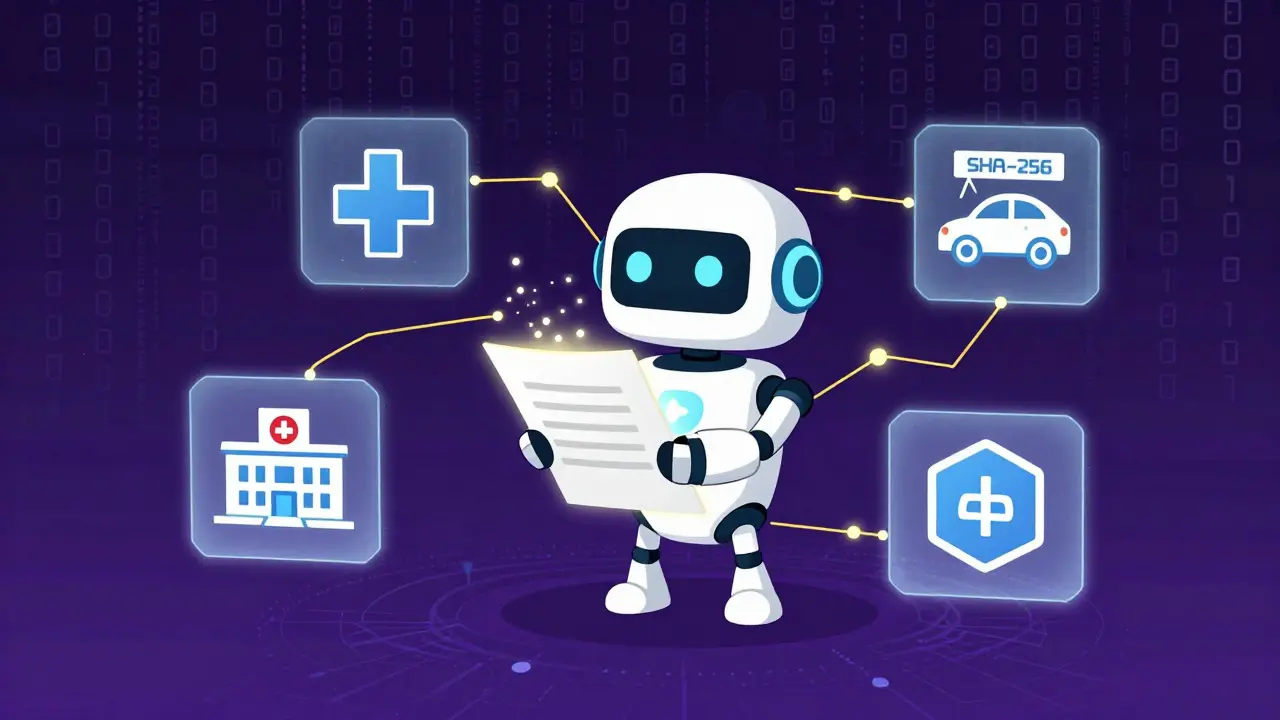
So, what does this look like in practice? At its heart, blockchain for insurance uses a permissioned network, meaning only authorized participants can join. Unlike public blockchains like Bitcoin, these networks prioritize privacy and speed. Technologies like Hyperledger Fabric or Ethereum Enterprise are commonly used. They rely on cryptographic hashing algorithms, such as SHA-256, to secure data. Think of a hash as a digital fingerprint. If even one letter changes in a document, the fingerprint changes completely, alerting the system to tampering.
The real magic happens through smart contracts. These are self-executing codes stored on the blockchain. They automatically trigger actions when specific conditions are met. For example, in parametric insurance, if a flight delay exceeds four hours (verified by trusted aviation data), the smart contract automatically releases the payout. No paperwork, no manual approval, and no opportunity for an employee to skim off the top. This automation reduces processing time dramatically. In AXA’s 'Fizzy' product, claims verification dropped from 30-45 days to just 2-3 days. Speed kills fraud because there is less time for bad actors to coordinate complex schemes.
Another critical feature is multi-signature approval. High-value claims require consensus from multiple parties before payment is released. This prevents a single corrupt insider from approving a fake claim. Combined with an immutable audit trail, every step of the claim process is recorded permanently. If a hospital tries to bill for services never rendered, the discrepancy becomes immediately visible against the verified patient records on the chain.
Real-World Results and Adoption Rates
This isn't just theory. Major players are already seeing results. As of Q2 2024, approximately 27% of major global insurers had implemented blockchain solutions for fraud prevention, according to Deloitte’s Insurance Technology Survey. Healthcare and property insurance lead the charge. In China, Ping An Insurance reported a 37% improvement in fraud detection accuracy during a 2022 pilot. In Europe, Estonia integrated blockchain into its national health system, reducing healthcare fraud by 22% between 2020 and 2023.
The B3i (Blockchain Insurance Industry Initiative) consortium, which includes over 40 global insurers, demonstrated significant success in marine cargo insurance. By enabling real-time verification of shipment data across multiple parties, they achieved a 42% reduction in fraudulent claims. Similarly, a life insurance provider reduced death benefit payouts from 30 days to 72 hours by accessing verified digital death certificates via blockchain. These examples show that when done right, blockchain delivers both efficiency and security.
| Feature | Traditional AI/ML Systems | Blockchain-Based Systems |
|---|---|---|
| Detection Accuracy | 92% (for complex patterns) | 85% (current implementations) |
| Data Integrity | Low (relies on input quality) | High (immutable records) |
| Duplicate Claim Prevention | Poor (siloed data) | Excellent (shared ledger) |
| Processing Speed | Fast (analysis only) | Moderate (consensus required) |
| Transparency | Low (black box algorithms) | High (auditable trail) |

The Challenges: It’s Not All Smooth Sailing
Despite the promise, blockchain is not a silver bullet. Experts like Dr. Jane Smith from the Wharton School note that blockchain must be integrated with AI analytics to be truly effective. Blockchain ensures data hasn’t been changed, but it doesn’t guarantee the data was correct when entered. This is the 'garbage in, garbage out' problem. If a fraudulent doctor enters false data initially, the blockchain will faithfully record that lie. Therefore, robust identity verification and IoT sensor integration are crucial prerequisites.
Scalability remains a technical hurdle. Current blockchain networks handle roughly 1,000-1,500 transactions per second, while traditional databases manage over 50,000. This limits blockchain’s ability to process peak claim volumes without bottlenecks. Privacy is another concern. Handling sensitive medical or personal data on a shared ledger raises GDPR compliance issues. New techniques like zero-knowledge proofs (ZKPs) are emerging to solve this. ZKPs allow one party to prove they know a value (like age or income) without revealing the actual value, maintaining privacy while ensuring verification.
Implementation costs and complexity are also significant barriers. Gartner’s 2024 assessment shows average deployment timelines of 8-14 months for enterprise solutions. One insurer reported an 11-month onboarding period due to legacy system integration issues. Staff training is another factor; 68% of employees need 3-4 months of specialized training. The talent gap is real, with blockchain developers earning $130,000-$180,000 annually in the US. Smaller insurers often rely on consortia like B3i to share development costs, but regulatory uncertainty across jurisdictions adds further complexity.
The Future: Hybrid Models and Tokenization
Looking ahead, the trend is moving toward hybrid systems. The Insurance Information Institute reports that 33% of major insurers are exploring combinations of blockchain and AI. Blockchain provides the trusted data layer, while AI handles the pattern recognition and unstructured data analysis. This synergy addresses the weaknesses of each technology individually. By 2027, the Coalition Against Insurance Fraud estimates blockchain solutions could prevent $8.2 billion in fraudulent claims annually.
We are also seeing the rise of tokenized insurance policies and peer-to-peer models. Twelve pilot programs were underway in Q2 2024 for policy tokenization, allowing fractional ownership and easier transfer of coverage. Parametric insurance is projected to grow from $1.2 billion to $7.8 billion by 2027, driven by blockchain’s ability to automate payouts based on objective triggers. However, regulatory harmonization remains a challenge. With 47 different regulatory approaches across US states and EU countries, compliance is a maze. The NAIC’s Blockchain Working Group is working on model regulations, but full standardization will take time.
For consumers, this means faster claims, lower premiums, and greater trust. For insurers, it means operational efficiency and risk reduction. While challenges remain, the trajectory is clear. Blockchain is transitioning from experimental pilots to core infrastructure. As interoperability improves and standards solidify, expect blockchain to become 'table stakes' for major insurers within the next five to seven years.
Is blockchain really secure for storing personal insurance data?
Yes, but with caveats. Blockchain itself is highly secure due to cryptographic hashing and decentralization. However, the main risk is not hacking the chain, but incorrect data entry or privacy leaks. Modern implementations use permissioned networks and zero-knowledge proofs to ensure that sensitive personal data is never exposed publicly while still allowing verification. Compliance with regulations like GDPR requires careful architectural design, often involving off-chain storage for raw data and on-chain hashes for verification.
Will blockchain replace human adjusters?
Not entirely, but it will change their role significantly. Routine, straightforward claims will be automated by smart contracts, freeing up human adjusters to focus on complex, high-value, or disputed cases. The job will shift from data collection and manual verification to investigation, negotiation, and customer service. Humans are still needed for empathy, judgment calls, and handling edge cases that algorithms cannot resolve.
How long does it take for an insurer to implement blockchain?
On average, enterprise-scale implementations take 8 to 14 months. This timeline includes integrating with legacy systems, training staff, and establishing governance frameworks. Smaller pilots or narrow use cases, like parametric insurance, can be deployed faster, sometimes in under six months. The complexity depends largely on the existing IT infrastructure and the willingness of partners to join the shared network.
Can blockchain stop all types of insurance fraud?
No technology can stop all fraud. Blockchain excels at preventing duplicate claims, identity theft, and tampering with records. However, it struggles with sophisticated social engineering, coordinated rings of actors, or initial data falsification ('garbage in'). It works best when combined with AI for pattern recognition and strong identity verification protocols. It is a powerful tool, but part of a broader ecosystem of fraud prevention strategies.
What is the difference between public and private blockchains in insurance?
Public blockchains like Bitcoin are open to anyone, offering maximum transparency but lower privacy and slower speeds. Private or permissioned blockchains, like Hyperledger Fabric, restrict access to known, verified participants. Insurance companies prefer permissioned networks because they need to protect sensitive customer data, comply with regulations, and achieve higher transaction throughput. Only authorized insurers, hospitals, and agencies can read or write to these ledgers.