

Imagine trying to buy Bitcoin with your Vietnamese dong (VND) in a country where the central bank has historically frowned upon digital assets. For years, this was the daily reality for millions of traders in Hanoi, Ho Chi Minh City, and beyond. But as we move through 2026, the landscape is shifting rapidly. The days of relying solely on shady peer-to-peer (P2P) deals are fading, replaced by a structured, albeit tightly controlled, regulatory framework.
If you are a trader in Vietnam, you might be wondering: Is it still safe? How do I actually get my money onto an exchange without getting my bank account frozen? And what does Resolution 05/2025 mean for your portfolio? This guide cuts through the noise to show you exactly how Vietnamese traders are accessing global markets today, balancing opportunity with compliance.
The Regulatory Shift: From Gray Area to Pilot Program
To understand how you trade today, you first need to grasp the rules that govern the market. For over a decade, cryptocurrency existed in a legal gray area in Vietnam. The State Bank declared it "not legal tender" back in 2014, but they never explicitly banned individuals from holding or trading it. This ambiguity allowed the market to explode, with over 21 million people-roughly 20% of the population-owning digital assets by 2025, according to Triple-A’s report.
That changed significantly with Resolution 05/2025, which was passed by the Vietnamese government on January 15, 2025. This resolution established a five-year pilot program for cryptocurrency trading platforms. It marked the first time the government formally recognized crypto exchanges, provided they operated under strict oversight.
Here is what this means for you:
- VND Only: All issuance, trading, and transactions on approved platforms must be conducted using the Vietnamese dong. Foreign currencies like USD or EUR are not used for direct settlement on these local platforms.
- Local Control: Foreign participation in any licensed exchange is strictly limited to 49%. This ensures that Vietnamese entities retain majority control, aligning with national economic security goals.
- Limited Licenses: The Ministry of Finance announced on July 10, 2025, that only five licenses would be issued for this pilot project. This creates a highly selective environment, raising the barrier to entry significantly.
The capital requirements are steep. Applicants need VND 10 trillion (approximately US$380 million) in charter capital, with 65% coming from institutional investors. Shareholders must also prove profitability for at least two consecutive years before applying. As Dr. Le Dang Doanh, a former advisor to the Prime Minister, noted in a VnExpress op-ed, this effectively hands the market to large state-owned banks and major financial institutions, excluding most smaller fintech startups.
How You Actually Deposit VND: The Current Methods
While the local pilot program is still in its early stages, most Vietnamese traders continue to use global centralized exchanges (CEXs). These platforms have adapted aggressively to serve the Vietnamese market. Here is how you can currently move VND onto these exchanges.
1. Peer-to-Peer (P2P) Trading
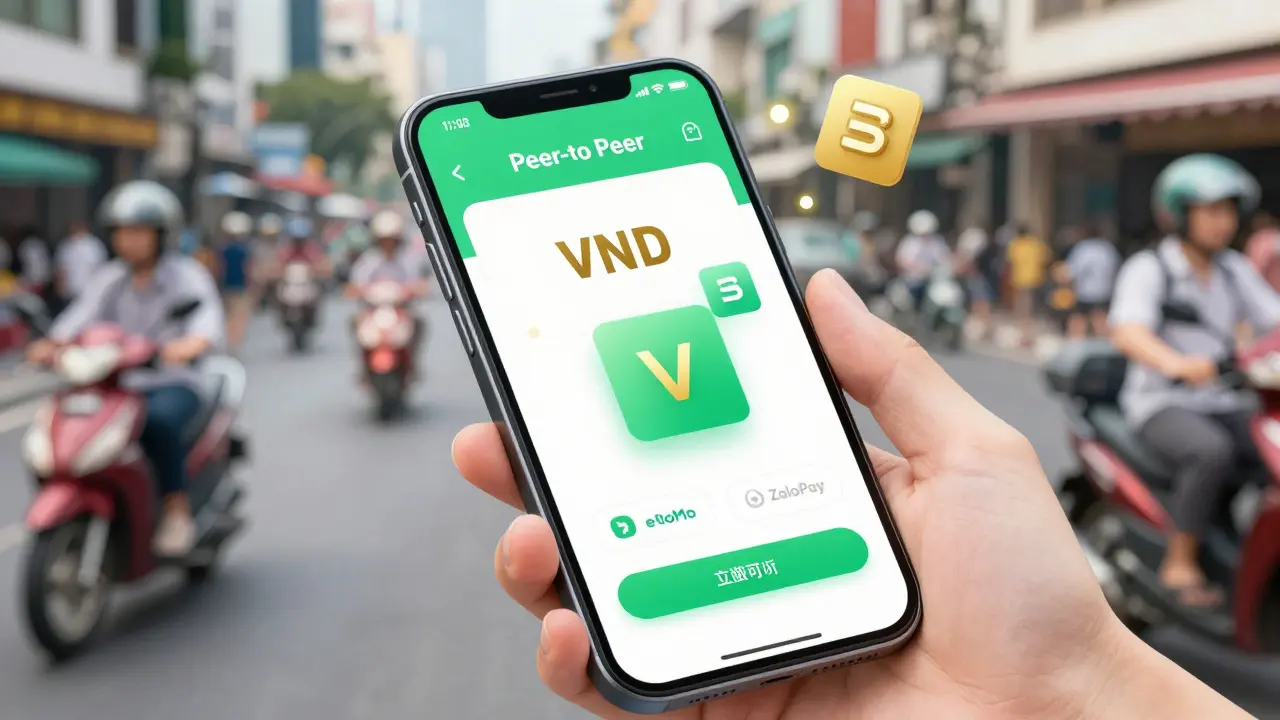
P2P remains the most popular method for onboarding VND, especially for beginners. Platforms like Binance, Bybit, and OKX offer robust P2P markets where you buy crypto directly from other users who accept VND transfers.
How it works:
- You select BTC, ETH, or USDT as the asset you want to buy.
- You filter sellers by payment method (e.g., MoMo, ZaloPay, Vietcombank).
- You initiate the trade and transfer VND to the seller’s bank account or e-wallet.
- Once the seller confirms receipt, the exchange releases the crypto to your wallet.
This method is flexible but carries risks. In Q3 2025 alone, Vietnam’s National Cyber Security Center reported 4,200 cases of P2P fraud. To stay safe, always keep communication within the platform’s chat system and never release crypto until you see the funds in your own account.
2. Direct Bank Transfers via Integrated Partners
Some exchanges have integrated with Vietnam’s National Payment Corporation (NAPAS), allowing for smoother deposits. As of September 2025, platforms like Binance support direct bank transfers from 28 major Vietnamese banks. Average processing times are quick: 2-5 minutes for deposits and 15-30 minutes for withdrawals, according to BrokerChooser’s assessment.
Pro Tip: Avoid transferring large sums in one go. A survey by VnReview found that 31% of users experienced bank account freezes when depositing large amounts. Financial advisor Nguyen Hoang recommends splitting transfers into smaller chunks under VND 100 million ($4,000) per transaction to trigger fewer automated alerts from anti-money laundering (AML) systems.
3. E-Wallet Integration
E-wallets like MoMo, ZaloPay, and VNPay are deeply embedded in daily life in Vietnam. Many P2P vendors prefer these methods because they are instant and irreversible. If you frequently trade small amounts, linking your e-wallet to a trusted vendor list on Binance or Bybit can save you significant time.
Top Exchanges for Vietnamese Traders: A Comparison
Not all exchanges are created equal. Your choice depends on whether you prioritize liquidity, low fees, or security. Here is how the major players stack up for Vietnamese users in 2026.
| Exchange | Key Strength | Spot Fees | VND Liquidity | KYC Speed |
|---|---|---|---|---|
| Binance | Highest volume & liquidity | 0.1% | Excellent (Tightest spreads) | ~18 hours |
| Bybit | Derivatives & Futures | 0.1% | Very Good | ~18 hours |
| OKX | Transparency (Proof of Reserves) | 0.08% | Good | ~24-48 hours |
| MEXC | Low fees & new tokens | 0.02% | Moderate | ~24 hours |
| Remitano | Simplicity for beginners | Variable | High (P2P focused) | Fast |
Binance dominates the market, capturing approximately 45% share among Vietnamese users. It handles $2.3 billion in 24-hour trading volume and offers the tightest spreads for BTC/VND pairs (average 0.08%). However, its customer service response time can lag during high volatility, averaging 72 hours according to Reddit community feedback.
Bybit is the go-to for derivatives traders. With $1.7 billion in daily futures volume from Vietnamese users, it leads in advanced trading tools. Note that leverage is capped at 25x to comply with draft risk management guidelines from the Ministry of Finance.
OKX appeals to those worried about solvency. They publish monthly proof-of-reserves audits, offering peace of mind after past industry collapses. Their fees are slightly lower, but their localized customer support is less developed than Binance’s.
Navigating KYC and Identity Verification
One of the biggest hurdles for Vietnamese traders is Know Your Customer (KYC) verification. Global exchanges now require strict identity checks to comply with international AML standards and Vietnam’s emerging regulations.
Currently, you will need to provide:
- National ID (CMND/CCCD): Most platforms accept both the old 9-digit ID and the new 12-digit Citizen Card.
- Facial Recognition: You must complete a live selfie scan that matches your ID photo against Vietnam’s citizen database.
A common pain point arises here. In October 2025, a thread on WebTruyen documented 147 users struggling to verify accounts on OKX due to mismatched National ID information. Ensure your name on the exchange matches your ID card exactly, including diacritics. If you have recently updated your CCCD, wait for the data to sync with national databases before attempting verification.
Looking ahead, Circular 18/2025/TT-BTTTT, issued in September 2025, mandates integration with Vietnam’s National Digital Identity system by Q1 2026. This should streamline the process, replacing manual uploads with instant digital verification.
Tax Implications and Compliance Risks
Trading isn’t just about profits; it’s about staying out of trouble. Vietnam imposes a 22% capital gains tax on cryptocurrency transactions. Unlike traditional stock markets, no exchange provides automated tax reporting for Vietnamese residents. You are responsible for tracking your buys, sells, and gains manually.
Keep detailed records of every P2P transaction and bank transfer. Use spreadsheet software or dedicated crypto tax calculators that support multi-currency inputs. When the Ministry of Finance’s draft Circular 15/2025/TT-BTC takes full effect, mandatory transaction reporting for amounts over VND 200 million ($8,000) will become stricter. Staying under this threshold doesn’t exempt you from tax, but it reduces the likelihood of immediate scrutiny from banking partners.
Be aware that 78% of exchanges operating in Vietnam were not fully implementing draft AML requirements as of late 2025, according to a CoinDesk report. Leading platforms like Binance have integrated with Vietnam’s National Financial Intelligence Unit (VNFIU) since August 2025, making them safer choices for compliant traders.
The Future: Local Exchanges vs. Global Giants
The next few years will define Vietnam’s crypto ecosystem. While global giants like Binance and Bybit currently dominate, local players are entering the arena. SSI Digital Corporation launched in September 2025 with VND 200 billion in capital, and Techcom Securities’ TCEX platform reached $89 million in volume by May 2025.
However, these local exchanges represent less than 5% of total market activity. Tiger Research forecasts that 3-5 Vietnamese-run exchanges could launch by Q2 2026, potentially reaching 15% market penetration by 2027. But Chainalysis predicts global exchanges will maintain over 85% market share through 2027 due to established user trust and superior liquidity.
For now, the hybrid approach works best. Use global exchanges for deep liquidity and advanced features, but stay informed about the five licensed local platforms. As the pilot program matures through 2029, the line between local and global may blur, offering Vietnamese traders more secure, regulated avenues for investment.
Is crypto trading legal in Vietnam in 2026?
Yes, but with restrictions. Under Resolution 05/2025, crypto trading is permitted on licensed platforms under a five-year pilot program. Individuals can hold and trade crypto, but businesses cannot use it for payments. Trading on unlicensed platforms exists in a gray area, so using reputable global exchanges or future licensed local ones is recommended.
Which exchange is best for buying crypto with VND?
Binance is widely considered the best option due to its high VND liquidity, tight spreads, and extensive P2P network. Bybit is a strong alternative for derivatives traders. For beginners seeking simplicity, Remitano offers an easy P2P interface, though with higher fees and fewer security features.
How do I avoid having my bank account frozen?
Avoid large, single transfers. Split deposits into smaller amounts under VND 100 million ($4,000). Use multiple banks if possible. Keep clear records of all transactions to prove legitimate source of funds if questioned by your bank. Be cautious of P2P vendors with poor ratings or short histories.
Do I need to pay taxes on crypto gains in Vietnam?
Yes. Vietnam charges a 22% capital gains tax on cryptocurrency profits. You must track your transactions manually and declare them during annual tax filing. No exchange currently automates this for Vietnamese residents, so maintaining accurate records is essential.
When will local Vietnamese crypto exchanges launch?
Several local platforms, such as SSI Digital and TCEX, have already launched in late 2025. More are expected by Q2 2026 as part of the five-license pilot program. However, they currently handle a small fraction of total volume compared to global exchanges like Binance and Bybit.