

You have Bitcoin on one chain, NFTs on another, and your DeFi positions somewhere else. It feels like having bank accounts in five different countries where you can’t send money between them without a massive fee and a week-long wait. This is the interoperability problem, and it’s not just annoying-it’s the biggest bottleneck stopping blockchain from going mainstream in 2025.
For years, we treated every blockchain as an island. Ethereum was great for smart contracts, Solana for speed, and Bitcoin for security. But they didn’t talk to each other. If you wanted to move value or data across these islands, you relied on clunky bridges that often got hacked or centralized custodians who took huge cuts. In 2025, that model is breaking down. The demand isn't just for moving tokens anymore; it's for seamless data exchange. Whether you're looking at healthcare records trying to sync with insurance ledgers or gaming assets needing to work across multiple metaverses, the core challenge remains the same: how do systems built on different rules trust and understand each other?
The Real Definition of Interoperability Today
Let’s clear up the jargon. When people say "interoperability," they often mean two very different things, and confusing them causes bad tech decisions. First, there’s technical interoperability. This is the plumbing. Can System A send a packet to System B? Can they speak the same language? Think of Border Gateway Protocol (BGP) in traditional internet infrastructure-it allows routers from different manufacturers to communicate. Without it, the internet would fragment into tiny, disconnected networks.
Then there’s semantic interoperability. This is the hard part. It’s not enough for System A to send data to System B; System B must interpret that data exactly the way System A intended. In healthcare, this is defined by standards like SNOMED CT. If Hospital A sends a patient’s medication list to Hospital B, both systems need to agree that "Drug X" means the same chemical compound and dosage. In blockchain, this translates to standardized token formats and metadata schemas. If your NFT metadata says "Rare Sword" but the receiving marketplace interprets "Rare" as a specific rarity tier that doesn't exist in their database, the asset becomes useless. True interoperability requires agreement on standards, technologies, and terminology among all stakeholders.
Technical Interoperability is the ability of different information systems to exchange data through compatible protocols and interfaces. It focuses on connectivity and transmission.
Semantic Interoperability is the capability of systems to share data with unambiguous meaning, ensuring consistent interpretation across platforms. It relies on shared ontologies and coding standards.
Why Centralized Bridges Are Failing
For a long time, the go-to solution for cross-chain movement was the centralized bridge. You lock your ETH on Ethereum, and a centralized service mints wrapped ETH on Polygon. Simple, right? Not really. These bridges are single points of failure. Remember the Ronin Network hack? Or the Wormhole exploit? Billions were lost because a small group of validators controlled the keys. In 2025, users and enterprises are tired of trusting code that hasn't been battle-tested for decades.
The shift now is toward decentralized interoperability protocols. These use cryptographic proofs rather than trusted third parties. Instead of asking "Do I trust this bridge operator?", the question becomes "Can I mathematically verify this transaction happened on the source chain?" Light clients and zero-knowledge proofs allow one blockchain to verify the state of another without downloading the entire history. This reduces trust assumptions significantly. If you’re building a dApp today, integrating a protocol that uses zk-proofs for verification is no longer optional-it’s a baseline requirement for security-conscious users.
The Rise of Middleware and Layer Zero
If blockchains are operating systems, middleware is the universal translator. Projects like LayerZero and Chainlink CCIP (Cross-Chain Interoperability Protocol) have emerged as critical infrastructure in 2025. They don’t try to replace individual chains; instead, they provide a communication layer that lets any application connect to any other chain securely.
Here’s why this matters for developers: you write your smart contract once, and the middleware handles the routing, message delivery, and gas payment complexities across different networks. This abstraction hides the chaos of multi-chain management from the end-user. Imagine buying a ticket for a concert on Ethereum, getting the NFT on Arbitrum, and using it to unlock exclusive content on Optimism-all without switching wallets or paying three separate gas fees. That’s the promise of modern middleware. It turns the fragmented landscape into a cohesive experience.
| Feature | Centralized Bridge | Decentralized Middleware | Native Rollups |
|---|---|---|---|
| Trust Model | Trusted Third Party | Cryptographic Proofs | Shared Security (Ethereum) |
| Speed | Fast | Moderate (Proof Generation) | Very Fast |
| Security Risk | High (Hacks common) | Low (Code audits required) | Low (Inherited from L1) |
| Developer Effort | Low | Moderate | High (Specific tooling) |

Data Silos Beyond Crypto: The Enterprise Angle
While crypto enthusiasts obsess over token transfers, the real revolution in interoperability is happening in enterprise data management. Healthcare and finance sectors are adopting blockchain-inspired principles to break down data silos. The Office of the National Coordinator for Health Information Technology (ONC) defines interoperability as the ability of systems to exchange health information and use it once received. But usage is key. Many current systems can exchange data but fail to interpret it correctly, leading to errors in clinical decision support.
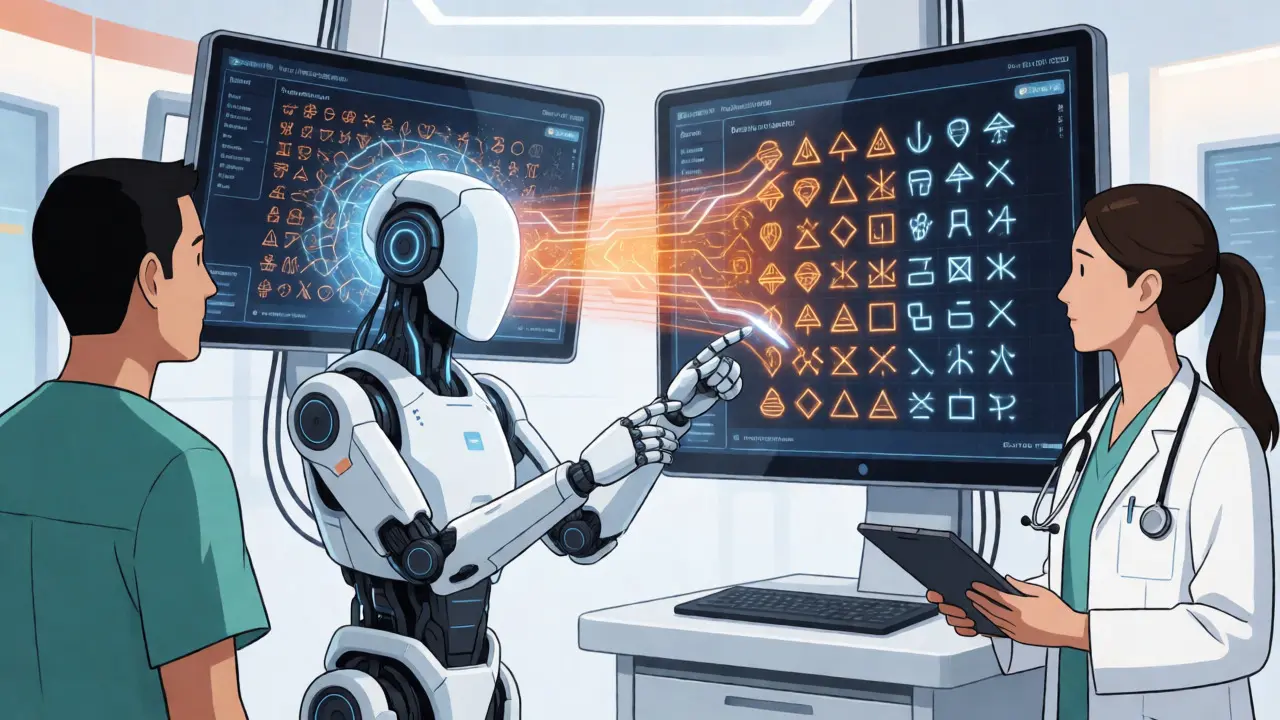
In 2025, AI plays a pivotal role here. Artificial Intelligence models are being used to bridge gaps between legacy systems and modern platforms. For example, AI-driven tools can extract structured data from unstructured medical notes and map them to standardized codes like SNOMED CT. This creates a layer of semantic interoperability that wasn't possible before manual coding. Similarly, in supply chain management, IoT devices generate massive amounts of data. Interoperability solutions ensure that a sensor on a shipping container in Shanghai can automatically update a ledger in London, triggering smart contract payments when conditions are met. This isn't just about blockchain; it's about creating a unified data fabric where information flows freely regardless of the underlying technology stack.
Standardization: The Missing Link
We still lack universal standards for SD-WAN and many blockchain protocols. Unlike the early internet, where TCP/IP became the de facto standard, the blockchain space is fragmented. There is no single "TCP/IP for blockchains." However, market forces are driving convergence. Initiatives like the IEEE Standard for Interoperable Blockchain Systems are gaining traction. These efforts aim to define common APIs and data structures that allow different ecosystems to plug into each other easily.
Without these standards, every integration is a custom project. That’s expensive and slow. Enterprises want out-of-the-box compatibility. They don’t want to hire a team of cryptographers to connect their ERP system to a private Hyperledger Fabric network. Standardization reduces friction. It allows developers to build modular applications that can swap backend providers without rewriting the frontend. If you’re a CTO evaluating blockchain solutions in 2025, ask vendors: "What standards do you adhere to?" If the answer is vague, walk away. Look for compliance with emerging frameworks like ISO/TC 307 or industry-specific consortia.
Practical Steps for Implementing Interoperability
So, how do you actually implement this in your organization or project? Here’s a checklist based on what’s working in 2025:
- Audit Your Data Flow: Map out where data enters and exits your system. Identify bottlenecks where format conversion happens manually.
- Adopt API-First Design: Ensure all internal services expose clean, documented APIs. Microservices architecture makes it easier to integrate external interoperability layers.
- Prioritize Semantic Consistency: Don’t just pass JSON blobs. Use standardized schemas (like OpenAPI or GraphQL) to enforce structure. In healthcare, align with HL7 FHIR standards.
- Evaluate Trust Models: Decide if you need permissioned (private) or permissionless (public) interoperability. Public chains offer transparency; private ones offer privacy. Hybrid models using zero-knowledge proofs are becoming popular for balancing both.
- Monitor Latency Costs: Cross-chain operations aren’t free. Factor in gas fees and confirmation times into your user experience design. Hide complexity where possible, but be transparent about costs.
One common pitfall is assuming interoperability equals automation. Just because two systems can talk doesn’t mean they should. Over-integration can create brittle dependencies. Keep your integrations loose. Use event-driven architectures where one system publishes an event, and others subscribe if needed. This decouples components and makes the whole system more resilient.
The Future Is Multi-Cloud and Multi-Chain
The trend is clear: monolithic systems are dying. We are moving toward a world where applications span multiple clouds and multiple chains. Cloud routing solutions now facilitate seamless data exchange between AWS, Azure, and Google Cloud. Similarly, blockchain interoperability protocols enable value transfer across Ethereum, Solana, and Cosmos. The distinction between "cloud" and "blockchain" infrastructure is blurring. Both are becoming utility layers for computation and storage.
For users, this means choice. You won’t be locked into one ecosystem. For developers, it means flexibility. You can pick the best tool for each job-high throughput for gaming, low cost for micro-transactions, high security for finance-and stitch them together seamlessly. The winners in 2025 won’t be the chains with the most features, but the ones with the best connections. Connectivity is the new scalability.
What is the difference between technical and semantic interoperability?
Technical interoperability refers to the ability of systems to exchange data via compatible protocols (e.g., sending a file). Semantic interoperability ensures that the receiving system interprets the data with the same meaning as the sender (e.g., understanding that 'DOE' refers to Department of Energy, not Date of Entry). Both are required for effective automated processing.
Are blockchain bridges safe in 2025?
Safety depends on the architecture. Centralized bridges remain vulnerable to hacks due to single points of failure. Decentralized protocols using zero-knowledge proofs or light clients offer higher security by relying on mathematical verification rather than trusted operators. Always check if a bridge has undergone recent independent audits.
How does AI improve interoperability?
AI helps bridge semantic gaps by automatically mapping data formats between different systems. For example, machine learning models can translate unstructured text from electronic health records into standardized codes like SNOMED CT, enabling accurate data exchange between hospitals using different software.
Do I need blockchain for data interoperability?
Not always. Traditional APIs and middleware can handle many interoperability needs. Blockchain adds value when you need trustlessness, immutability, or decentralized coordination between parties who don't fully trust each other. For internal enterprise data, standard APIs may suffice.
What are the main challenges in achieving full interoperability?
The main challenges include lack of universal standards, regulatory fragmentation across jurisdictions, high latency in cross-chain transactions, and the complexity of maintaining secure cryptographic proofs. Additionally, business incentives often conflict, making it difficult to get competitors to agree on shared data formats.