
Imagine spending months creating a digital artwork, minting it as an NFT, and watching it sell for thousands. Then, years later, that same piece trades hands again for even more money. You get nothing. Not a single cent. This used to be the reality for many creators before NFT royalties were introduced as a way to ensure artists earned a cut from every secondary sale. But today, in late 2025 and heading into 2026, the landscape has shifted dramatically. The promise of perpetual income is now tangled in a web of platform policies, optional enforcement, and fierce market competition. Understanding how these mechanisms work-and where they fail-is critical for anyone looking to monetize digital assets effectively.
How NFT Royalties Actually Work
At their core, NFT royalties are programmatically enforced commissions embedded within smart contracts. When an NFT changes hands on the secondary market, the contract triggers a transfer of a predetermined percentage-usually between 2.5% and 15%-to the original creator’s wallet address. This system was designed to mimic traditional art galleries or music streaming models, where creators earn residuals. However, unlike physical contracts, these rules are written in code, specifically leveraging standards like EIP-2981 on Ethereum-based chains. This standard allows marketplaces to query the royalty information directly from the token itself, theoretically ensuring consistency across platforms.
The technical implementation varies by blockchain. On Ethereum, EIP-2981 is the go-to protocol, defining how much should be paid and to whom. On Solana, the ecosystem relies on Metaplex's Creator Standard, which serves a similar function but operates under different infrastructure constraints. While the code specifies the payment logic, the actual execution depends entirely on the marketplace facilitating the trade. Here lies the fundamental flaw: blockchains themselves cannot force a user to pay a royalty if the marketplace chooses not to enforce it. The transaction will still succeed, but the creator’s share might vanish into thin air unless specific safeguards are in place.
The Great Fragmentation: Platform Policies Compared
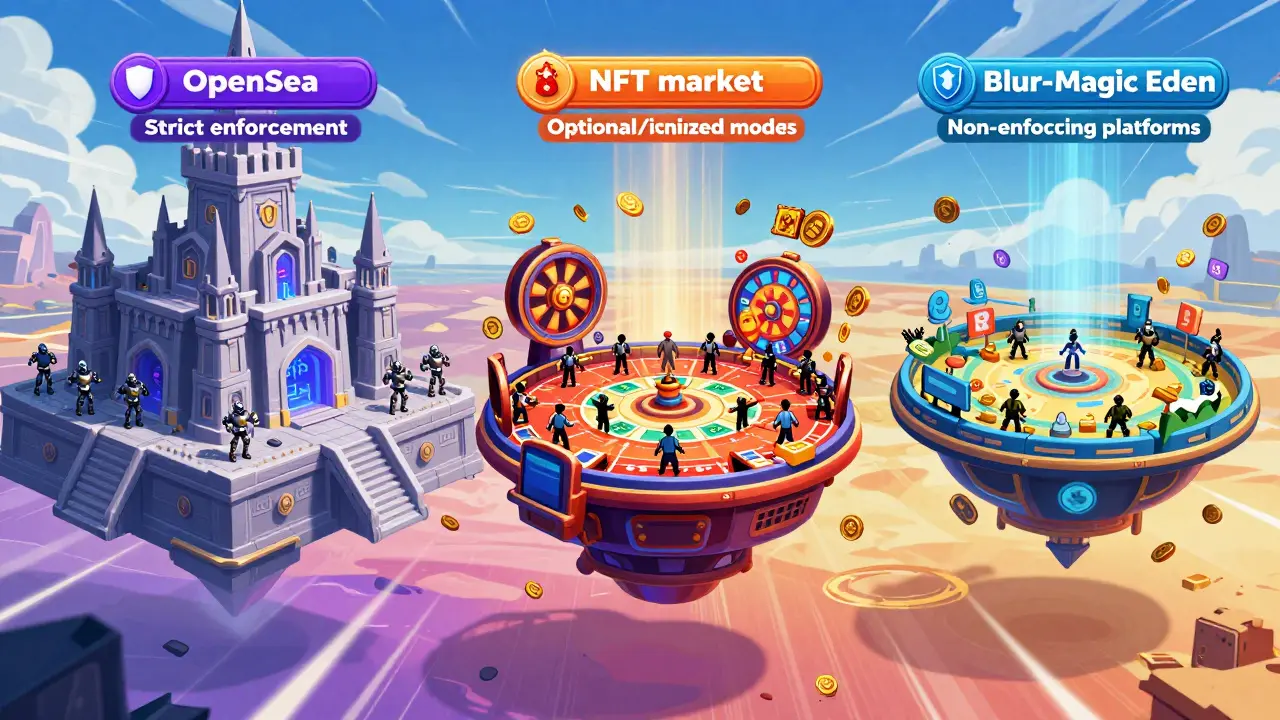
If you think all NFT platforms treat royalties equally, you’re mistaken. The market has fractured into three distinct camps: those that enforce royalties strictly, those that make them optional, and those that ignore them completely. This fragmentation means your earnings potential depends less on your art’s value and more on where your collectors choose to trade.
| Platform | Enforcement Model | Max Rate Allowed | Key Features & Risks |
|---|---|---|---|
| OpenSea | Enforced (via Operator Filter) | 10% | Uses blacklists to block non-compliant buyers/sellers. Only enforces at collection level, not individual pieces. |
| Blur | Optional (Incentivized) | Variable | Zero mandatory fees. Rewards traders with BLUR tokens if they honor royalties. Compliance tied to economic incentives. |
| Magic Eden | Optional (Royalty Shield) | Variable | Dominant on Solana. Introduced 'Royalty Shield' in Feb 2025, but only ~35% buyer compliance reported. |
| Rarible | Enforced | Up to 50% | Allows high royalty rates. Good for creators wanting maximum control, though liquidity may suffer. |
| Solanart | None | N/A | Does not enforce any royalty fees. Highly criticized by creators for killing sustainable ecosystems. |
OpenSea remains the heavyweight champion for creator protection, holding roughly 65% of the Ethereum NFT market share. Its secret weapon is the Operator Filter Registry, a tool that allows collections to blacklist wallets that bypass royalties. If a trader tries to buy a protected NFT on a non-compliant platform, the trade fails. It’s aggressive, but effective. However, this protection only works at the collection level. If you mint a standalone piece, you’re exposed.
On the other side of the spectrum sits Blur, which sparked the "royalty wars" in 2022 by eliminating mandatory fees. Instead of forcing payments, Blur gamified compliance. Traders who voluntarily pay royalties earn more BLUR tokens, which can be traded or staked. It’s a clever economic hack, but it shifts the burden onto the buyer. Data shows that while some traders comply to boost their rewards, many simply opt out, driving down effective royalty rates to near zero for unprotected assets.
Magic Eden, the dominant player on Solana, tried to walk a middle path. After switching to optional royalties in 2022, they faced backlash from creators whose incomes plummeted. In February 2025, they launched the "Royalty Shield," attempting to incentivize payments through UI prompts and minor perks. Early results? Only 35% of buyers honored the request. For Solana creators, this means relying on hope rather than code.
Why Enforcement Is Technically Impossible (And What That Means)
You might wonder why we can’t just hardcode royalties so they’re unbreakable. The short answer is: because NFTs are designed to be fluid. An NFT isn’t locked to one marketplace; it’s a token that can move across dozens of platforms, decentralized exchanges, and private sales. When you sell an NFT on OpenSea, the buyer owns the token. They can then list it on Blur, X2Y2, or even a peer-to-peer deal outside any major interface.
This interoperability is both the strength and weakness of the ecosystem. As noted by Crypto for Innovation in 2023, "even though royalty policies are immutable smart contracts, the Ethereum blockchain isn’t able to enforce stipulations on token transfers." Any enforcement is inherently voluntary at the application layer. If a marketplace decides to ignore the EIP-2981 data, the blockchain won’t stop the trade. It will simply record a transfer without the associated royalty payment. This creates a race to the bottom, where platforms compete for volume by lowering barriers-including removing creator payouts.
The result? Effective royalty rates have crashed. Pre-2022, creators saw averages of 8-10%. By late 2025, on platforms like X2Y2, that number dropped to approximately 0.4%. For an artist expecting passive income, this isn’t just a dip; it’s a collapse. The only defense against this volatility is choosing platforms that actively punish non-compliance, like OpenSea’s blacklist feature, or accepting that royalties are now a privilege granted by traders, not a right guaranteed by code.
Economic Impact: Do High Royalties Hurt Sales?
There’s a heated debate about whether high royalty rates actually benefit creators. Intuitively, earning 10% on every resale sounds great. But research suggests it might backfire. A 2022 SSRN study (#4205814) found that higher royalty rates lead to lower primary sale prices. Creators, anticipating future earnings, often discount their initial work-a phenomenon called the "delayed gratification effect." Unfortunately, the study also revealed an "overconfidence effect": many creators overestimate future resales and end up losing money in the short term because fewer people buy at inflated secondary prices.
Market inefficiencies play a role too. NFTs with enforced royalties tend to trade at a 5-8% premium compared to identical assets on royalty-free platforms. Why? Because buyers factor in the extra cost. If two identical Bored Apes are listed-one on OpenSea with 5% royalties and one on Blur with 0%-the latter will likely sell faster and cheaper. This reduces overall liquidity for protected collections. For brands like Nike or Tiffany’s, this risk is unacceptable, which is why they stick to strict, royalty-enforcing platforms. For independent artists, it’s a gamble.
Practical Steps for Creators in 2026
If you’re launching a new collection, don’t just pick a platform based on traffic. Consider your long-term revenue strategy. Here’s how to navigate the current landscape:
- Choose Your Battlefield Wisely: If royalties are critical, prioritize OpenSea or Rarible. Use OpenSea’s Operator Filter to blacklist known royalty-dodging wallets. If you’re on Solana, accept that Magic Eden’s protections are weak, and consider diversifying to Cardano, which maintains mandatory royalty structures.
- Set Realistic Rates: Avoid setting royalties above 10%. While Rarible allows up to 50%, such high rates deter trading. Most successful collections settle between 2.5% and 7.5%. Higher rates reduce secondary volume, potentially costing you more in lost sales than you gain in percentages.
- Verify Your Contract: Ensure your smart contract properly implements EIP-2981 (for Ethereum) or Metaplex standards (for Solana). Incorrect configuration is the #1 cause of failed royalty payments. Double-check recipient addresses before minting-37% of creator issues stem from simple typos here.
- Monitor Cross-Platform Activity: Just because you listed on OpenSea doesn’t mean your NFT stays there. Track where your assets are trading. If you see volume shifting to Blur or X2Y2, your effective royalty rate may drop to zero. Adjust your marketing to encourage trading on compliant venues.
- Use Community Tools: Explore community-driven solutions like the Royalty Registry, which aims to create cross-platform compatibility. While not yet universal, these tools represent the industry’s attempt to solve the fragmentation problem.
What’s Next for NFT Royalties?
Looking ahead to 2027, analysts predict a stabilization around 2-4% average royalty rates across major platforms. We’re likely moving toward a "two-tier market": premium, blue-chip collections will maintain strict royalty enforcement through brand loyalty and exclusive platforms, while commodity NFTs will operate largely royalty-free to maximize liquidity. The "royalty collapse" scenario-where payments disappear entirely-has a 25% probability, but the rise of standardized protocols like Royalty Registry offers a glimmer of hope for a unified system.
For now, the power lies with the marketplace. Creators must adapt, treating royalties not as a guaranteed stream but as a negotiable component of their business model. Stay informed, choose your platforms strategically, and never assume the blockchain will protect your income automatically.
Can I force royalties on all NFT platforms?
No. Blockchain technology does not allow for forced payments across all platforms. Royalties are enforced at the marketplace level. If a platform like Blur or Solanart chooses to ignore royalty data, the transaction will proceed without paying you. You can only enforce royalties on platforms that support and respect standards like EIP-2981 or use tools like OpenSea’s Operator Filter.
What is the best royalty rate to set for my NFT collection?
Most experts recommend a rate between 2.5% and 7.5%. Setting it too high (e.g., above 10%) can discourage secondary sales, reducing overall liquidity. While Rarible allows up to 50%, such high rates often lead to fewer trades. Aim for a balance that encourages trading while providing sustainable income.
Why did Blur remove mandatory royalties?
Blur removed mandatory royalties to attract professional traders who prefer low-friction environments. Instead of forcing payments, Blur incentivizes compliance by rewarding traders with BLUR tokens when they voluntarily pay royalties. This approach prioritizes volume and liquidity over guaranteed creator payouts.
Is Magic Eden safe for creators who rely on royalties?
Not entirely. While Magic Eden introduced the "Royalty Shield" in 2025 to encourage payments, it remains optional. Data shows only about 35% of buyers comply with royalty requests. If consistent secondary income is vital to your practice, you may want to supplement Magic Eden with stricter platforms or focus on primary sales.
How do I check if my NFT contract supports royalties?
You can verify royalty support by checking if your smart contract implements EIP-2981 (for Ethereum) or Metaplex Creator Standards (for Solana). Tools like Etherscan or Solscan allow you to view contract details. Additionally, most major marketplaces will display the royalty percentage during the listing process if the contract is correctly configured.
Comments (15)
It is frankly pathetic that the entire industry has devolved into a race to the bottom where creators are expected to beg for scraps. The pretension of calling this 'innovation' while stripping artists of their livelihoods is nauseating. OpenSea’s blacklist feature is the only thing keeping the ecosystem from total moral collapse, yet even that is insufficient against the sheer greed of platforms like Blur. We have allowed financial engineers to dictate artistic value, and now we wonder why true art is dying. The fact that Solanart exists at all is an indictment of our collective values.
stop crying about it and just mint on opensea if you want to get paid or go to rarible its simple math really
i feel so drained reading this because everyone keeps pretending there is a solution when there isnt really one unless you have millions of followers nobody cares about your royalties anymore its just sad honestly and i cant believe people still fall for the hype
wait so u mean i can actually set my own rate but then ppl just wont buy it? thats kinda messed up innit. i always thought the code forced them to pay. guess i was wrong again lol
The fundamental epistemological failure here lies in the assumption that decentralized protocols can enforce centralized economic mandates without violating the core tenets of libertarian free-market ideology which posits that voluntary exchange must remain unencumbered by artificial scarcity mechanisms imposed by legacy institutional thinking. Therefore, the erosion of royalty standards is not a bug but a feature of the emergent order.
You are all missing the obvious point. The market corrected itself because creators were overvaluing their work. If your art isn't worth trading without a royalty fee, it's worthless. Stop blaming the platforms for revealing the truth about your lack of demand. It's basic supply and dynamics, something most of you clearly failed to grasp in high school economics.
I think it is truly wonderful that we are having this conversation because it shows how much the community cares about the future of digital art and I believe that with enough patience and understanding we can find a way to make sure that every single artist feels supported and valued in this new landscape which is incredibly exciting and full of potential for growth and collaboration among all of us who love creativity.
This fragmentation is unacceptable. Platforms should be held accountable for enabling theft under the guise of 'liquidity.' If you build a marketplace, you respect the creator. Period. I’m done supporting venues that treat artists as optional participants in their profit model. We need regulation, not gamified incentives.
Look, it’s a bit of a wild west out there, ain’t it? One day you’re sipping champagne on secondary sales, next day you’re eating ramen because some trader found a loophole. But hey, that’s the thrill of the crypto circus! Just don’t bet the farm on a platform that treats your life’s work like a disposable token. Keep your powder dry and your contracts tight, folks.
man i totally get why everyone is frustrated. it sucks to put in all that work and then see someone else profit off it without giving back. i wish there was an easier way to fix this but i guess we just gotta stick together and support each other's work directly instead of relying on these big platforms too much
I appreciate the detailed breakdown here. It helps to understand exactly where the leverage points are. I’ve been considering moving my collection to Rarible since the higher cap might deter casual flippers but attract serious collectors. Does anyone have experience with the liquidity drop mentioned? Is it significant enough to worry about?
the irony is palpable when we consider the philosophical implications of ownership in a digital vacuum where value is purely perceptual and enforced by arbitrary code snippets that can be ignored by those with sufficient capital influence so really who owns what anyway
Just observing from the sidelines. Seems like the smart money is going to Cardano or sticking to blue chips on OpenSea. Everything else feels like noise right now.
Hey everyone, thanks for sharing your thoughts. It sounds like a tough situation for creators. I’m thinking about starting a small project myself. Should I focus on building a community first before worrying about the technical royalty settings? That seems like a safer bet than trying to game the system.
As someone who has navigated various creative industries across different continents, I find it fascinating how quickly this sector has shifted from promise to peril, yet I remain hopeful that through education and cross-cultural dialogue we can inspire a new generation of traders who value ethical consumption and recognize that supporting artists is not just a transactional obligation but a moral imperative that strengthens the fabric of our global cultural exchange.