

You might think that sending cryptocurrency is like handing someone cash in a dark alley-anonymous and untraceable. That’s a dangerous myth. In reality, every transaction on public blockchains like Bitcoin or Ethereum is permanently recorded on a distributed ledger visible to anyone. This transparency is the foundation of on-chain crypto transaction tracing, the systematic process of tracking funds across blockchain networks to identify patterns, attribute addresses to real-world entities, and follow the movement of assets. Whether you are a compliance officer at a bank, a forensic investigator chasing ransomware payments, or just a curious trader, understanding how these techniques work is no longer optional-it’s essential for navigating the digital asset landscape in 2026.
The stakes have never been higher. The global blockchain analytics market hit $1.87 billion in 2024 and is projected to reach $7.43 billion by 2029. Why? Because regulators and financial institutions need to know where the money goes. While only about 0.34% of all cryptocurrency transactions were linked to illicit activities in 2024, those dirty funds represent billions of dollars in potential risk. On-chain tracing helps separate legitimate commerce from fraud, money laundering, and sanctions evasion.
Why Blockchain Isn't Anonymous (It's Pseudonymous)
To understand tracing, you first need to fix your mental model of privacy. Cryptocurrencies are pseudonymous, not anonymous. Your name isn’t attached to your wallet address, but your behavior is. Every time you send or receive funds, you leave a digital footprint. If you ever interact with a centralized exchange like Coinbase or Binance, you’ve likely provided KYC (Know Your Customer) data linking your identity to that address. Once that link exists, investigators can trace your entire history.
This concept is central to wallet clustering, a technique that groups multiple wallet addresses into a single cluster representing one entity. When specific wallets are linked to real-world identities through exchange data, it becomes possible to associate complex transaction webs with individuals or organizations. As Dr. Sarah Meiklejohn, a cryptography professor at University College London, noted in her 2024 IEEE Security & Privacy keynote, "The attribution problem remains fundamentally unsolved; we can cluster addresses with high confidence but definitive identity linkage requires non-blockchain evidence." In other words, the blockchain tells you who owns what, but off-chain data tells you who that person is.
Core Techniques: Heuristics, Rules, and Graph Learning
How do analysts actually connect the dots? According to a comprehensive 2025 survey by Ayush Kumar and Vrizlynn L.L. Thing, there are three primary methodologies used in the field today. Each has its strengths and weaknesses depending on the complexity of the trail.
| Technique | How It Works | Best For | Limitations |
|---|---|---|---|
| Heuristic-Based | Uses ad hoc algorithms based on transaction time, block height, and common spending patterns. | Straightforward tracing within single blockchain networks. | Accuracy drops significantly (to ~63%) when tracing across multiple chains. |
| Rule-Based | Builds detection rules for anomalous transactions by observing characteristics of prior normal activity. | Identifying specific patterns like peel chains or unsupported tokens. | Requires constant updating as criminal tactics evolve; prone to false positives. |
| Graph Learning-Based | Applies machine learning algorithms to transaction graph structures to identify complex, non-linear patterns. | Complex multi-hop tracing and detecting sophisticated laundering schemes. | Requires substantial computational resources and large training datasets. |
Heuristic methods are the bread and butter of basic analysis. They rely on simple logic: if two inputs in a transaction come from different addresses but are spent together, they likely belong to the same owner. TRM Labs reported an 89% accuracy rate for Ethereum transactions using these methods in 2024. However, they struggle when funds move across chains. Rule-based approaches excel at spotting known bad behaviors, such as "peel chains," where criminals repeatedly split funds into smaller amounts to obscure the original source. Nansen’s 2025 analysis showed a 92% detection rate for these patterns. But rules are static; criminals adapt. That’s why graph learning is becoming the gold standard. By treating the blockchain as a massive network graph, AI models can spot subtle connections that human analysts or rigid rules would miss. Merkle Science reported 85% accuracy for multi-hop tracing across 2-3 chains using these advanced techniques in their 2024 whitepaper.
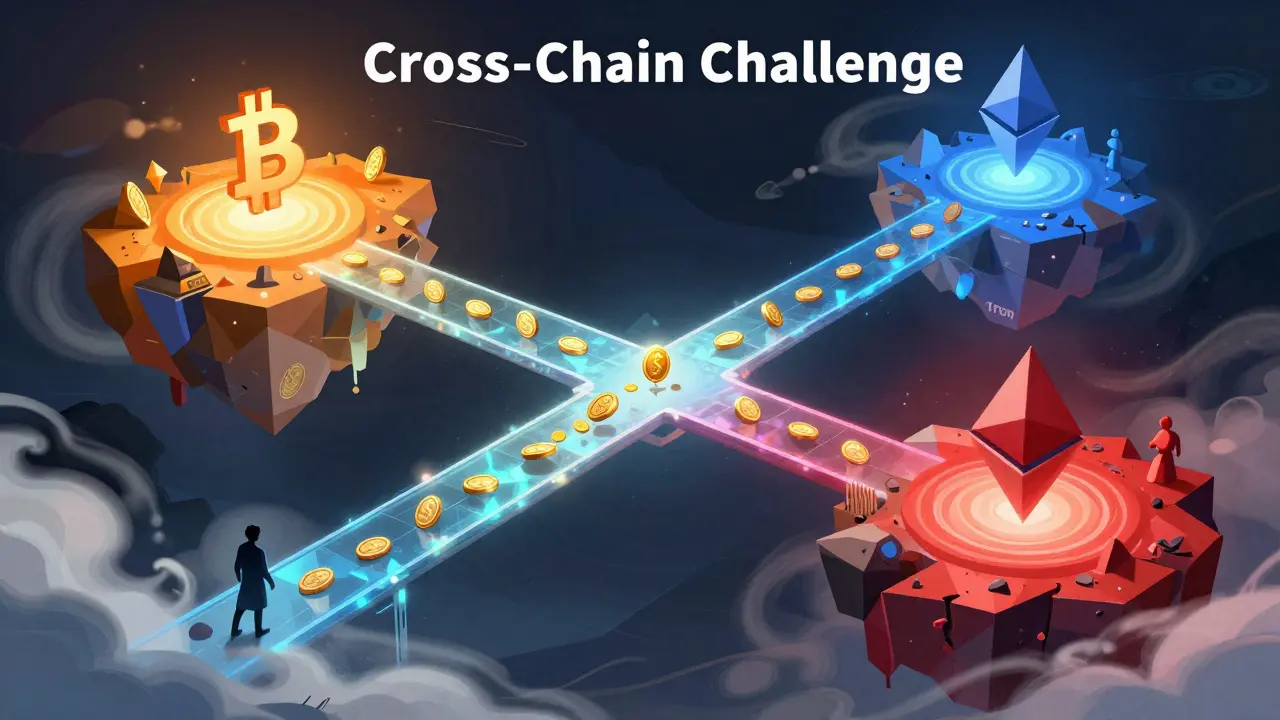
The Cross-Chain Challenge
If tracing within Bitcoin is hard, tracing across ecosystems is a nightmare. Modern launderers don’t stay on one chain. They bounce funds through Ethereum, then to Binance Smart Chain (BSC), then to Tron, often using decentralized bridges. Each hop requires investigators to pause, find the exit point on the new chain, and resume the trail. A 2024 report by Cryptoisac.org highlighted this friction, noting that "if at any point the trail becomes too convoluted... consider seeking expert assistance or more advanced tools."
Cross-chain tracing presents particular challenges because each blockchain has its own protocol and data structure. To bridge the gap, analysts must understand bridge mechanics-whether it’s a lock-mint system or a swap pool. Specialized platforms like Elliptic and TRM Labs now offer automated cross-chain tracing interfaces, but these premium tools cost approximately $27,500 annually per seat. For smaller teams, this creates a significant barrier to entry. The ability to seamlessly follow funds from a smart contract on Ethereum to a stablecoin transfer on Solana is currently the biggest differentiator between amateur and professional forensics.

Essential Tools and Skills for Investigators
You can’t do this job with just a web browser. Practical implementation requires a specific tech stack and a steep learning curve. Arkham’s 2024 guide reports that analysts typically need 3-6 months of dedicated training to become proficient. Here’s what that toolkit looks like:
- Blockchain Explorers: Free tools like Etherscan for Ethereum or Blockstream Explorer for Bitcoin allow you to view raw transaction data. These are your starting points.
- Professional Analytics Platforms: Solutions like Nansen, Elliptic, and TRM Labs provide labeled addresses, risk scores, and visualization tools. These are expensive but necessary for enterprise-grade compliance.
- Open-Source Tools: Projects like BlockSci or Chainalysis Reactor offer powerful querying capabilities for developers who want to build custom tracing scripts.
Beyond software, you need to understand obfuscation techniques. Criminals use mixers, privacy coins, and decentralized exchanges (DEXs) to break the chain of custody. Monero and Zcash accounted for 7.2% of illicit transaction volume in 2024, according to CipherTrace. While tracing Monero is nearly impossible due to its cryptographic design, tracing funds that enter or exit privacy coins via centralized exchanges is still feasible. You also need to watch out for "dusting attacks," where small amounts of crypto are sent to thousands of wallets to track them if they ever consolidate funds.
Regulatory Pressure and the Future of Tracing
The push for better tracing isn’t coming from tech enthusiasts; it’s coming from regulators. The Financial Action Task Force’s (FATF) 2019 "Travel Rule" required virtual asset service providers to share originator and beneficiary information for transactions over $1,000. This rule catalyzed the industry, driving the market from $200 million in 2019 to nearly $2 billion in 2024. In Europe, the MiCA regulation and in the U.S., Executive Order 14067, further accelerated adoption. Today, 87% of cryptocurrency exchanges use blockchain analytics tools to monitor their platforms.
But there’s a growing tension. Privacy advocates, including the Electronic Frontier Foundation, warn against surveillance overreach. Jeremy Gillula, an EFF technologist, argued in May 2024 that while tracing illicit activity is legitimate, we must ensure these tools aren’t used to undermine the privacy benefits of blockchain technology for legitimate users. This debate will shape the next decade of development.
Looking ahead, AI is the next frontier. Gartner predicts that by 2027, 70% of enterprise blockchain analytics tools will incorporate generative AI for anomaly detection. Researchers at MIT and Stanford are already developing neural networks specifically designed for transaction graph analysis. However, as David Jevans, CEO of CipherTrace, cautions, "The tracing arms race will continue indefinitely." As tracing gets smarter, so do the obfuscation techniques. With decentralized mixers accounting for 18.3% of illicit volume in 2024, the battle for transparency is far from over.
Is it possible to trace Bitcoin transactions?
Yes, absolutely. Bitcoin is pseudonymous, meaning every transaction is publicly recorded on the blockchain. While your name isn't directly attached to the address, analysts can use heuristic methods and wallet clustering to link addresses to real-world identities, especially if the funds interact with centralized exchanges that require KYC verification.
What is the difference between heuristic and graph learning tracing?
Heuristic tracing uses simple, rule-based logic (like "common input ownership") to group addresses. It’s fast and effective for single-chain analysis but struggles with complex patterns. Graph learning uses machine learning algorithms to analyze the entire transaction network as a graph, identifying complex, non-linear relationships and sophisticated laundering schemes that heuristics might miss.
How difficult is cross-chain tracing?
Cross-chain tracing is significantly more difficult than single-chain tracing. Funds moving between different blockchains (e.g., Ethereum to Tron) require analysts to understand bridge mechanics and often switch tools. Accuracy rates drop from ~89% on single chains to ~63% on cross-chain scenarios without specialized, expensive software.
Can privacy coins like Monero be traced?
Tracing Monero transactions directly is extremely difficult due to its advanced cryptographic features like ring signatures and stealth addresses. However, investigators can often trace funds entering or exiting Monero wallets via centralized exchanges or fiat on-ramps, which act as choke points for identification.
What tools do I need to start on-chain analysis?
For beginners, free blockchain explorers like Etherscan or Blockstream Explorer are sufficient. For professional work, you’ll need access to analytics platforms like Nansen, Elliptic, or TRM Labs, which provide labeled addresses, risk scoring, and visualization tools. Expect a 3-6 month learning curve to become proficient.