
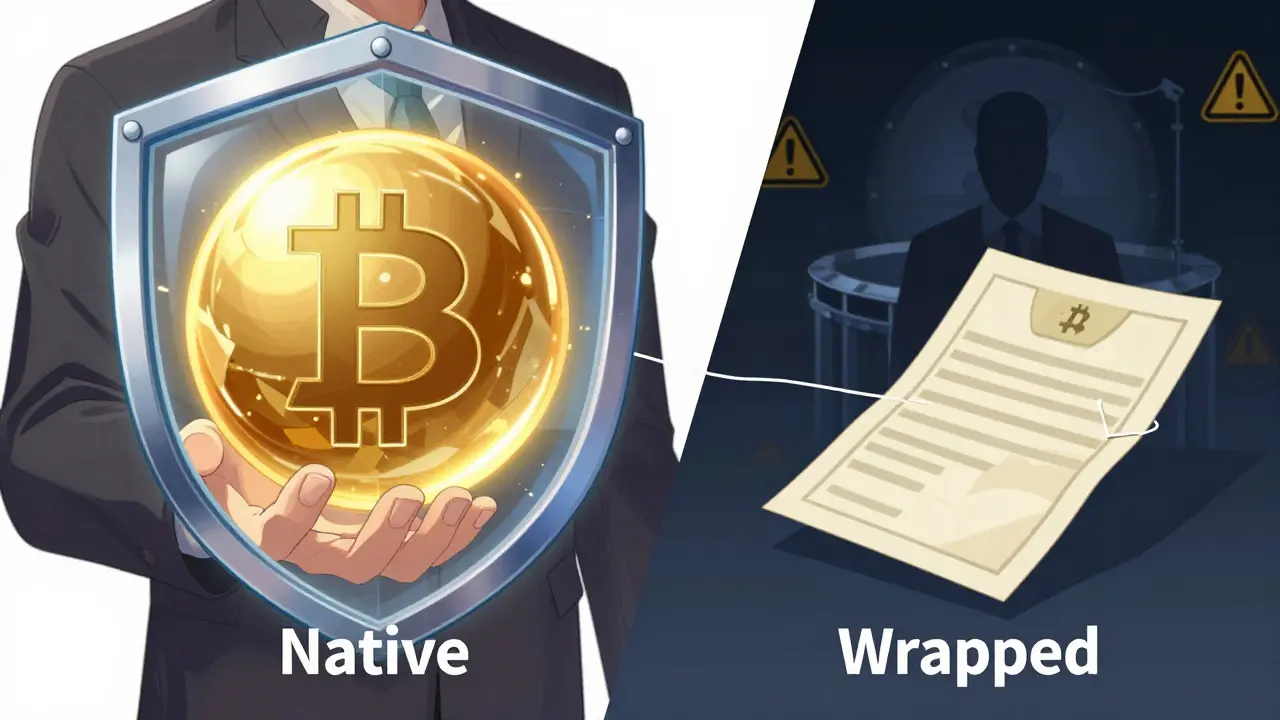
Imagine you have a physical gold bar in your safe. Now imagine someone gives you a paper certificate that says it represents that exact same gold bar. You can trade the paper easily, but if the company issuing the certificates goes bankrupt, your paper might become worthless. This is the core tension between wrapped assets and native assets on different blockchains.
In the world of cryptocurrency, this choice isn't just theoretical. It determines whether your Bitcoin sits safely in its own network or gets wrapped into a token to work on Ethereum. With over $12 billion locked in wrapped tokens as of late 2023, understanding the difference is critical for anyone participating in DeFi.
What Are Native Assets?
Native assets are cryptocurrencies that exist exclusively on their original blockchain. Think of Bitcoin (BTC) on the Bitcoin network or Ether (ETH) on the Ethereum network. These are the "real" coins. They operate under the specific consensus mechanisms of their home chains-Bitcoin uses Proof-of-Work, while Ethereum uses Proof-of-Stake.
The beauty of native assets is simplicity and security. When you hold BTC, you don't need to trust a third party to verify your balance. The entire Bitcoin network secures it. If you want to send money, you use the native protocol. There are no middlemen, no smart contracts managing your custody, and no external dependencies.
However, there is a catch. Native assets are isolated. Bitcoin cannot natively interact with Ethereum smart contracts. You cannot use BTC to lend money on Aave or provide liquidity on Uniswap directly. To do that, you need a bridge-and that’s where wrapped assets come in.
How Wrapped Assets Work
Wrapped assets are tokens created on one blockchain that represent an asset from another blockchain. The most famous example is WBTC (Wrapped Bitcoin), which allows Bitcoin holders to participate in the Ethereum ecosystem.
Here is the process:
- You send your native Bitcoin to a custodian (like BitGo).
- The custodian locks your Bitcoin in a secure vault.
- A smart contract on Ethereum mints an equivalent amount of WBTC tokens.
- You now hold WBTC, which behaves like any other ERC-20 token on Ethereum.
To get your Bitcoin back, you burn the WBTC tokens, and the custodian releases the locked Bitcoin to your wallet. This system maintains a strict 1:1 peg. For every 1 WBTC in circulation, there should be 1 BTC held in reserve.

Key Differences: Security and Control
The fundamental difference lies in who controls your funds. With native assets, you control your private keys, and the network validates transactions. With wrapped assets, you introduce trust assumptions.
| Feature | Native Asset (e.g., BTC) | Wrapped Asset (e.g., WBTC) |
|---|---|---|
| Security Model | Secured by blockchain consensus (Proof-of-Work/Stake) | Relies on custodians and smart contracts |
| Interoperability | Limited to home chain only | Can move across multiple chains (Ethereum, Polygon, etc.) |
| Trust Required | None (non-custodial) | High (must trust custodian and code) |
| Use Cases | Store of value, payments on native chain | DeFi lending, yield farming, cross-chain trading |
| Fees | Network gas/mining fees only | Minting/burning fees + network gas |
According to data from DeFi Llama, WBTC dominates the market with roughly 78% of all wrapped Bitcoin liquidity. While convenient, this centralization of liquidity creates risk. If the custodian fails, or if the smart contract has a bug, users could lose access to their funds.
The Risks of Wrapping Your Crypto
Why would anyone choose a riskier option? The answer is utility. But you must understand the dangers before wrapping your assets.
Custodial Risk: Most major wrapped tokens, including WBTC, rely on centralized entities. BitGo acts as the primary custodian for WBTC. If BitGo were hacked, went bankrupt, or froze withdrawals, your WBTC would be stuck. Remember the FTX collapse? Users holding wrapped assets backed by centralized exchanges faced weeks of delays trying to retrieve their funds.
Smart Contract Vulnerabilities: Even if the custodian is honest, the code minting and burning the tokens can fail. Security researcher Samczsun found that 63% of analyzed wrapped token implementations had at least one critical vulnerability. The Nomad Bridge hack in August 2022 resulted in a $600 million loss due to flaws in cross-chain verification logic.
Regulatory Uncertainty: The SEC has hinted that certain wrapped tokens issued by centralized entities could be classified as securities. This adds legal complexity that doesn't exist for native Bitcoin or Ether.
When Should You Use Wrapped Assets?
Despite the risks, wrapped assets are essential for the current state of DeFi. You should consider using them if:
- You want to earn yield: Native Bitcoin sits idle. Wrapped Bitcoin (WBTC) can be deposited into lending protocols like Aave or Compound to earn interest.
- You need cross-chain liquidity: If you are trading on a decentralized exchange (DEX) on Ethereum but only hold Bitcoin, you need WBTC to swap.
- You are using advanced DeFi tools: Many derivatives and options platforms require ERC-20 compatible tokens.
If your goal is simply to store value or make payments, stick to native assets. The extra step of wrapping introduces unnecessary risk for simple transactions.
The Future: Trust-Minimized Bridges
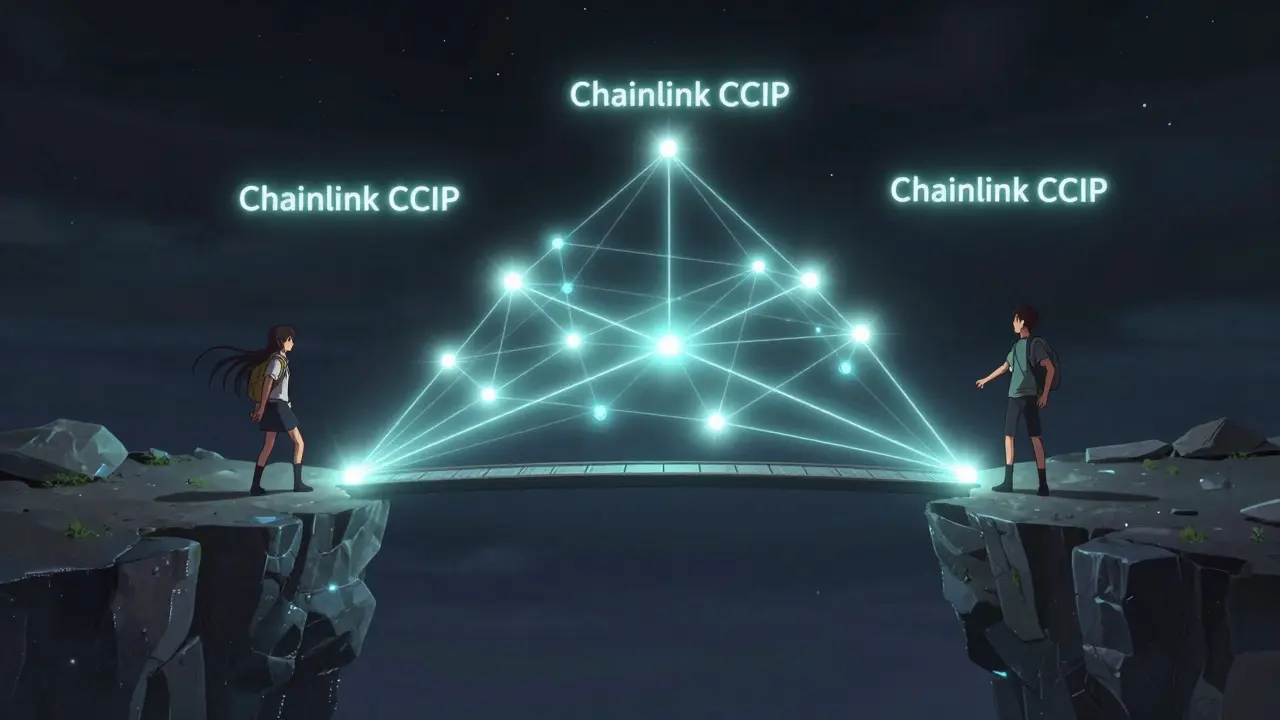
The industry is moving away from centralized custodians. New technologies like Chainlink's CCIP (Cross-Chain Interoperability Protocol) aim to create decentralized bridges. Instead of trusting a single company, these systems use oracle networks to verify transfers across chains.
Additionally, zero-knowledge proofs (ZKPs) are being developed to prove ownership of an asset on one chain without revealing private keys, allowing for "trust-minimized" wrapping. By 2025, analysts predict that 65% of wrapped assets will use these more secure, decentralized methods.
For now, however, the majority of wrapped assets still rely on the old model. Always check who the custodian is, read the audit reports, and never wrap more than you can afford to lose.
Is WBTC safe to hold?
WBTC is relatively safe compared to smaller projects because it uses established custodians like BitGo and undergoes regular audits. However, it is not risk-free. You are trusting a centralized entity with your Bitcoin. If the custodian is compromised or the smart contract has a flaw, you could lose funds. For long-term storage, native Bitcoin is always safer.
What happens if I send WBTC to a Bitcoin address?
This is a common mistake. WBTC is an ERC-20 token on Ethereum, not Bitcoin. If you send it to a native Bitcoin address, the tokens may be lost forever unless the receiving service supports recovery. Always ensure you are sending wrapped tokens to an Ethereum-compatible wallet address.
Are there fees for wrapping Bitcoin?
Yes. Minting WBTC typically involves a fee paid to merchants (around 0.2% to 0.875% depending on the provider) plus Ethereum gas fees for the transaction. Burning (redeeming) also incurs fees. These costs do not apply to holding native Bitcoin.
Can I use wrapped assets on Solana?
Yes. While WBTC is primarily on Ethereum, there are wrapped versions of Bitcoin and other assets on Solana (using the SPL token standard). For example, wSOL is Wrapped Solana, used to interact with Solana-based DeFi apps that require a standardized token format.
What is the difference between renBTC and WBTC?
WBTC relies on a centralized consortium of merchants and custodians. renBTC (RenVM) aims to be decentralized, using a network of nodes to lock and release Bitcoin. While renBTC offers less centralization risk, it currently has lower liquidity and fewer integrations than WBTC.