Bitcoin block time: How 10 minutes shapes blockchain security and mining
When you hear Bitcoin block time, the fixed interval of approximately 10 minutes between new blocks added to the Bitcoin blockchain. It’s not a suggestion—it’s a hard-coded rule that keeps the whole system running. This 10-minute window isn’t arbitrary. It was chosen by Satoshi Nakamoto to give nodes enough time to propagate new blocks across the globe without causing too many orphaned blocks. Too fast, and the network gets congested. Too slow, and users wait too long for confirmations. Bitcoin block time is the heartbeat of the network.
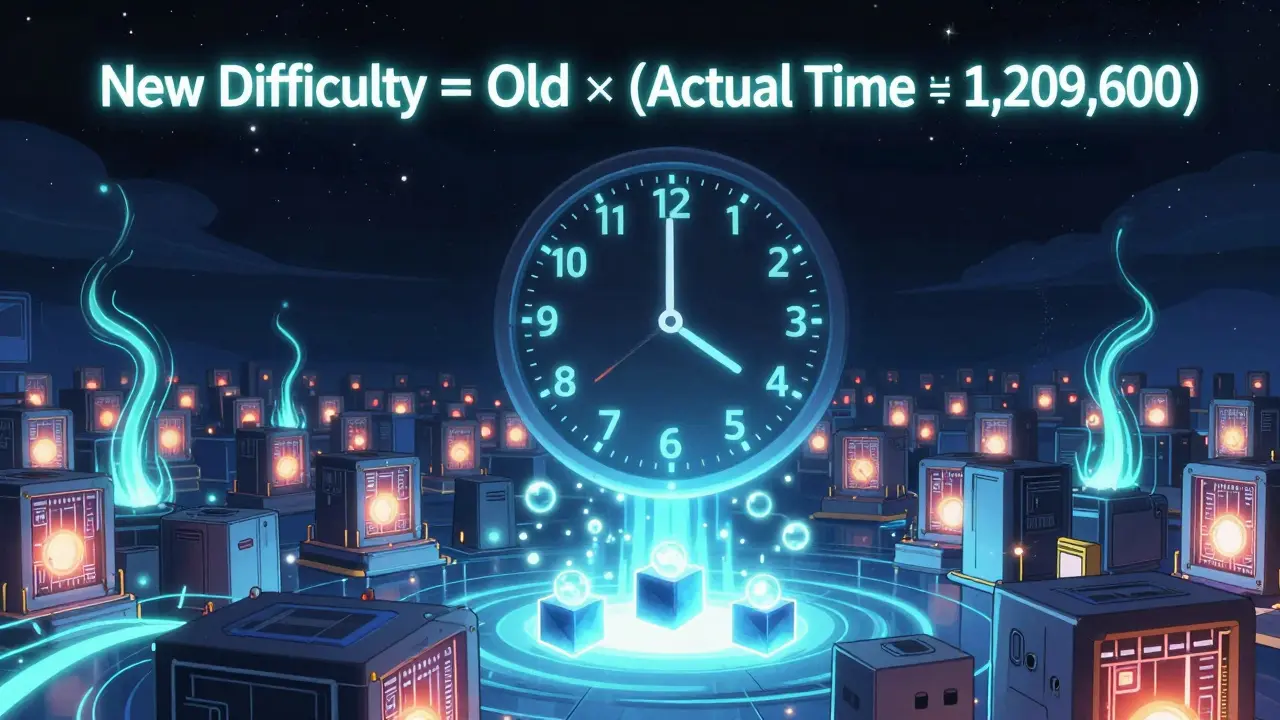
That 10-minute rhythm ties directly to Proof of Work, the consensus mechanism that secures Bitcoin by requiring miners to solve complex puzzles before adding a block. PoW makes mining expensive and energy-heavy, which deters bad actors. Every 2,016 blocks—roughly every two weeks—the network adjusts the mining difficulty to keep that 10-minute pace, no matter how many miners join or leave. If hash power spikes, difficulty rises. If miners shut down, difficulty drops. This Bitcoin mining difficulty, the measure of how hard it is to find a valid block hash is what keeps block time steady. It’s a self-correcting system designed for resilience, not speed.
That steady pace affects everything. Longer block times mean fewer transactions confirmed per hour, which is why fees rise during peak demand. It also means Bitcoin isn’t built for instant payments—unlike some altcoins that aim for 1-second blocks. But Bitcoin’s trade-off is security. More time between blocks gives the network more time to agree on the true chain, reducing the risk of double-spends and chain reorganizations. That’s why even after Taproot and Schnorr signatures improved efficiency, Bitcoin kept its 10-minute block time. Changing it would risk breaking the trust built over 15 years.
Some people think faster blocks mean better technology. But Bitcoin’s design isn’t about being the fastest—it’s about being the most secure and decentralized. The 10-minute block time is a quiet, invisible pillar holding up the entire system. It’s why Bitcoin survives attacks, regulatory pressure, and market crashes while other chains collapse. You don’t notice it when it’s working. But when it’s broken? Everything falls apart.
Below, you’ll find real-world examples of how block time impacts mining, security, and user behavior. From adaptive difficulty adjustments to scams pretending to offer "faster Bitcoin," these posts cut through the noise and show you what actually matters.