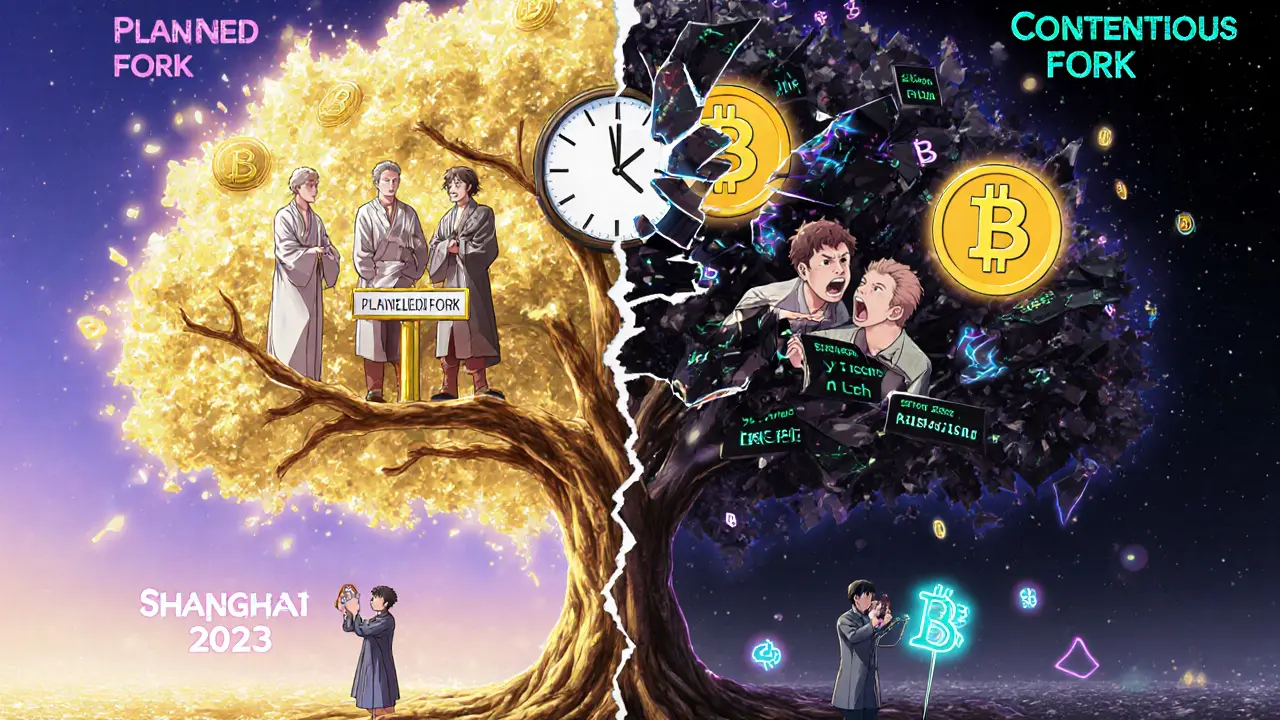
Contentious Fork: What It Is and Why It Matters in Crypto
When a contentious fork, a split in a blockchain caused by irreconcilable disagreements among developers and users. Also known as a hard fork, it happens when the community can’t agree on how to update the network—whether it’s about block size, transaction fees, or governance. This isn’t just a technical change; it’s a social rupture. Unlike smooth upgrades, a contentious fork creates two separate chains, each claiming to be the real version of the original. Bitcoin Cash and Ethereum Classic are two of the most famous examples—both born from bitter debates that split communities and wallets.
What makes a fork contentious isn’t the code—it’s the people. When one group wants faster, cheaper transactions, and another insists on absolute decentralization, compromise fails. That’s when miners, exchanges, and holders have to pick sides. Some stick with the old chain; others jump to the new one. And if an exchange doesn’t support the new fork, your coins might disappear from your balance overnight. This is why you need to know what’s happening behind the scenes—not just what the price chart shows.
Contentious forks often expose deeper problems: centralization risks, poor governance, or hidden agendas. Look at the Angola crypto mining ban or the Nigerian exchange crackdowns—those are external forces pushing crypto into corners. But internal fights? Those come from within the code itself. A contentious fork can kill a project, like the fading MUNITY token, or give birth to something new, like the $SWAP token on HyperSwap v2. Either way, it’s a reminder that blockchain isn’t just tech—it’s politics, trust, and human behavior.
What you’ll find here are real stories of splits, scams, and survival. From the genesis block’s protest message to the $37 million mining crackdown in Angola, these posts show how decisions made in code ripple into real-world consequences. You’ll learn how to spot a fake airdrop tied to a fork, why 2FA isn’t enough when your chain gets divided, and how to protect your assets when the network splits. No fluff. Just what happens when the blockchain breaks—and how to keep moving forward.