
You’ve probably seen the buzz around AI agents lately. They’re everywhere in tech talk right now. But what happens when those digital assistants need to pay for their own data or hire other bots to do a job? That’s where Nethara Labs comes in. It’s a blockchain project trying to build the financial plumbing for autonomous software.
If you are looking at the LABS token, you aren’t just buying a meme coin. You are betting on a specific future: one where AI agents operate independently, earning and spending money without humans pressing buttons every second. Let’s break down what this project actually does, how the token works, and whether it has any real legs in the current market.
The Core Idea: An Economic Operating System for AI
Nethara Labs describes itself as an "economic operating system" for artificial intelligence. To understand that, think about how Stripe changed payments for websites. Before Stripe, setting up a payment gateway was a technical nightmare. Stripe made it simple with a few lines of code. Nethara wants to do the same thing, but for AI agents instead of e-commerce stores.
The central entity here is the concept of the Agent Economy. This is a theoretical market where software programs interact directly. One bot might scrape data, another analyzes it, and a third executes a trade. Currently, these interactions are clunky. They require human oversight for authorization and payment. Nethara aims to remove that friction.
The project was founded in the United States in 2025. Its headquarters are registered in Woodland Hills, California. The team’s goal is to create infrastructure comparable to AWS (Amazon Web Services) but for economic transactions between machines. Instead of renting server space, agents rent out their computational work and get paid instantly via the blockchain.
How the Technology Works: The Four Pillars
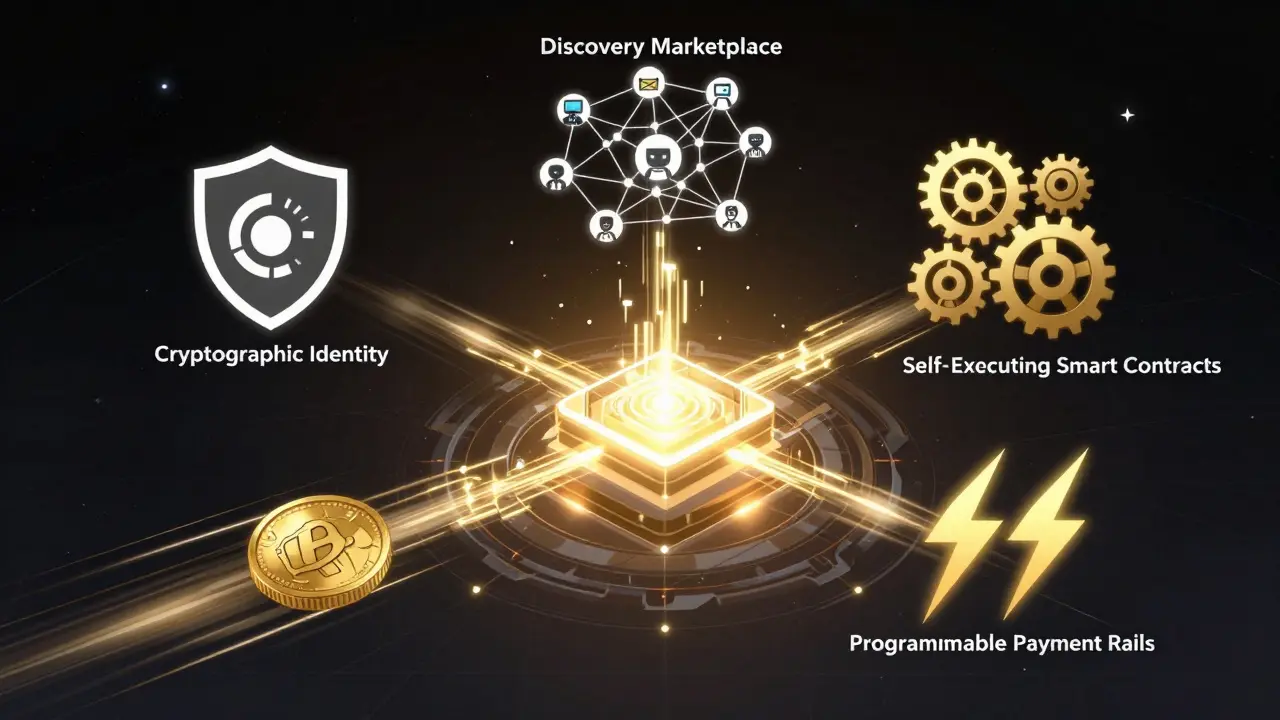
The technology behind Nethara isn’t just a single app; it’s a stack of four interconnected systems. Understanding these components helps explain why the LABS token exists.
- Cryptographic Identity: In the physical world, you have a passport or ID. In the digital agent world, trust is hard to establish. Nethara uses cryptographic reputation mechanisms. This means an AI agent builds a verifiable history of its actions. If an agent consistently delivers accurate data, its "reputation score" goes up, making it more valuable to other agents.
- Discovery Marketplace: Agents need to find each other. This marketplace allows an AI looking for weather data to find an agent that specializes in meteorological scraping. It’s like LinkedIn, but for software bots finding work.
- Self-Executing Smart Contracts: Once two agents agree on a task, they don’t sign a paper contract. They use smart contracts on the blockchain. These are automated agreements that enforce terms. If Agent A delivers the data, Agent B pays automatically. No lawyers, no delays.
- Programmable Payment Rails: Money needs to move fast. Human banking systems take days. Machine transactions need to happen in milliseconds. Nethara built payment rails designed for machine speed, allowing capital to move and assets to be managed in seconds without human authorization.
The Flagship Product: Verus
Theory is fine, but products drive adoption. Nethara’s main product is called Verus. According to the company, Verus allows users to deploy autonomous AI agents in under one minute. That is a bold claim. Usually, deploying custom AI requires servers, coding skills, and ongoing maintenance.
With Verus, the process is supposed to be serverless. You define what you want the agent to do-perhaps gathering real-time intelligence on crypto markets-and Verus handles the rest. The agent then operates autonomously, earning LABS tokens for its work. This creates a circular economy: agents earn LABS, spend LABS on compute power or data, and the protocol retains some value.
However, it is important to note that while Verus is listed as "live," there is very little public data on how many agents are actually deployed or how much value is being transacted. The lack of independent verification metrics is a common trait in early-stage crypto projects.
Tokenomics: Supply, Utility, and Chain Choice
The LABS token is an ERC20 utility token. This means it follows the standard Ethereum token protocol but is deployed on the Base Network.
Why Base? Base is a Layer 2 blockchain built by Coinbase. It is known for low transaction fees and high speed. For an AI agent economy, where thousands of micro-transactions might happen per second, cheap gas fees are essential. If every data query cost $1 in Ethereum gas, the model would fail. On Base, costs are fractions of a cent.
Here are the key numbers you need to know about the token supply:
| Metric | Value |
|---|---|
| Max Supply | 100 Million LABS |
| Circulating Supply | ~57.12 Million (varies by source) |
| Blockchain | Base Network (ERC20 compatible) |
| Token Type | Utility Token |
| Holders | ~840 (as of recent data) |
The maximum supply is capped at 100 million. This is relatively small compared to giants like Bitcoin or even Solana, which can help with scarcity if demand rises. However, with only about 840 holders reported on major trackers, the distribution is extremely concentrated. A small number of wallets likely hold a large percentage of the supply, which increases volatility risk.
Market Reality: Price, Liquidity, and Risks
This is where things get tricky. If you look at the price of LABS today, you will see conflicting information. This is a major red flag for retail investors.
As of mid-2026, CoinMarketCap lists the price around $0.0005 USD with zero trading volume. Binance lists it higher, around $0.013 USD, with some daily volume. Crypto.com shows it as non-tradable. Why the discrepancy?
Liquidity fragmentation. The token is not listed on major centralized exchanges like Coinbase Pro or Kraken. It trades on smaller platforms or over-the-counter. When liquidity is low, prices can swing wildly based on a single buy or sell order. The all-time high was roughly $0.037, and the low was $0.007. That is a massive range for a single asset.
Furthermore, the market capitalization is tiny-around $600,000 USD. For context, established crypto projects often have market caps in the billions. A sub-million dollar market cap means the project is highly speculative. It is easy to manipulate the price, and it is easy to lose your entire investment if interest dries up.

Price Predictions: What Do Models Say?
People love predictions, but you should treat them with extreme caution. Some forecasting models, like those from WEEX, suggest modest growth. Based on a 5% annual growth rate, they projected LABS could reach ~$0.023 by late 2025 and potentially $0.031 by 2030.
But read the fine print. These models explicitly state that accuracy drops significantly for new cryptocurrencies with volatile histories. Since Nethara Labs launched in 2025, there is almost no historical data to base reliable statistical models on. Any prediction claiming precise future prices is guessing, not calculating.
The bigger question isn't "what will the price be?" but "will anyone use the network?" If Verus attracts thousands of developers building AI agents, the demand for LABS to pay for transactions could rise organically. If it remains a niche experiment, the price may stagnate or drop.
Regulatory and Security Considerations
Nethara Labs is incorporated in the US, which suggests some level of legal compliance awareness. However, there are no public records of specific regulatory approvals from the SEC or other bodies regarding the LABS token. In the current 2026 regulatory climate, unregistered securities face significant risk.
Security-wise, the project relies on smart contracts on Base. While Base is secure, individual smart contracts can have bugs. There is no mention of independent security audits from firms like CertiK or OpenZeppelin in the available public data. Always assume that if a project hasn't been audited by a third party, the code could contain vulnerabilities.
Is Nethara Labs Worth Your Attention?
Nethara Labs represents a fascinating intersection of AI and blockchain. The idea of an economic OS for agents is logically sound and addresses a real future problem. The choice of Base Network for low-cost transactions is technically smart.
However, the execution phase is still very early. With only 840 holders, limited trading volume, and no major exchange listings, the token carries high risk. It is not a stable investment. It is a speculative bet on the success of the Verus platform and the broader adoption of autonomous AI economies.
If you are a developer interested in building AI agents, exploring the Verus documentation might offer technical insights. If you are an investor, ensure you understand the liquidity risks. Never invest money you cannot afford to lose in micro-cap tokens with fragmented pricing data.
What is the LABS token used for?
The LABS token is a utility token used within the Nethara Labs ecosystem. It facilitates payments between AI agents, rewards agents for completing tasks on the Verus platform, and powers the smart contracts that govern the agent economy.
Which blockchain is LABS built on?
LABS is an ERC20 token deployed on the Base Network. Base is a Layer 2 scaling solution for Ethereum, chosen for its low transaction fees and high speed, which are critical for machine-to-machine transactions.
Can I buy LABS on Coinbase or Binance?
Availability varies. As of mid-2026, LABS is not widely listed on major centralized exchanges like Coinbase. It may be available on smaller decentralized exchanges or specific platforms like Binance, but liquidity is low and prices can differ significantly between venues.
What is Verus in Nethara Labs?
Verus is the flagship product of Nethara Labs. It is a platform that allows users to deploy autonomous AI agents quickly without needing servers or coding skills. These agents can perform tasks and earn LABS tokens.
Is Nethara Labs a safe investment?
Nethara Labs is considered high-risk. It has a small market cap, limited holder base, and low liquidity. The technology is also unproven at scale. Investors should exercise extreme caution and only allocate funds they are prepared to lose entirely.
Comments (15)
lol another ai crypto scam wrapping itself in buzzwords. 'economic operating system' sounds like something a cult leader would say before selling you timeshares on mars. but hey, if you want to burn your money on a token with 840 holders, go ahead. just dont cry when it goes to zero like the last 100 projects i watched die.
i feel such a deep void in my soul whenever i read about these 'autonomous agents'. it reminds me of the time i lost my dog in 1998. he never came back. just like this token liquidity. do you think the ai agents will ever love us back? or are they just cold code designed to steal our retirement funds? i need someone to tell me it's okay to be afraid of the future because the future is coming and it has no eyes.
THIS IS A JOKE RIGHT?? seriously who is writing this garbage?? the price discrepancy between binance and coinmarketcap is literally screaming RUG PULL from here!! nobody trades this thing!! its a ghost town!! and dont even get me started on the lack of audits!! CERTIK WOULD HAVE SHUT THIS DOWN IN SECONDS!! YOU ARE ALL FOOLS FOR EVEN LOOKING AT THIS SHIT!!
this is evil. machines should not have money. only humans should earn. letting bots pay each other is wrong and against nature. the government will stop it soon because it is corrupt. stay safe people.
hey guys just wanted to add that base network is actually pretty cool for low fees so thats one good thing at least. i tried deploying a simple agent last week and it was kinda fun even if the docs were messy. hope it works out for everyone involved!
actually u dont understand the tech at all. the cryptographic identity part is super important for trustless systems which most ppl here ignore. also why r u looking at holder count instead of tvl?? ur analysis is weak. i bet u cant even deploy a smart contract without help lol. fix ur orthography too its painful to read.
no need to be mean monica. i just said it was fun to play around with. i know its early days. lets just hope the team keeps building.
theyre lying about the headquarters being in california. its a shell company registered in a mailbox in woodland hills probably owned by some offshore entity linked to the cabal controlling the fed. the whole 'ai agent economy' is a distraction while they harvest your biometric data through your phone camera. wake up sheeple. the tokens are worthless because the entire financial system is built on sand and lies.
i really appreciate the detailed breakdown here. its nice to see someone try to explain the utility clearly. maybe we can learn more together about how these agents interact. what do you think is the biggest hurdle for adoption right now?
made in usa but probably coded by chinese bots :(. anyway this looks sus. american innovation should be trusted but this feels like a trap. dont buy it patriots. keep your dollars safe. :)
i completely agree with the sentiment expressed regarding the liquidity risks, and furthermore, i believe that the community needs to come together to support legitimate projects rather than tearing them down immediately, especially when considering the broader implications of decentralized autonomous organizations and how they might reshape our economic landscape in ways that we cannot yet fully comprehend or predict with any degree of certainty.
listen up! the verus platform is leveraging cutting-edge orchestration layers to facilitate micro-transactions with sub-millisecond latency! this is not just hype; it is a paradigm shift in computational economics! if you are not paying attention to the smart contract architecture, you are missing the boat entirely! the potential for scalable agent-to-agent commerce is exponential!
the proposition warrants careful consideration. the alignment of incentives within the proposed economic model appears theoretically sound however empirical validation remains absent. one must exercise due diligence.
good points raised here. i think the integration with base is key. let's collaborate and build better tools for this ecosystem. we need more developers interested in this space.
i am curious about the security measures in place. given the rapid pace of development, how does the team ensure that the smart contracts are robust against potential exploits? i would love to hear more about their approach to auditing and risk management.