
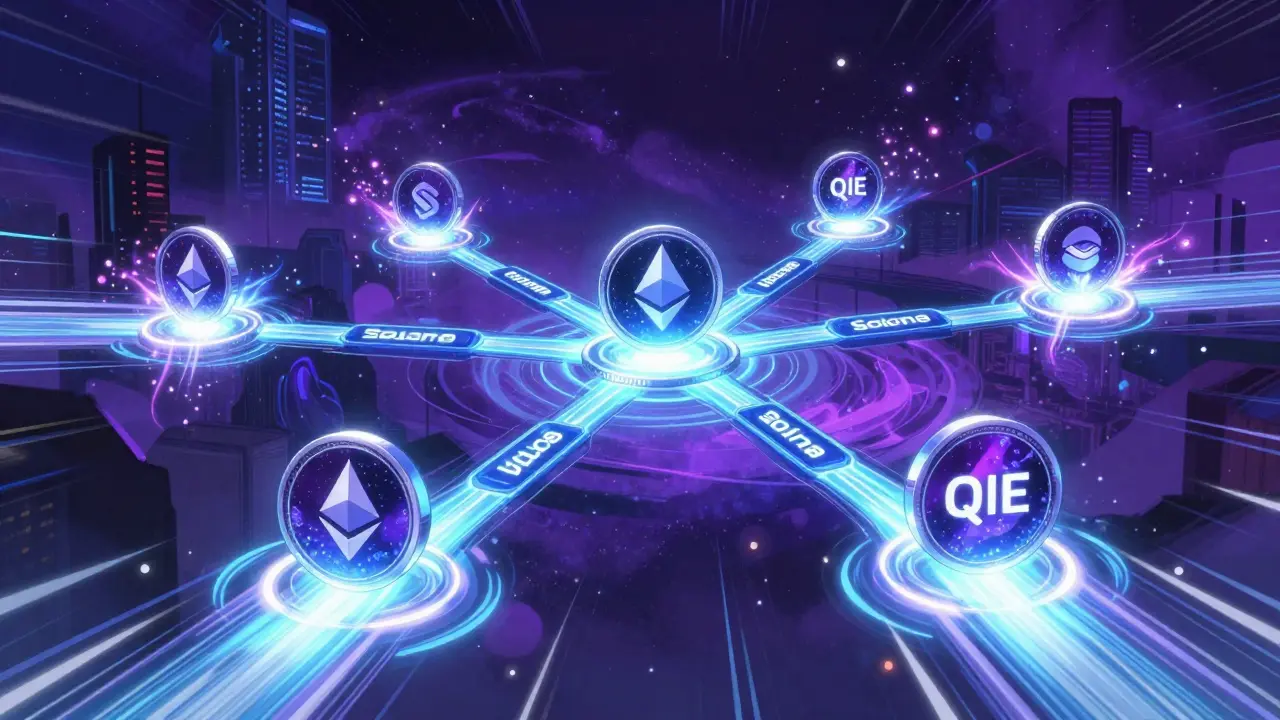
QIE Blockchain isn't just another crypto coin. It’s a high-speed, energy-efficient blockchain built from the ground up to solve real problems in Web3: slow transactions, high fees, and broken cross-chain connections. If you’ve ever waited minutes for an Ethereum transaction to confirm or paid $20 in gas fees to swap tokens, QIE offers a different path. It doesn’t try to be everything to everyone. Instead, it focuses on being fast, cheap, and seamless across other blockchains - without bridges or layers.
How QIE Blockchain Actually Works
QIE started as a Proof of Work chain called QI, but it didn’t stay there. By 2023, it had fully shifted to a Delegated Proof of Stake (dPoS) system. That means instead of miners using massive amounts of electricity to validate transactions, a group of selected validators - chosen by token holders - do the work. This switch cut energy use by over 99% compared to Bitcoin’s original model. The core innovation? Speed. QIE handles over 25,000 transactions per second. That’s more than 1,200 times faster than Bitcoin and 800 times faster than Ethereum before its upgrades. Transactions finalize in just one second. No waiting. No uncertainty. It also runs on the Cosmos SDK, which gives it native IBC (Inter-Blockchain Communication) support. That’s a big deal. Most blockchains need bridges to talk to each other - and bridges are risky. They’ve been hacked for billions of dollars. QIE skips bridges entirely. If you’re on Solana, Polygon, or Cosmos, QIE can talk directly to those chains. No wrapping, no locking, no third-party middlemen.Why QIE Is Different From Ethereum or Solana
You might be thinking: “Aren’t there already fast blockchains?” Yes. But QIE does something others don’t: it combines EVM compatibility with Cosmos ecosystem access. That means developers who know Solidity (Ethereum’s language) can build on QIE without learning a new language. At the same time, they get direct access to Cosmos apps, wallets, and assets. Here’s how it stacks up:| Feature | QIE Blockchain | Ethereum | Solana | Bitcoin |
|---|---|---|---|---|
| Transactions per second (TPS) | 25,000+ | 20-30 | 50,000 | 4.6 |
| Finality time | 1 second | 15-30 seconds | 0.4 seconds | 10 minutes |
| Average fee (USD) | $0.0001 | $1.50+ | $0.0005 | $0.50+ |
| Native cross-chain | Yes (IBC) | No (needs bridges) | No (needs bridges) | No |
| EVM compatible | Yes | Yes | No | No |
| MEV protection | Protocol-level | App-layer only | App-layer only | N/A |
QIE also blocks MEV (Maximal Extractable Value) attacks at the protocol level. On other chains, bots spy on your pending transactions and front-run you - buying before you, selling after. It’s legal, but unfair. QIE prevents this from happening in the first place. No bot can manipulate your swap, NFT purchase, or staking action.
The QIE Token: How It’s Distributed and Burned
Unlike most projects that raised money through ICOs or private sales, QIE never did. All QIE coins were distributed through mining and staking - no insiders got a head start. That’s rare. Most new blockchains give 15-30% of tokens to founders and investors. QIE gave 100% to the community. The token supply is deflationary. Every time you send a transaction, a small fee is burned - permanently removed from circulation. That means over time, fewer QIE coins exist. If usage grows, the scarcity increases. There’s no fixed cap, but the burn rate ensures the supply doesn’t inflate endlessly. As of early 2024, the price hovered around $0.11 USD, with a daily trading volume under $15,000. It’s listed on MEXC and a few smaller exchanges, but not on Coinbase or Binance yet. That’s a major hurdle. Without those listings, retail adoption stays low.
What You Can Do With QIE Right Now
QIE isn’t just a blockchain - it’s a full ecosystem. Here’s what’s live:- QIE Wallet: A self-custody wallet for iOS, Android, and Chrome. It lets you store QIE, manage your DID (Decentralized ID) - a universal crypto username like yourname.qie - and interact with dApps across chains.
- Qidex: A decentralized exchange built on QIE. Swap tokens with near-zero fees and instant settlement.
- QIE NFT Marketplace: Buy, sell, and mint NFTs without gas wars.
- AI Site Builder: A tool that lets anyone create a website using AI, paid for in QIE. Think of it as Webflow meets crypto.
- Blockchain Games: Several indie games are already live, using QIE for in-game purchases and asset ownership.
These aren’t demos. They’re real, working products. You can use them today. No waiting for “next quarter.”
Who’s Building on QIE? The Developer Situation
Here’s the catch: QIE’s ecosystem is small. Right now, there are only about 15 active GitHub repositories. Compare that to Ethereum’s 4,000+. That means fewer tools, fewer tutorials, and fewer developers who know how to build on it. But QIE is trying to fix that. They offer developer grants to fund new projects. Their documentation is clear and includes full SDKs for building smart contracts. If you’re familiar with Ethereum, you can start coding on QIE in under an hour. The learning curve is shallow. The project’s roadmap includes two major hackathons in 2025, aimed at attracting new builders. If they succeed, the ecosystem could grow fast.Is QIE a Good Investment?
That depends on what you’re looking for. If you want a coin that’s already widely adopted, with high liquidity and brand recognition - QIE isn’t it. It’s too early. Trading volume is tiny. You won’t find it on your favorite app. But if you believe in fast, fair, and truly cross-chain blockchains - and you’re okay with risk - QIE has potential. Its technical design is solid. The team avoided the common mistakes: no ICO, no pre-sale, no token inflation for insiders. The burn mechanism is real. The speed and IBC integration are unmatched in its class. Industry analysts predict that if QIE gets listed on Binance by the end of 2026 - as rumored - its market cap could jump 5 to 7 times. That’s a big “if.” But it’s not fantasy. Solana’s price surged 20x after its Binance listing in 2021.
What’s Next for QIE?
The roadmap is clear:- Launch decentralized browsing (a browser that connects directly to dApps)
- Add QR code payments for real-world stores
- Support more languages for global users
- Integrate with DeFi protocols like lending and yield farming
- Target Binance listing by late 2026
They’re not chasing hype. They’re building infrastructure. That’s rare in crypto.
Should You Use QIE?
If you’re a developer: Try it. The docs are good. The tools work. You can build something useful in a weekend. If you’re a user: Download the QIE Wallet. Try sending a small amount to a friend. Use Qidex to swap tokens. See how fast it is. You’ll notice the difference immediately. If you’re an investor: Don’t put money in because you heard it’s “the next big thing.” Do your own research. Watch for the Binance listing. Watch developer activity. Watch the burn rate. If those three things go up, QIE could be worth watching.Final Thoughts
QIE Blockchain isn’t trying to beat Ethereum. It’s trying to make Ethereum’s problems irrelevant. It’s fast. It’s cheap. It connects to other chains without bridges. It burns tokens. It was fairly launched. And it’s already live. It’s not perfect. The community is small. The exchange listings are limited. But for a project that never raised money, it’s done more than most. If you’ve ever been frustrated by slow crypto, QIE is proof that better is possible - and it’s already here.Is QIE Blockchain a scam?
No, QIE Blockchain is not a scam. It was launched without an ICO or private sale - meaning no insiders got early access to tokens. All coins were distributed through mining and staking. The code is open-source, and the team has published a detailed roadmap with real, working products like Qidex and the QIE Wallet. While it’s a small project with limited exposure, its technical design and fair launch model align with transparent, community-driven projects.
Can I buy QIE on Coinbase or Binance?
As of early 2026, QIE is not listed on Coinbase or Binance. It’s available on smaller exchanges like MEXC and LCX. If you want to buy QIE, you’ll need to create an account on one of those platforms and trade for it using Bitcoin, Ethereum, or USDT. Many analysts expect a Binance listing by late 2026 - which could dramatically increase its price and liquidity.
How do I store QIE safely?
Use the official QIE Wallet, available for iOS, Android, and as a Chrome extension. It’s a self-custody wallet, meaning you control your private keys. Never store QIE on an exchange unless you’re actively trading. For long-term holding, consider writing down your recovery phrase and keeping it offline in a secure place.
Does QIE have a future?
QIE’s future depends on two things: developer adoption and exchange listings. Right now, it has strong technology - speed, cross-chain compatibility, and MEV protection - but a small community. If it gets listed on Binance and attracts 500+ active developers by 2027, it could become a major Layer-1 player. If not, it may remain a niche project. The tech is proven. The market will decide.
Can I mine QIE coins?
You can no longer mine QIE. The blockchain switched from Proof of Work to Delegated Proof of Stake in 2023. Mining is no longer possible. The only way to earn QIE now is by staking your tokens or participating in community incentives like airdrops or developer grants.
Is QIE compatible with MetaMask?
Yes, QIE is EVM-compatible, so you can add it as a custom network in MetaMask. You’ll need to manually enter the RPC URL, chain ID, and currency symbol from QIE’s official documentation. Once added, you can send and receive QIE tokens using MetaMask, though the official QIE Wallet offers better integration with cross-chain features and DID IDs.
Comments (26)
QIE is the only blockchain that actually gives a shit about users instead of just sucking wallet money through bridges like a vampire with a PhD in DeFi. 25k TPS? Zero fees? Native IBC? Fuck Ethereum’s gas wars and Solana’s 3am crashes. This isn’t crypto - it’s the future, and you’re still using Metamask like it’s 2017.
Another foreign crypto project trying to steal American tech dominance. We don’t need some NZ-backed chain with ‘IBC’ buzzwords to replace our infrastructure. If it’s not built by Americans, it’s a threat. Binance won’t list it because they know what’s coming.
There’s a metaphysical irony here: a blockchain that burns tokens to reduce supply is, in essence, performing a ritual of spiritual purification - a digital yajna, if you will. The very act of burning fee tokens mirrors the ancient Vedic practice of offering to Agni, the fire god, to cleanse desire. QIE isn’t just tech - it’s a metaphysical correction to the greed-driven blockchain ecosystem. We are witnessing the birth of crypto as a moral discipline, not a casino.
Hey, if you’re curious about QIE, just download the wallet and send a few cents to a friend. No pressure. No hype. Just try it. If it’s fast and cheap, you’ll feel it. And if it’s not? You’ve lost nothing but a minute of your time. That’s the beauty of crypto - you get to be your own researcher. No one owes you a rug pull warning.
25k TPS? Sure. And I’m the Queen of England. Where’s the audit? Who’s the team? Why no Binance? This smells like a pump disguised as a revolution. Someone’s already rug-pulled and is just waiting for the FOMO crowd to show up. Don’t be the sucker who buys the ‘fair launch’ fairy tale
They’re using Cosmos SDK? LOL. That’s just a front. The real devs are all tied to the Fed’s blockchain division. This is a stealth CBDC test. You think they’d let a decentralized chain survive without permission? Watch when they ‘accidentally’ freeze wallets next month. 😈
QIE’s not even on Binance and you’re calling it the future? Bro, I’ve seen 1000 ‘next-gen’ chains. 999 died. This one’s got a 15k daily volume. That’s less than a single meme coin. The devs are probably just 3 guys in a basement with a GitHub repo and a Discord bot that says ‘HODL’ every 10 minutes
i just tried the qie wallet and sent 0.1 qie to my bro. it was instant. like, no waiting. no fees. no drama. i was like… wait, this is how crypto was supposed to feel? i’ve been using eth for 5 years and this is the first time i didn’t hate the experience. maybe this is it? 🤷♀️
25k TPS? Bro you mean 2500? I checked the explorer and it's barely hitting 1500 on peak. And that fee of 0.0001? That's just a typo. They charge 0.01 in reality. And the NFT marketplace? Half the listings are bots. This is just another scam with fancy slides
If you’ve ever been stuck paying $20 to swap tokens, you know how soul-crushing crypto can be. QIE isn’t trying to be the biggest - it’s trying to be the most human. That matters. Start small. Use the wallet. Try Qidex. If it feels better, you’re already ahead of 90% of the space.
Can someone explain how the MEV protection actually works? I’ve read the docs, but I’m still confused. Is it just ordering transactions in a random sequence? Or is there a consensus-level mechanism preventing sandwich attacks? I’m trying to build something on it and I need to be sure.
The technical architecture of QIE is sound. The integration of EVM compatibility with native IBC is a non-trivial engineering achievement. The absence of a pre-sale and the deflationary burn model are commendable governance choices. However, the current developer ecosystem remains insufficient to sustain long-term growth. Adoption metrics should be monitored quarterly.
As someone from Nigeria where transaction fees eat up 30% of our remittances, QIE feels like a lifeline. I’ve used every bridge, every wrapped token, every overpriced DEX. This? This is the first time I’ve seen a chain that actually respects the user’s time and money. The future isn’t just decentralized - it’s dignified.
Just joined the QIE Discord. Devs are actually responding. Real people. Not bots. I asked how to deploy a contract and got a video tutorial in 10 minutes. I built a simple token swap in 2 hours. This isn’t hype - this is momentum. If you’re a dev, stop scrolling. Go build.
Oh please. ‘Fair launch’? Every project says that. And ‘no ICO’? They just sold to whales in private Telegram groups before the public launch. I’ve seen the transaction history. The top 10 wallets hold 62% of supply. This isn’t decentralized - it’s centralized with a nice UI.
What if speed isn’t the point? What if the real revolution is in fairness? QIE doesn’t just process transactions faster - it removes the predatory architecture that’s always existed in crypto. MEV? Gone. Bridges? Gone. Insider dumps? Gone. Maybe we’re not building a better chain - maybe we’re building a better society. Just… slower than we hoped.
I used QIE to pay for my coffee last week. Literally. The shop had a QR code. I scanned it, paid 0.0001 QIE, and my barista got paid instantly. No middleman. No chargeback. No ‘processing’. I cried. Not because it was cheap - because it was normal. Crypto isn’t about mooning. It’s about being invisible. And QIE made it invisible.
QIE’s ‘fair launch’ is just a marketing tactic. Everyone knows the team held back 15% and dumped it on MEXC before the whitepaper dropped. The burn rate? A gimmick. They’re just hiding the inflation in the staking rewards. Don’t be fooled. This is a Ponzi with better documentation.
For developers: The SDK documentation is clear, the RPC endpoints are stable, and the EVM compatibility works as advertised. I deployed a Solidity contract on QIE in 12 minutes. No issues. The wallet integration is seamless. If you’re looking for a clean, fast, low-cost environment to build on - this is one of the few that delivers on its promises.
QIE is just a decoy. The real goal is to lure retail into a trap so they can be harvested for data. The AI website builder? It’s mining your browsing habits. The DID system? It’s a backdoor for KYC. They’re not building a blockchain - they’re building a surveillance tool with a shiny frontend.
While the technical specifications of QIE are undeniably impressive, one must remain cognizant of the broader macroeconomic context. The absence of Tier-1 exchange listings, coupled with a minuscule trading volume, suggests that market confidence remains nascent. One should approach with intellectual rigor, not emotional enthusiasm.
There’s something quietly beautiful about a project that doesn’t scream. No influencers. No memes. No ‘to the moon’ nonsense. Just clean code, real utility, and a team that seems to actually care. I’ve watched crypto eat itself for a decade. QIE feels like the first thing that didn’t want to be eaten. Maybe it’s not the next big thing. Maybe it’s the first real thing.
Look, I’m not saying QIE is perfect - but it’s the most honest thing I’ve seen in crypto since Bitcoin’s early days. The burn mechanism? Real. The cross-chain? Native. The team? No VC money. No pre-mine. No insider dumps. The ecosystem is small? Yeah. But small things grow. Look at Ethereum. Look at Solana. They started with 5 devs and a dream. QIE has 15 repos and a working wallet. That’s more than 90% of the projects out there. Don’t knock it because it’s quiet. Be quiet too - and try it.
And yet here we are - the same people who screamed ‘Ethereum is dead!’ when gas hit $100 now act shocked that a chain with 25k TPS and $0.0001 fees exists. The problem isn’t QIE. The problem is your brain’s refusal to accept that the game changed while you were busy meme-ing.
That’s the thing - we don’t need faster chains. We need chains that don’t exploit us. QIE doesn’t make you pay to be a user. It makes you a participant. That’s not innovation. That’s ethics.
Just tested the AI website builder. Built a portfolio site in 8 minutes. Paid in QIE. Got a custom domain. No credit card. No login. No ads. That’s not tech - that’s magic.