
Imagine posting a photo and actually owning it. Not just the file on your phone, but the digital record of who saw it, who liked it, and how much value it generated. For over a decade, centralized giants like Meta and X (formerly Twitter) have treated user data as their private property, harvesting billions in ad revenue while users get nothing but targeted ads in return. That model is cracking.
In 2026, decentralized social networks are no longer just a niche experiment for crypto enthusiasts. They are a viable alternative for creators, privacy advocates, and communities tired of algorithmic censorship and sudden platform bans. These networks run on blockchain technology, shifting control from corporate servers to distributed nodes. But what does that actually mean for your daily scrolling? And is it worth the learning curve?
What Are Decentralized Social Networks?
Decentralized social networks are online platforms where data storage, identity verification, and content distribution are managed by a distributed network of computers rather than a single central authority. Unlike traditional social media, which relies on proprietary databases controlled by one company, these networks use blockchain or federated protocols to ensure no single entity can unilaterally alter or delete your history.
The core idea is simple: you own your identity. In a centralized system, if Facebook deletes your account, your friends list, posts, and followers vanish with it. In a decentralized system, your profile is tied to a cryptographic key pair-a public address and a private key-that you hold. If one app shuts down, you can take your followers and content to another app built on the same protocol.
This shift emerged around 2016-2017 when developers realized blockchain could do more than track cryptocurrency transactions. Early projects like Steemit launched in July 2016, offering users tokens for creating content. While Steemit pioneered the concept, the ecosystem has since matured into distinct categories: blockchain-native protocols like Lens Protocol and Farcaster, and federated systems using the ActivityPub standard, such as Mastodon.
How the Technology Actually Works
To understand why these networks are different, you need to look under the hood. Traditional social media uses a client-server model. Your device sends data to a central server, which processes it and sends it back. This creates a single point of failure-if the server crashes, the whole platform goes offline (as seen with Meta’s massive outage in October 2022).
Decentralized networks operate differently depending on their architecture:
- Blockchain-Native (e.g., Lens Protocol): These run on blockchains like Polygon (a Layer 2 solution for Ethereum). Every action-following someone, liking a post-is recorded as a transaction on the ledger. This ensures immutability; once a post is made, it cannot be altered or deleted by anyone except the creator. However, this comes with costs. As of late 2023, interactions cost between $0.01 and $0.50 in gas fees, though Layer 2 optimizations have significantly reduced this.
- Federated (e.g., Mastodon): These use the ActivityPub protocol. Instead of a global blockchain, they consist of independent servers called "instances." Each instance is run by an individual or organization. You join one instance, but you can interact with users on other instances. There is no global ledger, but there is no single owner either. If your instance administrator acts badly, you can migrate your account to another instance without losing your followers.
The security backbone for both types is cryptographic hashing. Each block of data contains a unique digital fingerprint (hash) linked to the previous block. To tamper with data, an attacker would need to rewrite the entire chain across more than 51% of the network’s computing power simultaneously-a feat considered computationally impossible for established networks.
Centralized vs. Decentralized: The Real Trade-offs
Switching to decentralized social media isn’t about finding a "better" version of Instagram. It’s about choosing different priorities. Here is how they compare based on real-world metrics from 2023-2024 data:
| Feature | Centralized (e.g., Meta, X) | Decentralized (e.g., Lens, Mastodon) |
|---|---|---|
| Data Ownership | Platform owns all user data | User owns data via private keys |
| Censorship Resistance | Low (platforms can ban/delete at will) | High (requires community consensus or migration) |
| Monetization | Ads only; creators earn little | Token economies; direct creator payments |
| Uptime Reliability | Vulnerable to outages (14 major outages for Meta in 2022) | High (99.98% uptime due to distributed nodes) |
| Onboarding Difficulty | Easy (email/password) | Hard (wallet setup, seed phrases, gas fees) |
| Content Moderation | Automated + Human teams | Community-driven or instance-based |
The most significant advantage is sovereignty. According to CoinGecko’s 2023 analysis, centralized platforms generated $171 billion in ad revenue in 2022 by monetizing user data without compensating creators. Decentralized networks flip this script. On Lens Protocol, top creators earned between $500 and $2,000 monthly in 2023 through token rewards and tips. You are not the product; you are the stakeholder.
However, the trade-off is complexity. A study by Hostinger found that new users need 8-12 hours to become proficient with decentralized tools, compared to 1-2 hours for traditional apps. You must manage a cryptocurrency wallet (like MetaMask), keep your seed phrase safe, and understand concepts like gas fees. If you lose your private key, your account is gone forever. There is no "forgot password" button.
Top Platforms to Watch in 2026
The landscape is consolidating. While dozens of projects existed in 2023, industry analysts predict that by 2026, only 3-5 dominant protocols will remain. Here are the leaders shaping the current market:
Lens Protocol
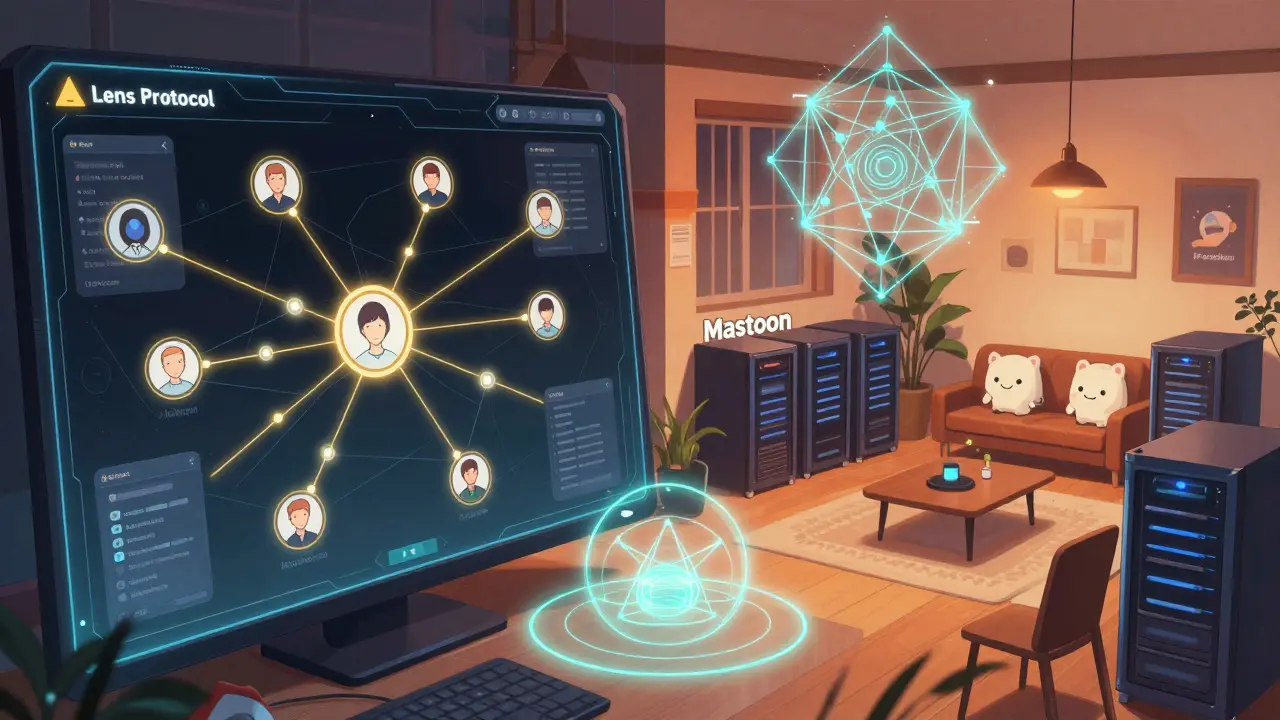
Built on Polygon, Lens is the leading blockchain-native social graph. Its killer feature is portability. Your followers and following lists are stored on-chain. This means you can build an audience on one app (like Lenster) and then switch to a competitor app tomorrow, taking your entire network with you. In November 2023, Lens v2.0 introduced cross-platform identity features, adopted by 42% of active users within a month. It is ideal for creators who want to monetize directly through NFTs and tokens.
Mastodon & The Fediverse
Mastodon remains the face of decentralized microblogging. It uses the ActivityPub protocol, making it part of the "Fediverse"-a universe of interconnected apps including Pixelfed (for photos) and PeerTube (for video). Mastodon doesn’t use blockchain for every interaction, which makes it faster and cheaper to run. It collects zero user data by design. As of 2023, it had 5.8 million active users across 5,000+ instances. It is best for users who prioritize privacy and hate algorithms.
Farcaster
Farcaster operates as a hybrid. It stores its social graph on Optimism (another Ethereum Layer 2) but uses a separate network for message storage to improve speed. Launched in beta in October 2022, Farcaster has attracted developers and crypto natives who find Lens too complex and Mastodon too slow. Apps like Warpcast provide a familiar interface similar to Twitter, lowering the barrier to entry.
Challenges and Risks
Despite the promise, decentralized social networks face serious hurdles. The biggest is the "chicken-and-egg" problem. Dr. Robert Chen of Forrester Research noted that 78% of early adopters returned to centralized platforms within six months because their friends weren’t there. Network effects drive social media, and breaking those effects is incredibly difficult.
Moderation is another critical issue. Vitalik Buterin, co-founder of Ethereum, acknowledged in May 2023 that balancing censorship resistance with safety is unsolved. Without a central authority to ban spammers or remove illegal content, platforms rely on community moderation. A 2023 study by ilink.dev found a 37% higher incidence of extremist content on unmoderated fediverse instances compared to mainstream platforms. Users must actively curate who they follow and which instances they trust.
Scalability remains a technical bottleneck. While Ethereum mainnet handles only 15-20 transactions per second (TPS), Layer 2 solutions like Polygon achieve 7,000+ TPS. However, this still lags behind Twitter’s estimated 5,000 TPS for simple actions. During peak usage, decentralized apps can experience delays or higher fees. The upcoming Ethereum Dencun upgrade aims to reduce costs by 90%, which could alleviate this pressure.
Getting Started: A Practical Guide
If you want to try decentralized social media, here is how to begin without getting overwhelmed:
- Choose Your Path: Decide if you want blockchain-native (Lens/Farcaster) for monetization and ownership, or federated (Mastodon) for simplicity and privacy.
- Set Up a Wallet: For blockchain platforms, install a wallet like MetaMask or Rainbow. Write down your 12-word seed phrase on paper. Never store it digitally. This is your master key.
- Fund Your Wallet: Buy a small amount of cryptocurrency (ETH or MATIC) to cover gas fees. Start with $10-$50. For Mastodon, no crypto is needed-just pick an instance.
- Select an Interface: Don’t go straight to the raw protocol. Use user-friendly front-ends. For Lens, try Lenster or Phaver. For Farcaster, use Warpcast. For Mastodon, use the official app or Ivory.
- Import Your Network: Find your existing contacts. Many decentralized apps allow you to import your Twitter or Instagram followers to kickstart your network.
Expect a learning curve. Transaction failures occur in 12-15% of interactions initially. Join Discord communities or Reddit forums like r/decentralizedsocial for support. Response times average 18 hours, so patience is required.
The Future Outlook
The trajectory for decentralized social networks is upward but cautious. Gartner’s 2023 hype cycle places them on the "slope of enlightenment," predicting mainstream adoption between 2026 and 2028 if scalability issues are resolved. The World Wide Web Consortium (W3C) formed a Decentralized Social Web Community Group in October 2023, with participation from engineers at Google, Microsoft, and Meta. This signals that even big tech recognizes the inevitability of interoperable standards.
Regulatory uncertainty remains the biggest risk. The EU’s Digital Services Act (effective November 2023) mandates centralized moderation entities, which conflicts with decentralized architecture. Legal experts warn that poorly tailored compliance requirements could stifle innovation. However, the demand for user-owned data is growing. With 68% of current decentralized users citing data ownership as their primary reason for joining, the cultural shift is already underway.
Decentralized social networks are not here to replace Instagram overnight. They are here to offer a choice. For creators seeking fair compensation, activists needing censorship resistance, and privacy advocates tired of surveillance capitalism, these platforms provide a functional, albeit imperfect, alternative. As technology matures and interfaces simplify, the gap between convenience and sovereignty will narrow. The question is no longer whether decentralized social media will survive, but how quickly the rest of the internet will catch up.
Is decentralized social media safe?
Yes, but with caveats. Technically, blockchain-based networks are highly secure due to cryptographic encryption and distributed storage, making hacking nearly impossible. However, user error is the biggest risk. If you lose your private key or seed phrase, you lose access to your account permanently. Additionally, because there is no central customer support, you cannot recover stolen funds or hacked accounts easily. Always use hardware wallets for high-value profiles and never share your seed phrase.
Do I need cryptocurrency to use decentralized social networks?
It depends on the platform. Blockchain-native networks like Lens Protocol and Farcaster require a cryptocurrency wallet and small amounts of crypto to pay for transaction fees (gas). Federated networks like Mastodon do not require cryptocurrency; you simply sign up on an instance with an email address. However, even non-crypto platforms may charge small fees for premium features or instance hosting.
Can I make money on decentralized social media?
Yes, but it is not guaranteed. Platforms like Lens Protocol and Steemit use token economies where users earn cryptocurrency for creating content, tipping, and engagement. Top creators on Lens earned $500-$2,000 monthly in 2023. However, most users earn very little. A 2023 study found that 61% of creators earned less than $5 monthly. Monetization requires building a dedicated audience and understanding token dynamics.
Why are decentralized social networks slower than Twitter?
Decentralized networks prioritize security and immutability over speed. Recording every action on a blockchain requires consensus among multiple nodes, which takes time. While centralized servers process thousands of requests instantly, blockchain transactions must be verified and added to a ledger. Layer 2 solutions like Polygon have improved speeds significantly (7,000+ TPS), but they still lag behind the optimized infrastructure of companies like X Corp.
What happens if my decentralized social app shuts down?
Unlike centralized platforms, your data survives. Because your identity and connections are stored on a public blockchain or federated protocol, you can switch to a different application that supports the same standard. For example, if a Lens-based app closes, you can log into another Lens app with your wallet and see your exact same followers and posts. You are not locked into a single company’s ecosystem.
Comments (14)
Look, I get the hype. We all want to own our data. But let's be real for a second. The barrier to entry is absolutely insane for the average person. Asking someone to manage a seed phrase and understand gas fees before they can post a picture of their cat? That is not a solution, that is a filter for tech bros who already have too much time on their hands.
I tried setting up a wallet last week just to see what the fuss was about. I lost an hour figuring out which browser extension to use, then another hour trying to buy $10 worth of MATIC without getting scammed by some phishing site. By the time I actually got into the app, I was so exhausted I just went back to Instagram. It’s easier to just give Meta my data than it is to learn blockchain mechanics. Until the UX is invisible, this isn't mainstream. It's a niche toy.
The argument regarding user experience is valid yet overlooks the fundamental shift in paradigm required for true digital sovereignty. One must consider that convenience has historically been the currency paid for privacy. The learning curve is steep because the technology is foundational rather than superficial.
Furthermore, the comparison to centralized platforms ignores the externalities of surveillance capitalism. When one loses access to an account due to arbitrary algorithmic changes or corporate policy shifts, there is no recourse. In a decentralized model, the initial friction serves as a necessary gatekeeper for responsibility. You are not merely a consumer of content but a stakeholder in the network infrastructure. This requires a different mindset, one that values long-term security over short-term ease of use. The transition period will inevitably involve frustration, but the end state offers unprecedented control over one's digital identity.
uuhh yea right like u really think big tech is gonna just let u take yer data away lol. its all a con. theyre building these things to track u even more. every transaction on the blockchain is public so now instead of facebook selling yer clicks they sell yer whole life history to the highest bidder. plus the energy usage is gonna melt the planet again. i saw a doc about this. its all fake news anyway. keep ur money in yer pocket and stay off the grid if u wanna be safe. trust me bro.
Hey John, I hear your frustration with the UX hurdles. 🛑 However, we need to differentiate between Layer 1 chains and the emerging Layer 2 solutions like Polygon or Optimism mentioned in the article. The gas fees you experienced might have been on mainnet Ethereum, which is notoriously expensive.
Platforms like Lens Protocol are specifically designed to abstract away much of this complexity for the end-user. While the underlying architecture still requires a wallet, the front-end interfaces (like Lenster) are becoming increasingly seamless. It is not perfect, but the trajectory is toward abstraction where users don't even realize they are signing transactions. Give it another six months and try a dedicated social dApp rather than a raw wallet interface. 👍
This entire premise is flawed because you are assuming decentralization equals freedom. It does not. It equals chaos. Without central moderation, these platforms become cesspools of extremism and spam within weeks. Look at Mastodon instances. They fracture into tiny echo chambers because nobody wants to deal with the toxic elements.
You cannot scale community moderation. It is mathematically impossible to maintain safety standards across thousands of independent nodes. The 'chicken-and-egg' problem cited in the article is not a bug; it is a feature of human nature. People want safety and convenience, not ideological purity tests. Centralized platforms provide order. Decentralized ones provide anarchy. Most people will always choose order. Stop pretending otherwise.
Precisely. The idea that the average user wants to curate their own feed and moderate their own instance is laughable. Most people do not have the bandwidth or the desire to engage in governance. They want to scroll.
Also, the monetization aspect is a joke. Earning $500 a month is the top 0.1%. For the rest, it is pennies. Why would I switch from a platform that pays me nothing but gives me reach to one that pays me pennies and gives me zero reach? It makes no sense economically or socially. Stick to the incumbents until they collapse under their own weight, which will take decades.
I think we are missing the point about ownership. It is not just about money right now. It is about portability. If you build an audience on Twitter and they ban you, you lose everything. On Lens, you take your followers with you. That is huge for creators who are tired of being held hostage by platform policies.
I started using Farcaster recently via Warpcast. The interface is surprisingly close to Twitter, so the learning curve wasn't as bad as people say. Yes, you need a wallet, but once you set it up, you rarely touch it. It feels like normal social media but without the ads and the shadowbanning. It is definitely early days, but the vibe is cleaner. Worth a shot if you are a creator.
totally agree fede! i tried warpcast and its pretty chill. yeah the setup took like 20 mins but after that its smooth sailing. no more algos deciding what i see. i just see what my friends post. its refreshing. also love that i can tip ppl directly. small change but feels good to support creators directly instead of feeding the beast. go for it guys!
Nice to see positive feedback here :) From India, we are seeing a lot of adoption in the Web3 space because mobile-first wallets are making it easier. Apps like Phantom or Trust Wallet are very user-friendly now. You don't need to be a coder to use them anymore.
The key is education. Once people understand that their private key is their password and their bank account combined, they start taking care. It is a bit scary at first but empowering later. Keep exploring! The future is bright for those who learn early. 🙏
Oh, look at us, playing house in the sandbox while the giants sharpen their knives. 😂 Sure, you can move your followers from App A to App B, but who is paying for the storage? Who is handling the legal liability when someone posts illegal content? Spoiler alert: Nobody. And that is why regulators are going to crush this experiment faster than a steamroller.
The EU DSA mentioned in the article is a death sentence for unmoderated federated networks. You think you are free? You are just waiting for the subpoena. Enjoy your 'sovereignty' while it lasts, folks. It is cute, really.
The regulatory landscape is indeed precarious, yet the technological imperative remains. The encryption standards utilized in these protocols render mass surveillance significantly more difficult compared to plaintext databases maintained by corporations. While compliance may be enforced, the underlying architecture resists total control.
Furthermore, the notion that illegal content cannot be moderated is a misconception. Community-led moderation tools are evolving rapidly. Algorithms can flag content based on hash matching known illicit material. The difference is that the power to define 'illicit' rests with the community consensus rather than a board of directors in Silicon Valley. This shift, however imperfect, is a critical step toward democratizing information governance.
oh god here we go again with the 'community consensus' nonsense. like that ever works. its just mob rule. i tried joining a mastodon instance and got banned for posting a meme that was slightly edgy. welcome to the woke police state of decentralization. its not freedom its just fragmentation. everyone hides in their little bubbles screaming at each other. and dont get me started on the environmental impact. burning coal to tweet about cats. brilliant. really brilliant.
Can we stop bashing Mastodon? It uses ActivityPub, not blockchain. It does not burn energy. It is literally just servers talking to each other. The carbon footprint is negligible compared to running massive data centers for ad targeting.
And yes, moderation varies by instance. That is the point. If you don't like the rules of Instance A, you go to Instance B. It is not a flaw; it is a feature. You get to choose your community. On Twitter, you get whatever Elon decides today. I prefer having a choice. Even if that choice means dealing with some annoying admins sometimes.
I think the confusion comes from mixing up blockchain-native and federated systems. They are solving different problems. Blockchain is for ownership and monetization. Federated is for privacy and censorship resistance.
I am currently testing both. I use Mastodon for casual chatting because it is easy. I use Lens for my professional portfolio because I want to own my connections. It is not an either/or situation. You can use both. The interoperability is improving too. Soon you might be able to cross-post easily. It is exciting times if you are willing to tinker.