

Imagine living in a country where using Bitcoin is technically illegal, yet millions of people are quietly doing it every day. That is the reality in Bangladesh, which has maintained its position as a significant player in the global cryptocurrency adoption rankings despite a strict government ban on digital assets. It sounds like a contradiction, right? But when you look at the numbers, the story becomes clear. As of 2025, data from CoinLaw indicates that approximately 3.1 million verified crypto users operate within the country. This isn't just speculation; it's a measurable phenomenon driven by economic necessity rather than speculative hype.
You might wonder how such a large user base survives under a complete regulatory prohibition. The answer lies in the specific utility these technologies provide. For many Bangladeshis, cryptocurrency isn't about getting rich quick with meme coins. It’s about survival and efficiency. With neighboring countries like India leading global adoption metrics and Pakistan seeing massive growth due to freelance earnings, Bangladesh fits into a broader regional pattern where traditional banking systems often fail to meet the needs of the average citizen. The persistence of this user base suggests that enforcement mechanisms have gaps, or perhaps more accurately, that the demand for financial freedom outweighs the fear of legal repercussions for many individuals.
The Paradox of Regulation vs. Reality
The official stance of the Bangladesh Bank is unequivocal: cryptocurrencies are not legal tender, and trading them can lead to penalties under existing laws. Yet, the Chainalysis Global Crypto Adoption Index and other research bodies consistently place Bangladesh in notable positions, sometimes fluctuating between ranks 13 and 35 depending on the metric used. Why does the ranking matter if the activity is underground? Because it highlights a disconnect between policy and practice. When CoinLedger positioned Bangladesh at rank 35 in May 2025, it wasn't validating the legality of the trade but acknowledging the volume of engagement.
This discrepancy forces us to ask: what are these 3.1 million people actually doing? They aren't likely sitting in cafes openly buying Ethereum with cash. Instead, they are leveraging technology to bypass traditional bottlenecks. The primary driver here is remittance alternatives through stablecoins. Bangladesh is one of the world's top recipients of worker remittances. Traditional channels involve high fees, slow processing times, and currency conversion losses. Stablecoins like USDT offer a faster, cheaper, and more transparent way for overseas workers to send money home. This practical application transforms crypto from a risky asset class into a vital financial tool.
Why Stablecoins Dominate the Underground Market
In most Western markets, crypto adoption is often linked to investment portfolios and institutional interest. In emerging markets like Bangladesh, the narrative is different. Users prioritize stability over volatility. This explains why stablecoins dominate the local ecosystem. Unlike Bitcoin, which can swing 10% in a week, stablecoins pegged to the US Dollar offer predictability. For a family waiting for funds from a relative working in the Middle East, certainty is worth more than potential upside.
The infrastructure supporting this adoption relies heavily on peer-to-peer (P2P) networks and international exchanges that don't strictly enforce local geo-blocks or do so inconsistently. Users often employ VPNs to access platforms like Binance or OKX, creating a shadow economy of digital finance. This setup creates a unique risk profile. While the utility is undeniable, the lack of consumer protection means that if an exchange freezes an account or a P2P trader commits fraud, there is little legal recourse. Yet, the benefits continue to outweigh these risks for millions.

Regional Context: South Asia's Crypto Landscape
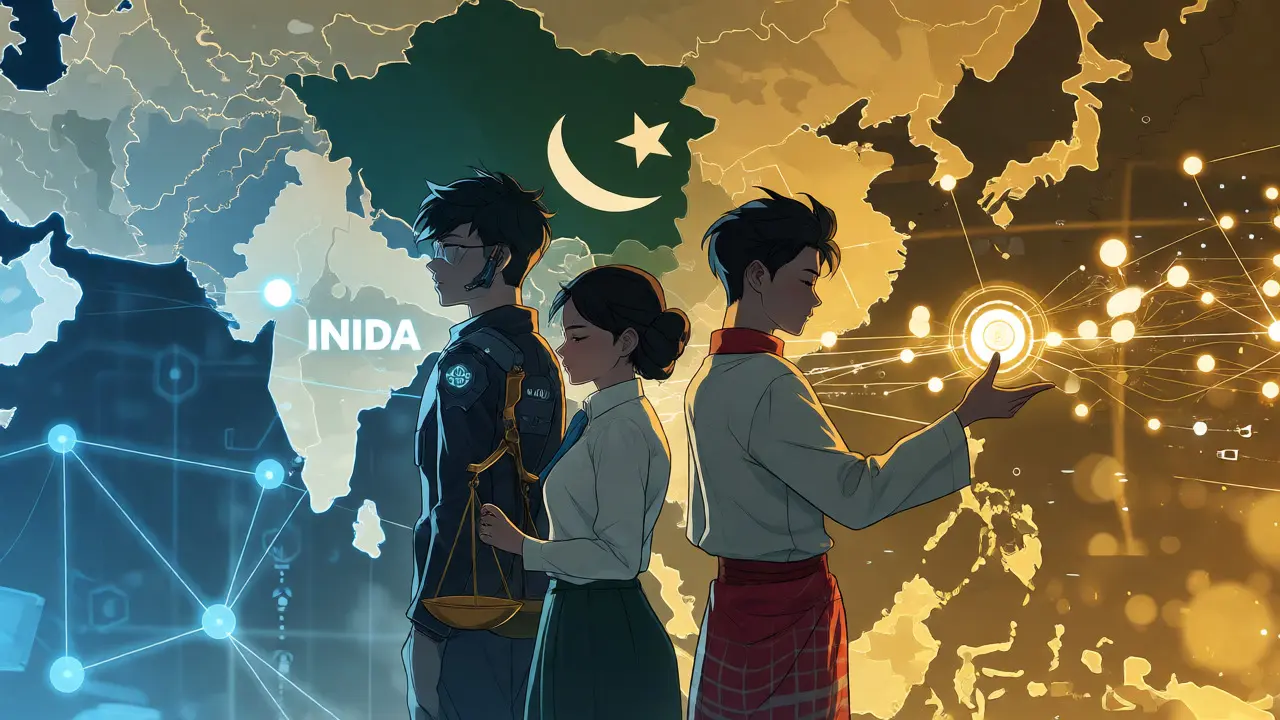
To understand Bangladesh's ranking, you must look at its neighbors. The South Asian region presents a mixed bag of regulatory approaches and adoption rates. India leads the pack with an adoption index of 1.000 according to Coinpedia's 2025 report, driven by a massive tech-savvy population and clearer, albeit taxed, regulations. Meanwhile, Pakistan holds the third-highest global adoption index at 0.619, having added 5.4 million new users in 2025 alone. These figures highlight a regional trend: economic pressure drives innovation.
| Country | Regulatory Stance | Adoption Rank/Index | Primary Driver |
|---|---|---|---|
| India | Legal but Taxed | Rank #1 (Index 1.000) | Speculation & Tech Sector |
| Pakistan | Restrictive/Gray Area | Rank #3 (Index 0.619) | Freelance Payments & Remittances |
| Bangladesh | Complete Ban | Rank ~35 (Varies) | Remittance Alternatives (Stablecoins) |
Bangladesh's position is distinct because it operates under the harshest restrictions among these three. While India integrates crypto into its tax system and Pakistan navigates a gray area, Bangladesh maintains a hardline ban. Yet, the adoption persists. This resilience suggests that the fundamental economic drivers-high inflation, limited access to USD-denominated savings, and expensive cross-border transfers-are too powerful for regulation alone to suppress.
How Users Navigate the Ban
If you were to walk through Dhaka today, you wouldn't see billboards advertising Bitcoin exchanges. However, you would find vibrant online communities discussing P2P trades on Facebook groups and Telegram channels. The method of operation is decentralized and informal. Users typically buy stablecoins from local merchants who hold inventory acquired through international arbitrage. These merchants act as off-ramps and on-ramps, bridging the gap between the Bangladeshi Taka (BDT) and the digital dollar.
- Peer-to-Peer Trading: Most transactions occur directly between individuals, bypassing regulated intermediaries.
- Mobile Money Integration: Services like bKash or Nagad are often used to settle payments for crypto purchases, keeping the trail within the formal mobile financial system even if the underlying asset is digital.
- VPN Usage: To access global liquidity, users frequently rely on virtual private networks to mask their location from exchanges that block Bangladeshi IPs.
This workaround ecosystem is fragile but functional. It demonstrates remarkable adaptability. The users aren't trying to break the law out of rebellion; they are solving a problem that the current financial system hasn't addressed efficiently. The verification of 3.1 million users implies that identity confirmation still happens, often through KYC processes on international platforms that tolerate the usage despite local prohibitions.
The Future of Crypto in Regulated Emerging Markets
What does this mean for the future? The case of Bangladesh serves as a critical study for policymakers worldwide. It proves that bans do not eliminate demand; they merely shift it underground. As the Asia-Pacific region led global crypto growth with a 69% expansion in 2025, according to Coinpedia, the momentum is undeniable. If traditional banks fail to lower remittance costs or improve speed, the gravitational pull of cryptocurrency will only strengthen.
There is also the factor of technological literacy. As younger generations in Bangladesh become more familiar with digital tools, the barrier to entry for crypto decreases. We are already seeing parallels in other nations like Cambodia, where national digital wallets coexist with hybrid crypto usage. If Bangladesh continues to ignore the economic realities driving this adoption, it risks losing out on the efficiency gains that blockchain offers. Conversely, a regulated framework could bring these 3.1 million users into the light, providing them with security and the state with tax revenue.
For now, the paradox remains. Bangladesh stands as a testament to the idea that financial innovation often moves faster than legislation. The ranking may be low compared to India, but the per-capita engagement and the sheer volume of underground activity tell a story of resilience. Whether the government chooses to regulate, liberalize, or maintain the status quo, the users have already made their choice. They have voted with their wallets, proving that in the face of economic necessity, code often finds a way.
Is cryptocurrency completely illegal in Bangladesh?
Yes, the Bangladesh Bank has issued circulars stating that cryptocurrencies are not legal tender and that trading or holding them can result in fines or imprisonment under existing foreign exchange and anti-money laundering laws. However, enforcement against individual users is often inconsistent compared to commercial entities.
How many crypto users are there in Bangladesh?
According to 2025 data from CoinLaw, there are approximately 3.1 million verified crypto users in Bangladesh. Other estimates vary, but all agree that the number is substantial given the regulatory environment.
Why do Bangladeshis use stablecoins instead of Bitcoin?
Stablecoins, particularly those pegged to the US Dollar like USDT, are preferred because they offer price stability. This makes them ideal for remittances and preserving value against the depreciation of the local currency, whereas Bitcoin's volatility makes it less suitable for everyday transactions or saving in a high-inflation environment.
Where does Bangladesh rank globally in crypto adoption?
Rankings vary by source. CoinLedger placed Bangladesh at rank 35 in May 2025, while other historical indices have seen it range between 13 and 15. These fluctuations reflect the difficulty of measuring underground market activity.
Can tourists use crypto in Bangladesh?
Technically, no. Since crypto is banned, there are no official merchants accepting it. Tourists relying on crypto for payments would need to convert to fiat currency via P2P methods, which carries legal risks and logistical challenges.